Friday Oct 16, 2026
Friday Oct 16, 2026
Monday, 20 April 2026 04:19 - - {{hitsCtrl.values.hits}}
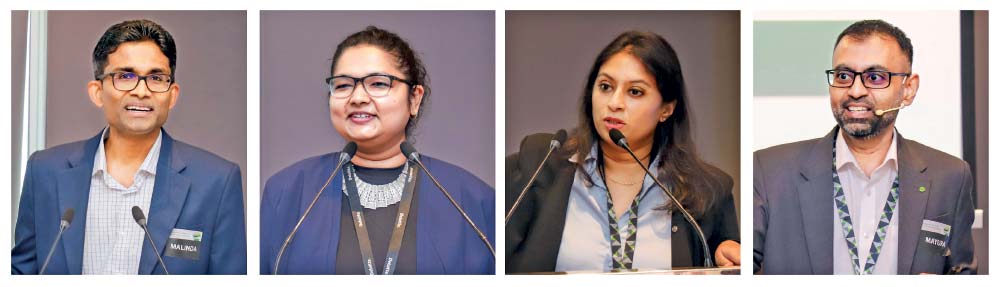
From left: Assurance Leader and Industry Leader for Financial Services Malinda Boyagoda, Senior Consultant – Workforce Transformation Amanda Perera, Human Capital Consulting Practice Leader Upekha Ukuwela, and Strategy and Analytics Leader Mayura Malagala
Deloitte Sri Lanka recently hosted a leadership briefing for Corporate Business Leaders and Human Resource Professionals of Non-Bank Financial Institutions (NBFIs) to mark the official launch of the Non-Bank Financial Institutions Sector Compensation and Benefits Survey 2025 report.
The first NBFI sector focused pay survey in Sri Lanka by Deloitte, highlights how companies are responding to evolving compensation and benefits related challenges in the NBFI sector.
Honourable guest Central Bank of Sri Lanka Department of Supervision of Non-Bank Financial Institutions Director Chanoori Jayasinghe was present to witness the launch of the 2025 report. The session focused on insights from the survey, covering sector specific compensation practices leveraging Deloitte’s extensive experience in delivering Compensation and Benefits surveys in the Sri Lankan market over the past decade.
The first segment of the event focused on understanding the key aspects of the NBFI landscape and Shifting Trends led by Deloitte Sri Lanka & Maldives Assurance Leader and Industry Leader for the Financial Services Industry Malinda Boyagoda. He focused on a data-driven view of the sector, highlighting the positioning of NBFIs within Sri Lanka’s financial system and their critical role in supporting Small and Medium Enterprises (SMEs) and Micro, Small, and Medium Enterprises (MSME) segments. The session unpacked key trends across asset growth, profitability, capital adequacy, and asset quality, pointing to a sector that is stabilising following recent economic pressures. He also explored the impact of the interest rate cycle, noting a transition from a high-rate environment to a phase of normalisation, with most high-yield assets already repriced. As the sector moves beyond rate-driven performance, the focus is increasingly shifting towards execution, driven by volume growth, portfolio quality, collections effectiveness, and cost discipline.
Importantly, these structural shifts are closely linked to the evolving human capital landscape within the NBFI sector. With nearly half of operating costs driven by personnel costs, the discussion highlighted how talent shortages, rising regulatory complexity, and increasing demand for digital and analytics capabilities are reshaping workforce priorities. This reinforces the need for organisations to rethink workforce models, invest in skills-based hiring, market aligned pay scales and strengthen leadership capabilities to navigate a more complex operating environment.
To familiarise the audience with Deloitte’s differentiated approach to Compensation benchmarking, Deloitte Sri Lanka Senior Consultant – Workforce Transformation Amanda Perera presented the survey methodology, design, data collection and analysis, defining the pay anchors incorporated in the 2025 report.
Deloitte Sri Lanka & Maldives Human Capital Consulting Practice Leader Upekha Ukuwela walked participants through the key findings of the 2025 report, sharing practical insights into compensation benchmarks and prevailing benefit perspectives across the NBFI sector. The session provided a comprehensive view of the NBFI workforce, drawing on survey based demographic insights such as gender distribution, age profiles, attrition trends, budgeted salary increments, and workforce cost pyramids. By linking reward outcomes with workforce structure and cost composition, the session enabled corporate leaders to better assess affordability, competitiveness, and sustainability of their rewards frameworks. The discussion reinforced the importance of adopting a data-driven approach to reward planning, supporting more informed decision making while balancing business priorities, regulatory considerations, and evolving employee expectations in a highly labour-intensive sector.
Building on these insights, Deloitte Sri Lanka & Maldives Strategy and Analytics Leader Mayura Malagala shared perspectives on the Future of Work influenced by Artificial Intelligence. Malagala guided the conversation, illustrating how AI is rapidly evolving, from automation and predictive analytics to generative and agentic AI - reshaping how organisations operate and create value. He highlighted the broad spectrum of value creation from AI, including revenue growth, process efficiency, cost optimisation, and innovation acceleration, with practical applications across the NBFI value chain spanning front office, core lending operations, and back-office functions.
Importantly, the discussion reinforced the implications for the workforce, demonstrating how AI can augment HR processes across the entire talent lifecycle, from hiring and onboarding to performance management and learning. This directly builds on the themes raised in the compensation survey, emphasising that organisations must not only rethink how they reward talent, but also how they deploy, develop, and augment it in an increasingly technologically enabled environment.
As the NBFI sector continues to evolve, Deloitte remains committed to bringing clarity and structure to the rewards landscape through robust benchmarking and dedicated rewards advisory services. We aim to assist organisations to navigate emerging trends, make data driven decisions, and develop compensation strategies that attract and retain top talent, while keeping transparency, equity, and long-term sustainability at the core of every rewards strategy.




