Tuesday Sep 22, 2026
Tuesday Sep 22, 2026
Thursday, 2 April 2026 05:16 - - {{hitsCtrl.values.hits}}
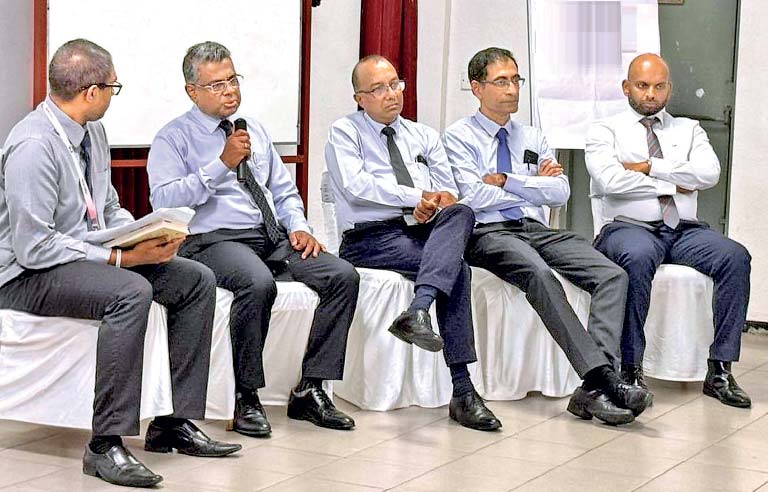
The DFCC Bank panel comprised senior representatives from key business areas, including (second from left) Senior Vice President – Head of Treasury Prins Perera, Vice President – Head of Business Banking Pradeep De Alwis, Vice President – Trade Services Prasanna Premaratne and Assistant Vice President Business Banking Jude Muttiah. The session was moderated by Assistant Manager Business Banking. Koushall Vian (extreme left)
DFCC Bank said Sri Lanka’s export sector is operating under increasingly complex global trade conditions, with currency volatility, payment risks, and shifting market dynamics reshaping how businesses approach growth, following its participation in recent industry discussions at the Export Acceleration Program hosted by the Ceylon Chamber of Commerce.
Sri Lanka’s exporters are adjusting to a different kind of global environment. Costs are less predictable, currencies are moving faster, and trade routes are no longer as stable as they once were. Growth remains on the table, but it is now accompanied by more questions than before.
These realities came into sharper focus at the Ceylon Chamber of Commerce earlier this month, where the Export Acceleration Program brought together exporters, bankers, and industry stakeholders over two days of discussion. DFCC Bank participated in the program, contributing to conversations that quickly moved beyond theory and into the practical challenges businesses are navigating today. What began as a capacity-building workshop evolved into a more grounded dialogue, reflecting a noticeable shift in how the export landscape is being understood.
One theme emerged consistently: foreign exchange is no longer something managed in the background. It has moved firmly to the forefront of decision-making. Currency movements are sharper, timing is more critical, and the cost of misjudgment is significantly higher.
Payment risk has also become a more pressing concern. Exporters are experiencing longer settlement timelines, particularly in less familiar markets, while counterparty risk has become harder to assess. In some cases, transactions are being restructured simply to create greater certainty around when, or whether, payments will be received.
There is still appetite for growth, and that has not changed. However, the way companies are approaching expansion has become more measured. Businesses are moving more selectively, weighing opportunities against currency exposure, compliance requirements, and working capital constraints. Growth remains the objective, but it is being pursued with greater discipline.
This shift is also reshaping expectations of financial partners. Access to funding alone is no longer sufficient. Exporters are increasingly seeking guidance on structuring transactions, managing exposure, and navigating the practical realities of cross-border trade. Treasury, trade services, and advisory capabilities are becoming more closely integrated.
DFCC Bank’s contribution to the discussion reflected this evolving need. The focus was not on listing solutions, but on connecting global market developments to the realities faced by Sri Lankan exporters managing cash flow, fulfilling orders, and protecting margins in a changing environment.
The broader outlook remains mixed. Opportunities continue to emerge, particularly in diversification and value-added exports, and new markets are opening up. Demand has not disappeared.
However, the operating environment has become less forgiving. The conversation is no longer centred on how quickly exporters can grow, but on how effectively they can navigate what lies ahead.




