Thursday Jul 16, 2026
Thursday Jul 16, 2026
Wednesday, 18 March 2026 00:02 - - {{hitsCtrl.values.hits}}
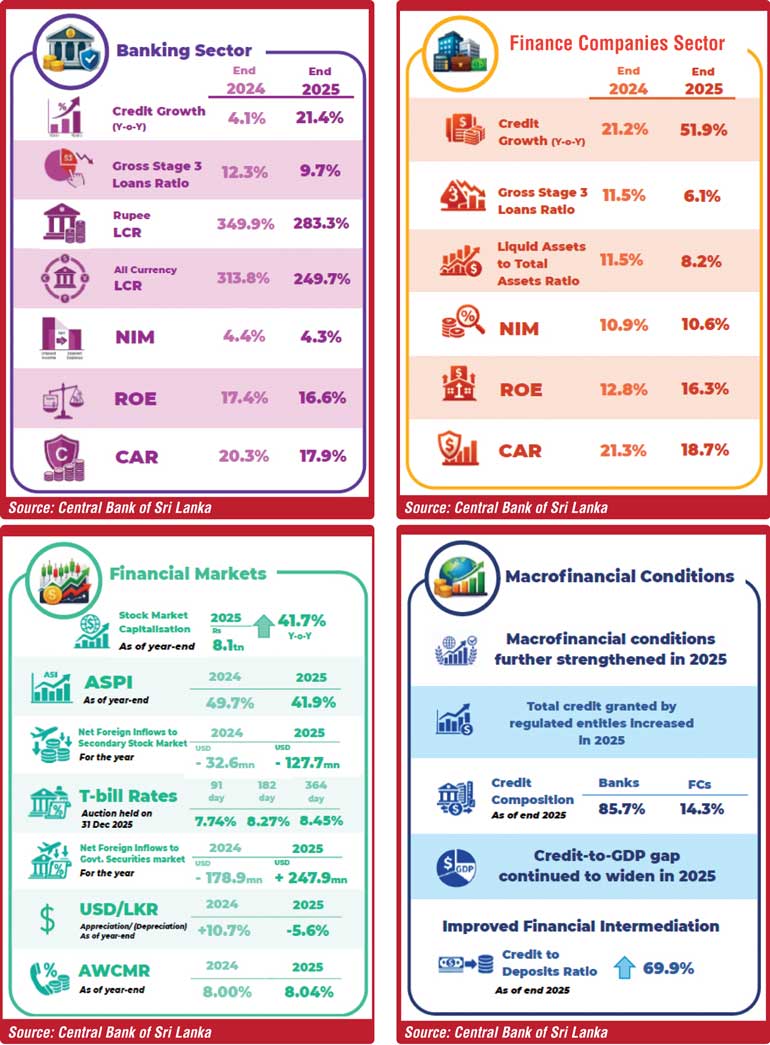
Domestic macro-financial conditions strengthened further in 2025, supporting a marked acceleration in credit growth, although external vulnerabilities remain a concern, the Central Bank of Sri Lanka (CBSL) said in its Financial Sector Performance 2025 report released yesterday.
The CBSL said total credit extended by banks and Finance Companies (FCs) increased significantly by end 2025, with the financial sector’s exposure shifting further toward the private sector amid strong credit demand, while exposure to the public sector contracted in line with fiscal consolidation. “Despite the decline, Government related exposure remains sizeable,” the CBSL said.
Financial intermediation improved, reflected in a rise in the banking sector’s credit-to-deposits ratio. “However, the credit to GDP gap widened further into the positive territory of the credit cycle, underscoring the importance of maintaining vigilance over the potential build-up of systemic risk within the financial sector,” the CBSL noted.
Credit growth in the banking sector accelerated sharply, with gross loans and receivables expanding by 21.4% year-on-year at end 2025, compared to 4.1% at end 2024. The expansion was broad-based, driven by financial services, trade, consumption, lending to overseas entities, construction and manufacturing.
Credit to the financial services sector recorded a sharp increase of 148.0% year-on-year, reflecting higher funding requirements of the FC sector.
Asset quality improved alongside this expansion, with the Stage 3 loans ratio declining to 9.7% at end 2025 from 12.3% at end 2024, marking the first return to single-digit levels since the second quarter of 2022.
Liquidity and capital buffers moderated but remained well above regulatory minimums. The rupee and all currency Liquidity Coverage Ratios declined to 283.3% and 249.7%, respectively, at end 2025 from 349.9% and 313.8% at end 2024, remaining comfortably above the 100% requirement.
The banking sector recorded a return on equity of 16.6% in 2025, while total capital adequacy stood at 17.9% at end 2025 compared to 20.3% a year earlier, reflecting strong credit expansion.
The FC sector also recorded strong growth momentum, with gross loans and advances rising by 51.9% year-on-year at end 2025, compared to 21.2% growth at end 2024.
This expansion was driven by vehicle-backed lending, which grew by 52.7% year-on-year, and gold-backed lending, which increased by 63.8%.
Asset quality improved significantly, with the sector’s gross Stage 3 loans ratio declining to 6.1% at end 2025 from 11.5% at end 2024.
Liquidity remained above regulatory thresholds despite a decline in surplus liquid assets to Rs. 74.3 billion at end 2025 from Rs. 105.1 billion a year earlier, reflecting increased loan disbursements.
Profitability strengthened, with profit after tax reaching Rs. 61.5 billion in the first nine months of the 2025/26 financial year, a 45.0% year-on-year increase.
The sector’s total capital adequacy ratio moderated to 18.7% at end 2025 from 21.3% at end 2024.
Financial markets remained resilient during the year, supported by improved macroeconomic conditions and investor confidence. The Colombo Stock Exchange recorded strong gains, with the All-Share Price Index increasing by 41.9% and the S&P SL20 Index rising by 26.6%, following gains of 49.7% and 58.5%, respectively, in 2024.
Market capitalisation increased by 41.7% by end 2025 compared to end 2024, despite a cumulative net foreign outflow of $ 127.7 million.
In the Government securities market, yields remained broadly stable during the fourth quarter of 2025, with a moderate upward adjustment toward late December. The secondary market recorded a cumulative net foreign inflow, largely into Treasury Bonds, although foreign holdings remained a relatively small share of total outstanding Government securities.
In the foreign exchange market, the Sri Lanka rupee depreciated by 5.6% in 2025, following appreciations of 12.1% in 2023 and 10.7% in 2024. Exchange rate volatility remained contained, while liquidity in the domestic interbank foreign exchange market improved further.
In the domestic money market, surplus liquidity persisted, contributing to a moderation in short-term interest rates.
The CBSL warned that global uncertainties, including geopolitical tensions in the Middle East, volatility in commodity prices and adverse weather conditions, could pose downside risks to credit quality, underscoring the need for continued fiscal consolidation and stronger external sector buffers to safeguard macro-financial stability.




