Thursday Oct 15, 2026
Thursday Oct 15, 2026
Friday, 13 February 2026 00:12 - - {{hitsCtrl.values.hits}}
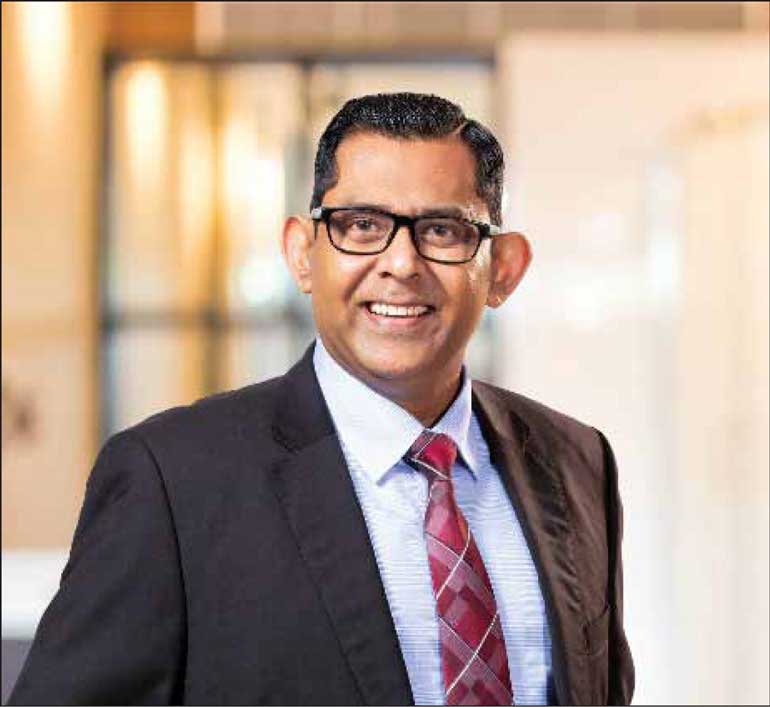
HNB Managing Director/CEO Damith Pallewatte
By Damith Pallewatte, Managing Director/CEO of HNB PLC
At Davos in January, Canadian Prime Minister Mark Carney said what many were thinking but few were willing to state plainly: “We are in the midst of a rupture, not a transition…The old order is not coming back. We shouldn’t mourn it. Nostalgia is not a strategy.”
The rules-based global systems that Sri Lanka relied upon for generations are giving way to something more fluid, contested, and multipolar. Tariff pressures, stagnation in Free Trade Agreements, and the rise of global competitors have generated unprecedented headwinds. Many are rightfully anxious. But I want to offer a different perspective.
A multipolar world is not simply a threat to be weathered. It rewards exactly what Sri Lanka has in abundance — if we choose to use it: resilience, adaptability, and entrepreneurial instinct. The ability to move quickly, hone in on niches, and build relationships across divides will determine whether we thrive in this new order.
This is especially pressing given that our economic revival hinges on exports into markets facing their own significant challenges. We are heavily dependent on imports to fuel both exports and domestic energy. In 2026, we cannot afford to underestimate how global developments will impact Sri Lankan economic, food, and energy security. But understanding these risks brings with it the ability to be proactive in mitigating them.
Far from our true potential
My honest assessment — travelling all parts of this island and meeting with traders, farmers, business owners, and especially young Sri Lankans — is that we are still far from our true potential as a nation.
We possess untapped or underutilised assets that few nations can claim. Ceylon cinnamon has no true equivalent anywhere on earth. Our Ayurvedic traditions offer authentic wellness experiences the world is actively seeking. Our geographic position places us at the crossroads of major shipping lanes. Our workforce is educated, capable, and when given the chance remarkably entrepreneurial.
Yet we have consistently settled for less than we deserve. In tourism, we chase mass arrivals rather than developing the wellness, adventure, eco-tourism and other valuable niches where we hold genuine competitive advantage.
In agriculture, we export bulk commodities when we could command premium prices through geographic branding and value addition. Industrial zones built with great ambition remain underutilised.
While the resources exist, our ability to build systems that convert them into realised value do not. Without the technology transfer, quality standards, and access to global value chains that strategic foreign investment can bring, we risk remaining trapped in a model of volume over value — a race to the bottom we cannot win.
Connecting the dots
For decades, the Sri Lankan dream was defined by departure. Success meant children settled abroad. We accepted this not as loss, but as aspiration fulfilled.
Yet in speaking with young Sri Lankans across the island — in corporate offices and farming communities, in established businesses and emerging startups — it is clear that they do not leave because they have given up on this country. They leave because they cannot see a way to connect the dots between the skills they possess and the opportunities available to them.
Our youth are digitally fluent, globally aware, and impatient to build something meaningful. But when they survey the economy, they see fragmented industries, unclear pathways, and potential that remains stubbornly unexposed. What is needed is a fundamental reorientation — a national effort to make opportunity visible and accessible, so they can engage with value chains where they can contribute, grow, and eventually lead.
Building opportunity ecosystems
Real success will not come from driving top-down initiatives. Instead we must establish opportunity ecosystems: interconnected networks of skills, technology, finance, and markets that create real pathways to prosperity.
Consider agriculture. Traditional farming holds little appeal for young Sri Lankans as it represented toil with no meaningful reward. But the sector today encompasses greenhouses, aquaponics, drone technology, IoT-enabled monitoring, precision soil testing, cold chain logistics, and digital marketplaces connecting rural producers directly to export markets. It is a vibrant ecosystem with multiple entry points for technologists, researchers, logistics specialists, marketers, and entrepreneurs.
This insight drives HNB’s Sarusara initiative, our commitment to developing 30,000 agripreneurs across Sri Lanka. Through corporate partnerships, targeted finance, and capacity building, we have already brought over 15,000 participants onto the platform. The results challenge assumptions about what is possible in rural economies.
Tasks that once required five people working across four days can now be completed in ninety minutes with appropriate equipment and training. This goes well beyond incremental improvements. Agri modernisation and automation liberates farmers to move up the value chain rather than remain trapped at subsistence level. By connecting the dots between smallholders and corporate buyers, between rural producers and international markets, between traditional knowledge and frontier technology – we establish ecosystems that in turn will serve as the foundation of Sri Lanka’s economic revival
When a young person in Anuradhapura can trace a clear pathway from soil science to food processing to export logistics, staying in Sri Lanka becomes not just viable, but attractive. The ecosystem makes opportunity visible.
Scaling opportunity across all provinces
This same logic must extend geographically. For too long, economic attention has concentrated in Colombo and a handful of surrounding districts. Credit data tells us lending is concentrated in a few areas. But does this mean opportunity exists only there? Or does it reveal our failure to look beyond familiar territory?
Travelling this country as extensively as I do, the overlooked potential is striking. Uva is largely absent from national economic conversations. Sabaragamuwa remains unexplored. The Southern belt possesses assets extending far beyond its beaches. The Northern, North Central, and Eastern provinces offer proximity to ports, available land, and emerging energy infrastructure we have barely begun to develop.
The Northern Investment Summit offered an instructive model: it asked the right questions about which industries should be prioritised, which locations offer strategic advantages, and how formal frameworks can channel capital to convert potential into opportunity at scale.
Institutions that evolve
Building ecosystems and unlocking regional potential requires financial institutions willing to evolve alongside the economy they serve. The banking sector in 2026 faces three interrelated challenges that will shape how effectively we can support national recovery.
The first is liquidity. Attracting and retaining deposits in a competitive environment requires deliberate effort, particularly as the market adjusts to post-crisis conditions. The second is asset quality. As credit growth accelerates — and we expect decent growth this year — banks must remain vigilant about loan performance.
The third challenge is one that accompanies progress itself: digital risk. As banking migrates toward digital ecosystems, the threat surface expands. Fraud attempts grow more sophisticated. Investment in security infrastructure is no longer optional it is foundational.
At HNB, we have embarked on a five-year strategic plan for 2026–2030, designed to ensure consistency while meeting these challenges in a strategic and sustained manner. We are exploring further investments into Machine Learning and Artificial Intelligence to streamline and secure credit assessment and monitoring, in security operations.
At the same time, we are looking beyond Sri Lanka’s shores. Our five-year plan encompasses both organic growth and selective international expansion. We are in advanced stages of exploring opportunities in overseas markets, with the aim of establishing presence within the coming year. The logic is straightforward: diversifying revenue sources beyond a single economy provides resilience — for the institution, and by extension, for the customers and communities we serve.
If Sri Lanka faces headwinds, we want to be positioned to draw strength from other markets. If we are serious about thriving in a multipolar world, our institutions must themselves become multipolar. This is what it means to build a bank beyond borders.
If the old Sri Lankan dream was about leaving, the new one must be about staying and building something that connects Sri Lanka to the world while matching the aspirations of a new generation. This will not emerge through government action alone. It requires financial institutions extending beyond traditional banking to construct ecosystems; corporates forging connections with smallholders and rural enterprises; educators aligning curricula with emerging opportunities; and policymakers creating frameworks that channel investment where it can generate the greatest impact.




