Friday Oct 16, 2026
Friday Oct 16, 2026
Thursday, 30 April 2026 00:10 - - {{hitsCtrl.values.hits}}
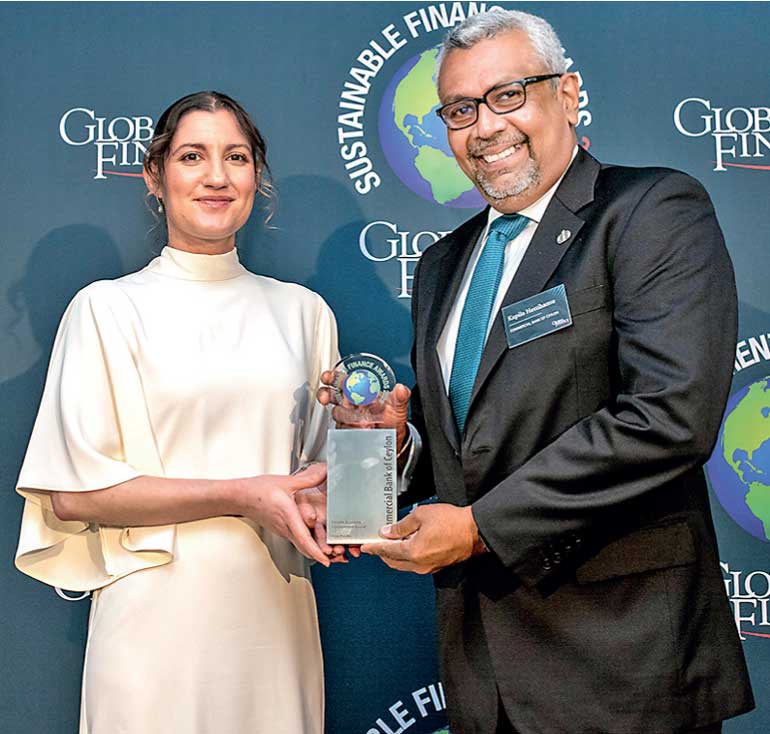
Chief Risk Officer Kapila Hettihamu accepts the award on behalf of Commercial Bank
Commercial Bank of Ceylon has been named the Asia Pacific regional winner of the Circular Economy Commitment award at the sixth annual Sustainable Finance Awards presented by Global Finance, securing a significant third-party endorsement of the bank’s commitment to sustainable and responsible banking.
The award recognises leadership in advancing financing initiatives that promote the reuse and regeneration of materials and resources, thereby supporting production models that are environmentally sustainable and climate-resilient. Among the other regional recipients of the Circular Economy Commitment award this year are Scotiabank for North America and VUB for Central and Eastern Europe.
Chief Risk Officer Kapila Hettihamu accepted the award on behalf of the Bank at the presentation ceremony held recently in London.
Global Finance announced the winners of its Sustainable Finance Awards program for 2025, honouring global, regional and local leadership in funding initiatives designed to mitigate the negative impacts of climate change and contribute to a more sustainable future. Winners were selected by the editors of Global Finance based on formal submissions and independent research, with evaluation criteria encompassing governance policies, strategic goals and measurable achievements in environmental and social sustainability financing during the period January to December 2025.
Winners have been chosen in areas such as overall sustainability financing, excellence in bond issues, community support, resource management, transparency and reporting, infrastructure, and emerging-markets sustainability funding, the magazine said.
Commercial Bank’s Green Financing Strategy provides the governance foundation for directing financial resources towards low-carbon, climate-resilient and environmentally beneficial projects. The strategy is aligned with the CBSL Green Finance Taxonomy, The UN Sustainable Development Goals and Sri Lanka’s Nationally Determined Contributions. It guides the identification, assessment and monitoring of projects that generate measurable climate impact, including renewable energy, energy efficiency, climate-smart agriculture, sustainable transport, waste management and green buildings.
Commercial Bank utilises the Climate Assessment for Financial Institutions (CAFI) tool, developed by the International Finance Corporation (IFC), to systematically evaluate and quantify the climate impact of its green financing facilities. Through this tool, the Bank assesses eligible green projects by estimating the reduction in greenhouse gas emissions generated through such investments.
The bank said it is in the process of developing a Climate Transition Plan with technical support from the International Finance Corporation, setting a clear pathway to aligning its operations with Sri Lanka’s national Net Zero target by 2050, following the bank’s sectoral decarbonisation pathways.
Complementing these measures, the bank’s Environmental and Social Risk Management System ensures that all lending decisions incorporate environmental and social risk considerations in line with IFC Performance Standards. Every credit proposal is screened against a negative activity list and categorised according to risk level, embedding sustainability considerations at the earliest stage of credit evaluation.
Commercial Bank’s comprehensive Sustainability Framework integrates environmental, social and governance principles across all operations, positioning sustainability as a core strategic priority rather than a peripheral function.




