Thursday Jul 16, 2026
Thursday Jul 16, 2026
Monday, 16 March 2026 04:31 - - {{hitsCtrl.values.hits}}
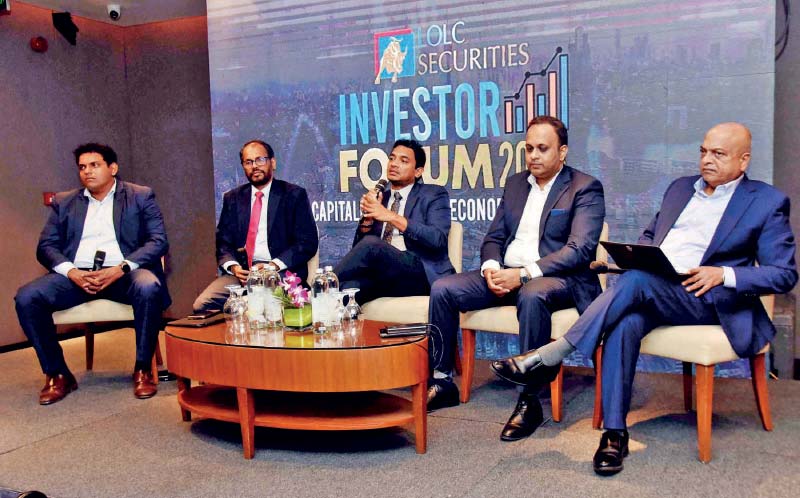
From left: Lynear Wealth Management CEO Unit Trust and Head of Equities Asanka Herath, EDB Chairman Mangala Wijesinghe, Industry and Entrepreneurship Development Deputy Minister Chathuranga Abeysinghe, LOLC Securities CEO Shehan Bartholomeuz and Daily FT Editor and CEO Nisthar Cassim

By Charumini de Silva
The LOLC Securities ‘Investor Forum 2026’ recently reflected a confluence of optimism and pragmatism, with policymakers, market analysts and trade facilitators collectively highlighting Sri Lanka’s path toward macroeconomic stability, structural reforms and a more vibrant capital market.
The forum was a showcase of optimism tempered by caution, as experts highlighted both the opportunities and risks in the country’s financial landscape.
For investors, the forum underscored the importance of focusing on fundamentals, long-term value, and structural growth trends rather than chasing short-term market gains. With planned reforms, fiscal discipline, a recovering export sector, and a revitalised capital market, Sri Lanka is positioning itself not only to attract investment but to build globally competitive companies capable of driving sustainable economic growth well into the next decade.
The Investor Forum also included a panel discussion featuring Industry and Entrepreneurship Development Deputy Minister Chathuranga Abeysinghe, Sri Lanka Export Development Board Chairman Mangala Wijesinghe, Lynear Wealth Management CEO Unit Trust and Head of Equities Asanka Herath and LOLC Securities CEO Shehan Bartholomeuz. The session was moderated by Daily FT Editor and CEO Nisthar Cassim.
Credit rating upgrade could trigger foreign inflows
LOLC Securities’ Head of Research, Ruvini Kaushalya, opened the forum with a comprehensive presentation on the stock market outlook. She emphasised that a potential upgrade in Sri Lanka’s sovereign credit rating could act as a catalyst for foreign capital inflows.
“If Sri Lanka receives a credit rating upgrade, we expect foreign funds to flow into the market. That will encourage more international investors to enter the Sri Lankan equity market,” she said.
Kaushalya highlighted the dramatic improvement in the market capitalisation of the Colombo Stock Exchange, which has grown from approximately Rs. 2.9 trillion in 2022 to around Rs. 7.6 trillion by 2026. The recovery, she explained, is underpinned by stabilised macroeconomic fundamentals following the economic crisis. GDP growth for 2025 is projected at 4.5%–5%, and the Sri Lankan rupee has stabilised compared to previous years.
LOLC Securities’ Head of Research, Ruvini Kaushalya, opened the forum with a presentation outlining the stock market outlook, pointing to the potential impact of a sovereign credit rating upgrade. “If Sri Lanka receives a credit rating upgrade, we expect foreign funds to flow into the market. That will encourage more international investors to enter the Sri Lankan equity market,” she said, underscoring the pivotal role of investor sentiment in shaping market momentum.
Kaushalya highlighted that the market capitalisation of the Colombo Stock Exchange (CSE) has surged from around Rs. 2.9 trillion in 2022 to around Rs. 7.6 trillion by 2026, reflecting a renewed confidence in the country’s economic prospects. The recovery, she explained, is underpinned by stabilised macroeconomic fundamentals following the economic crisis. GDP growth for 2025 is projected at 4.5%–5%, and the Sri Lankan rupee has stabilised compared to previous years.
Despite these positive developments, she cautioned that global tensions and rising crude oil prices remain significant risks. “Increased fuel import costs could strain the exchange rate, potentially leading to currency depreciation. Inflation, although moderating, could rise again in response to external shocks, even as the Central Bank targets around 5% in early 2026,” she added.
However, Kaushalya pointed out that in a low interest rate environment, equities often become more attractive than alternative financial instruments.
Corporate earnings and market fundamentals on the rise
She also noted that corporate earnings have improved significantly, reflecting stronger demand and operational efficiency. “Lower financing costs have helped firms expand profit margins, while robust business fundamentals have driven stock price gains rather than speculation.”
In terms of market valuation, Kaushalya said Sri Lanka’s price-to-earnings (P/E) ratio has returned to pre-COVID levels and price-to-book ratios have steadily improved since 2022. Despite this recovery, the market still trades at a discount relative to regional peers, signalling room for further growth.
She highlighted sectors with promising growth potential, including financial services, capital goods, construction, export-oriented companies, and diversified conglomerates. “The financial sector is expected to benefit from recovering credit growth and improved credit quality, even as net interest margins compress. Capital goods and construction are supported by infrastructure development and reconstruction following Cyclone Ditwah. Export-oriented companies stand to gain from State support to expand overseas markets, while diversified conglomerates continue to offer defensive stability amid global uncertainties,” she explained.
Kaushalya encouraged investors to prioritise long-term value and fundamental strength over short-term fluctuations, stressing that the equity market still offers promising opportunities.
Keynote highlights: Predictable growth and industrial expansion
Delivering the keynote address, Industry and Entrepreneurship Development Deputy Minister Chathuranga Abeysinghe framed Sri Lanka’s economic trajectory as a more predictable environment, supported by fiscal discipline, structural reforms and stabilised macroeconomic indicators.
He emphasised the importance of capital markets in financing industrial growth and announced a plan to bring around 100 new companies to the stock market over the next two to three years.
Abeysinghe highlighted that the limited use of capital markets has historically constrained industrial expansion, as many firms relied with debt-heavy balance sheets, increasing vulnerability during economic downturns. “One of the greatest barriers for industrialisation in Sri Lanka is not the lack of capital, but the lack of knowledge about capital,” he said.
Expanding the capital market, he argued, is essential to developing globally competitive companies capable of taking Sri Lankan brands overseas.
He also discussed the Government’s focus on fiscal discipline under the IMF-supported program, noting that reconstruction spending following Cyclone Ditwah has been financed from excess cash balances without affecting the primary Budget.
Abeysinghe said recent policy measures such as Tax Identification Number (TIN) requirements aim to broaden the tax base, while increased capital expenditure utilisation in 2026 is expected to provide a further boost to economic growth.
The Deputy Minister noted that infrastructure restoration is a priority, including rail networks, roads, and housing. While some delays have occurred due to land and technical issues, most repairs are expected to be completed by the end of the year. Medium-sized factories damaged by the cyclone are receiving support from the Government and insurers, ensuring continuity in industrial production.
He also highlighted that Sri Lanka’s external sector is also strengthening, with rising export earnings, a recovering tourism industry, higher remittances, and increased foreign investment inflows. Exports reached around $ 17.2 billion last year, remittances exceeded $ 8.1 billion, and foreign direct investment through the Board of Investment of Sri Lanka crossed $ 1.2 billion, with total inflows expected to exceed $ 2 billion annually. Debt servicing obligations are projected to remain manageable, falling below $ 3.5 billion annually until 2032.
“Sri Lanka is targeting around 5% economic growth, underpinned by expansion in export industries, tourism, electronics manufacturing, technology services, and value-added agriculture,” he added.
According to him, structural reforms under way include a new national trade and tariff policy, investment reforms, a proposed Public-Private Partnership (PPP) framework, and legislative amendments governing investments and the Colombo Port City. A major digital transformation of Government services aims to reduce bureaucracy and improve transparency, allowing transactions to move online and minimise citizen touchpoints with officials.
Abeysinghe acknowledged that implementing reforms has been gradual, given the need to amend outdated legislation, some dating back to the 1890s.
The Deputy Minister also highlighted Sri Lanka’s strategic neutrality and expanding trade partnerships, positioning the country as a regional hub for trade, investment, and financial services.
Stock market recovery and long-term prospects
Herath highlighted signs of recovery in Sri Lanka’s stock market and corporate sector. Market capitalisation has expanded from Rs. 2.9 trillion in 2022 to around Rs. 7.6 trillion in 2026, reflecting improved investor confidence. “Lower interest rates and stronger corporate earnings are expected to support further growth, with valuations returning to pre-COVID levels,” he added.
Despite risks such as geopolitical tensions, oil price volatility, and potential interest rate adjustments, Herath said the long-term investment outlook remains promising.
He pointed out that the economy is operating with “twin surpluses” a current account surplus and a fiscal surplus, which strengthen macroeconomic stability. The framework supporting these surpluses has been institutionalised through legislation, including the Central Bank Act, the Public Finance Management Act, the Public Debt Management framework, and the Economic Transformation Act.
“These laws make disciplined macroeconomic management legally binding and uncommon among frontier Asian economies, providing a robust foundation for sustained economic stability,” Herath said.
Capital market optimism amid structural reforms
Bartholomeuz noted that the stock market has benefited from improved macroeconomic fundamentals, with indices rising and corporate earnings recovering. “Valuation indicators such as P/E ratios have remained relatively stable even as profitability improved. Further upside remains possible, particularly if potential credit rating upgrades materialise,” he said.
Abeysinghe stressed that fiscal discipline remains central to the IMF-supported program. Reconstruction spending following Cyclone Ditwah, financed from excess cash balances, does not impact the 2026 primary budget. He expressed confidence in revenue targets and highlighted measures to expand the tax base, such as requiring Tax Identification Numbers for property purchases, vehicle registrations, and company registrations. Capital expenditure utilisation is set to increase in 2026, providing a boost to GDP growth alongside reconstruction efforts.
Infrastructure restoration, including rail networks, roads, and housing, is a key priority, with electricity already fully restored. While some delays are expected due to land issues and technical reports, most repairs should be completed by year-end, and broader recovery by 2027. Medium-sized factories damaged by the cyclone are receiving support from the Government and insurers.
Export expansion and national competitiveness
Wijesinghe elaborated on the upcoming National Export Development Plan (NEDP), which focuses on sector diversification, global market integration, and structural reforms to achieve the ambitious goal of $ 36 billion in export earnings by 2030. “The plan aims to strengthen competitiveness, expand market access, and support sustainable economic growth,” he added.
He noted that Sri Lanka’s exports stagnated between $14 billion and $15 billion for nearly a decade, highlighting the urgency for structural transformation. Achieving the $36 billion target will require annual growth of over 10%, supported by diversification beyond traditional sectors such as apparel, tea, rubber, and coconut products. He outlined emerging priority sectors including; automotive components, electrical and electronic products, mineral-based industries, processed foods and beverages, spices, and gems and jewellery.
The EDB Chief said strategy also emphasises market diversification to reduce reliance on traditional markets. Currently, around 25% of exports go to the United States and 23% to the European Union, making the economy vulnerable to external shocks. Expanding exports to Africa, Asia, and the Middle East will be critical to mitigating this dependency.
He opined that preferential trade agreements, including SAFTA, APTA, bilateral FTAs with India and Pakistan, and GSP+ access to the EU, will play a pivotal role in supporting market expansion, complemented by recent UK trade concessions.
To enhance trade facilitation, he said the Government is accelerating the National Single Window system, digitising customs procedures, revising the national tariff policy to reduce import duties on raw materials, and expanding export-oriented industrial zones. The system integrates multiple agencies, allowing exporters and investors to obtain approvals more efficiently.
Wijesinghe said proposed product-specific zones aim to attract foreign investment and support industrial diversification.
Strategic investment and national priorities
Abeysinghe discussed legislative initiatives such as the proposed Investment Protection Act, which aims to create a comprehensive legal framework for safeguarding investor interests. The law would extend protections beyond companies registered with the Board of Investment, providing stronger legal recourse against policy changes.
On reform resistance, he noted challenges arise both from individuals unwilling to change and political actors outside government seeking advantage. Transparent communication and structured transformation processes have helped mitigate these challenges, with examples such as biometric fingerprint verification at Sri Lanka Post illustrating successful implementation. Compensation reforms, including four-year salary increment structures for public servants, are part of the broader strategy to support governance and reduce corruption risks.
The Deputy Minister advised investors to focus on long-term economic growth rather than short-term market gains. Although some companies are poised for 20%–25% earnings growth over the next 12 months, expectations of repeat 40% annual returns are unrealistic. Public investment, tourism expansion, and export growth are expected to reflect in the stock market gradually, and patience will be rewarded by those who embrace the long-term trajectory.
National airline as strategic asset
Abeysinghe also addressed concerns regarding the financial burden of the national airline. While acknowledging its cost to the Government, he stressed the importance of maintaining direct international connectivity. “SriLankan Airlines is strategically vital for sustaining tourism and trade links. The Government has allocated funds and developed a three-year turnaround plan, with the possibility of future partnerships that retain the national brand,” he asserted.
The Deputy Minister said strengthening operational performance will ensure Sri Lanka negotiates from a position of strength, safeguarding both financial and strategic interests.
A forward-looking market
Although risks remain, including geopolitical tensions, energy price volatility, and global market shocks, the prevailing message was clear: Sri Lanka is emerging from its crisis years with strengthened institutions, predictable policy frameworks, and compelling investment opportunities.
The forum was a showcase of optimism tempered by caution, as experts highlighted both the opportunities and risks in the country’s financial landscape. It stressed on the importance of fundamental strength, long-term value creation, and strategic engagement with the capital markets as Sri Lanka charts a path toward sustainable economic growth.

- Pix by Upul Abayasekara




