Tuesday Oct 20, 2026
Tuesday Oct 20, 2026
Tuesday, 26 May 2026 01:28 - - {{hitsCtrl.values.hits}}
The AICPA & CIMA successfully concluded the APAC CFO Summit – Sri Lanka on 19 May 2026 at Amari Colombo, bringing together senior finance and business leaders for a high-level exchange on the future of finance leadership in a rapidly changing business environment.
Held under the theme of Advancing finance leadership for a changing APAC economy, this invite-only summit convened C-suite executives, finance professionals, technology leaders, and sustainability practitioners for discussions on strategy, AI, governance, and enterprise transformation.
Opening the summit, AICPA & CIMA Sri Lanka Country Head Tharindu Wijewardena, ACMA (UK), CGMA highlighted the growing role of management accounting in enterprise leadership and the increasing expectation for finance professionals to contribute beyond traditional reporting functions toward enterprise-wide strategic influence.
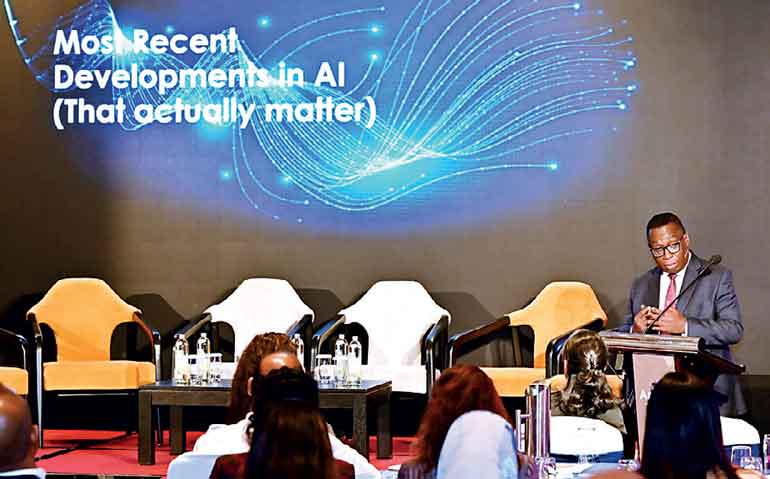
The keynote address by Nile Business School Professor and Dean and Park Knowles Ltd., CEO Dr. Noel Tagoe, FCMA (UK), CGMA examined how AI is reshaping finance functions, decision-making structures, and enterprise leadership. He emphasised that business leaders must adapt to a business environment where competitive advantage relies not just on data access, but on the ability to apply sound judgment, challenge assumptions, and navigate uncertainty.
Dr. Tagoe explored the rise of agentic AI and its implications for accountability, controls, and governance, while underscoring the growing importance of capabilities such as AI literacy, scenario thinking, data stewardship, and ethical decision-making. He also outlined how finance roles are evolving from transactional execution toward strategic business partnering, validation, and enterprise oversight.
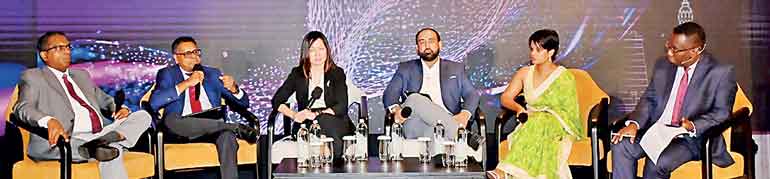
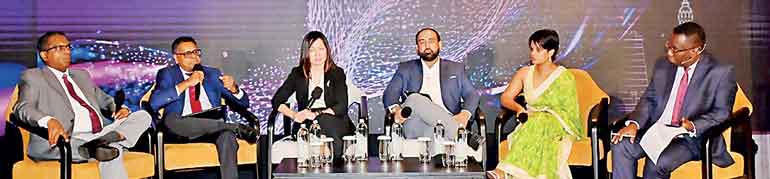
The summit’s featured panel discussion, moderated by Dr. Tagoe, explored the practical realities confronting finance leaders across industries in Sri Lanka. The panel featured LankaPay CEO Channa de Silva, Union Bank Director and CEO Dilshan Rodrigo, FCMA (UK), CGMA, Noyon Lanka CEO Husni Salieh, ACMA (UK), CGMA, Hayley PLC Head – Group ESG Prashani Ilangasekara, and Dialog Axiata PLC Group CFO Sim Siew Shan.
Panellists discussed the shift from traditional finance functions toward more forward-looking roles centred on investment planning, capital allocation, sustainability, risk, and digital transformation.
Speaking from a banking perspective, Dilshan Rodrigo noted how organisations must balance resource constraints with the need for faster reporting and more agile decision-making. Channa de Silva emphasised the role of digital infrastructure and integrated systems in enabling real-time enterprise visibility.
Prashani Ilangasekara highlighted the increasing influence of sustainability, ESG, and ethical governance within business strategy, while Husni Salieh reflected on the need for finance leaders to expand beyond technical finance into broader commercial and transformation leadership.
Sim Siew Shan shared insights from the telecommunications sector, particularly around balancing investment in emerging technologies such as AI and automation against the realities of constrained capital, legacy infrastructure, and evolving customer expectations. Discussions also focused heavily on the challenge of measuring returns on AI investments and managing organisational readiness for technology adoption.
A consistent theme across the summit was the need for finance teams to strengthen capabilities in data quality, governance, skills development, and organisational adaptability as AI adoption accelerates.
The summit concluded with interactive table discussions and workshop sessions exploring the evolving fiduciary responsibilities of CFOs, the balance between regulation, ethics, and people-centred leadership, and the role of finance in steering organisations through technological and sustainability transitions.
Closing the event, Dr. Tagoe encouraged participants to continue challenging traditional assumptions around finance leadership and to embrace the opportunities presented by AI responsibly and strategically. He noted that organisations that succeed will go beyond adopting AI tools to redesign workflows, governance, and decision-making models around them.