Friday Sep 18, 2026
Friday Sep 18, 2026
Friday, 22 May 2026 00:27 - - {{hitsCtrl.values.hits}}
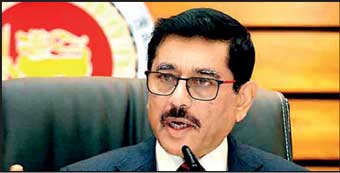 |
| CBSL Governor Dr. Nandalal Weerasinghe |
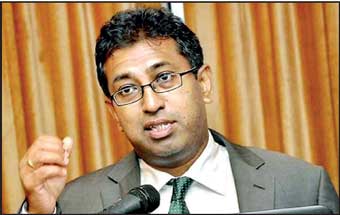 |
| SJB MP Dr. Harsha de Silva |
The Central Bank of Sri Lanka (CBSL) yesterday met bankers and currency dealers as authorities weighed tighter foreign exchange regulations to contain mounting pressure on the rupee amid heightened dollar demand and global uncertainty linked to the Middle East war.
The indicative telegraphic transfer (TT) LKR/USD rate published by the CBSL yesterday ranged from Rs. 342.63 buying to Rs. 354.03 selling, weakening from Rs. 332.09 and Rs. 342.70, respectively, the previous day. The latest movement also marked a further decline from Monday’s TT rates of Rs. 326.74 buying and Rs. 334.27 selling.
Interbank spot contracts were traded within the range of Rs. 331 to Rs. 348 against the US dollar yesterday, weakening from Rs. 329.25 to Rs. 330.25 recorded the previous day.
Bank currency dealers said the CBSL was intervening in the market to provide dollar liquidity as importers increasingly front-loaded letters of credit (LCs) and booked foreign currency requirements up to three months in advance, while exporters continued delaying conversions of export proceeds.
Dealers said the CBSL is expected to tighten foreign exchange regulations in the coming days to curb demand pressures in the market.
Among the measures under discussion is a possible reduction in the period allowed for mandatory conversion of export proceeds from the current 90 days to around 30 days, similar to measures introduced following the 2022 debt crisis.
The continued weakening of the rupee comes amid rising fuel import costs, stronger demand for dollars, and broader global uncertainty linked to developments in the Middle East.
Pressure on the rupee intensified following the escalation of the Middle East conflict. The currency had weakened 1.4% year-to-date (YTD) by 27 March, deteriorated further to 2.9% by 30 April, and reached 4.5% by 15 May.
Yesterday in Parliament, Samagi Jana Balawegaya (SJB) MP Dr. Harsha de Silva warned of a worsening confidence crisis in Sri Lanka’s foreign exchange market, arguing that uncertainty and deteriorating market sentiment are intensifying pressure on the rupee.
Dr. de Silva pointed to the rapid depreciation of the rupee, noting that the Bank of Ceylon selling rate had recently reached Rs. 354 against the US dollar.
He said the issue confronting the market was not solely economic but also linked to confidence and expectations.
“Markets operate on trust. If market trust collapses, the market itself collapses,” Dr. de Silva said, adding that both the foreign exchange and rupee markets were increasingly being shaped by weakening confidence rather than fundamentals alone.
He argued that exporters were delaying conversions of export proceeds in anticipation of further rupee depreciation, while importers were accelerating demand for dollars amid expectations the exchange rate could weaken further.
According to Dr. de Silva, this behaviour is contributing to tightening liquidity conditions and reinforcing volatility in the market.
He also claimed trading activity in the foreign exchange market had deteriorated sharply, with price discovery becoming increasingly limited.
“Today, there isn’t even a rate in the market. There isn’t a single bid or offer,” he said, adding that most transactions were now taking place through the CBSL.
Dr. de Silva questioned how Sri Lanka is expected to attract foreign direct investment (FDI) or advance projects such as Colombo Port City under conditions of limited transparency and weak market confidence.
Looking ahead, he said restoring stability could require a stronger monetary policy response, including a possible increase in interest rates of between 50 and 100 basis points (bps) in the coming week.
While acknowledging that tighter policy may help restore confidence, he warned that higher interest rates would also increase Government borrowing costs and place additional pressure on taxpayers and businesses.



