Tuesday Jun 16, 2026
Tuesday Jun 16, 2026
Friday, 2 January 2026 00:18 - - {{hitsCtrl.values.hits}}
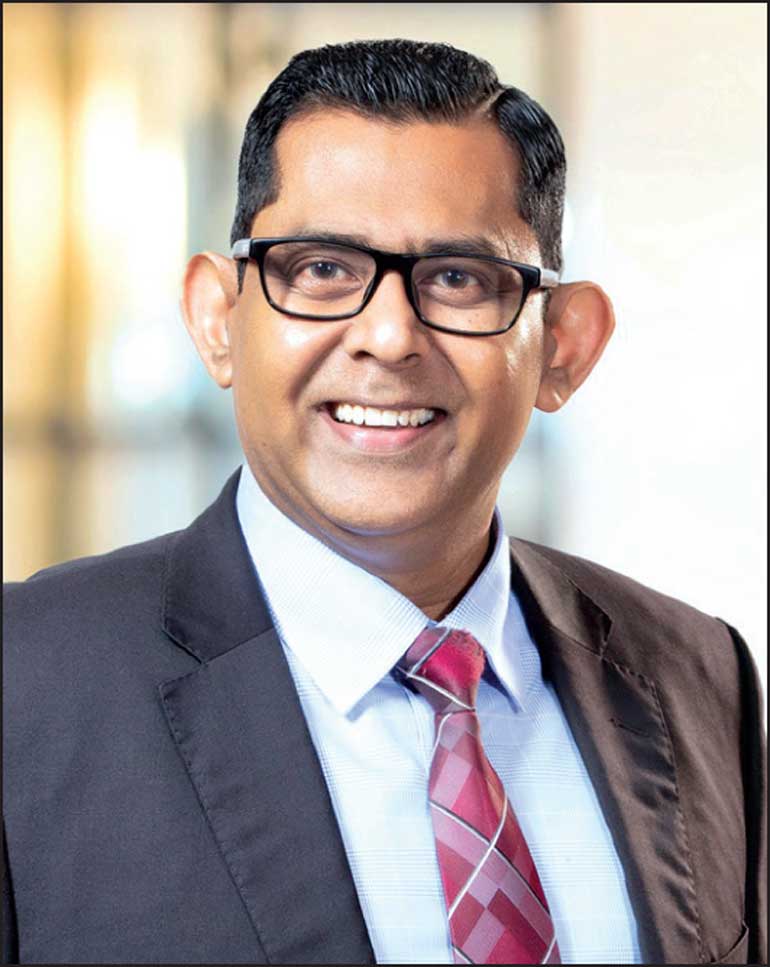
HNB Managing Director/CEO Damith Pallewatte
HNB's recognition as Sri Lanka's 'Best Bank for 2025' by The Banker magazine UK, alongside being named the 'Strongest Bank in Sri Lanka' by The Asian Banker (TAB), comes at a pivotal moment for the nation and its financial sector.
These prestigious awards, which evaluate global banks on financial strength, innovation, governance, and long-term strategic performance, emphasised HNB's exceptional resilience and focused strategic direction at a critical moment in Sri Lanka economic history.
Sri Lanka's transition from stabilisation to recovery with GDP growing at around 5% in the first half of 2025, inflation moderating, and foreign reserves rebuilding has been challenged by climate change, most recently through the devastation of Cyclone Ditwah. HNB MD/CEO Damith Pallewatte reflected on the challenges maneuvered past in 2025, and the strategies that enabled HNB to emerge as a catalyst for national economic resurgence, and those which will likely play a critical role in the year ahead.
Q: Congratulations on The Banker award. It's been a remarkable year for HNB, yet one of profound challenges for Sri Lanka that was just getting back on its feet. How do you reconcile this achievement with the broader context?
A: Thank you. This recognition is particularly meaningful because it reflects our entire team's commitment during extraordinarily difficult times. You're absolutely right Sri Lanka has been through an unprecedented sequence of calamities. While external triggers like the COVID-19 pandemic and the recent devastation of Cyclone Ditwah could not have been avoided, the total impact has exposed long-standing vulnerabilities in the Sri Lankan economy and numerous systemic gaps that urgently need addressing.
Until the impact of the cyclone, the macroeconomic indicators had shown welcome improvements. We saw GDP grow by 4.8% during the first half of 2025 after contractions of 7.3% in 2022 and 2.3% in 2023. Inflation moderated from its peak of 69.8% in September 2022 to single digits. Worker remittances surged to $ 7.2 billion by November 2025, providing crucial breathing room. Yet many families were one shock away from hardship, and thousands of SMEs were working harder than ever simply to stay afloat.
Then came Cyclone Ditwah, disrupting lives and livelihoods just as recovery was gaining momentum. The agricultural sector, already vulnerable, faced severe disruption during the critical Maha cultivation season. As a bank serving over 7 million Sri Lankans, with a majority in the agricultural sector, we're seeing firsthand how severely our communities have been impacted. Our immediate focus at the time was to support humanitarian needs, and now on the longer-term rehabilitation support.
In moments of national crisis, the true measure of an institution lies not in its balance sheet, but in our commitment to the communities we serve. We consider robust financial performance our responsibility precisely because it strengthens our ability to support national recovery efforts. Our experience has shown that ultimately, adaptability and growth has been the best path to resilience.
Q: From an operational perspective, what specific strategies enabled you to maintain service excellence across 2025?
A: Our operational resilience stems from three deliberate strategic pillars we've been building: digital infrastructure, human capital development, and dynamic risk management.
On the digital front, HNB has always been a first-mover in technology and innovation, but we've dramatically accelerated our transformation, and the results are becoming apparent in the surging transaction volumes across all digital channels.
Our mobile banking platform has seen exponential growth, while initiatives like HNB Accept are expanding convenient, low cost digital payment access to entrepreneurs and small businesses. We've just launched Sri Lanka's first bank-led cashless payment solution for buses with the National Transportation Commission, a landmark achievement that will transform daily commuting for millions while advancing financial inclusion.
We've fundamentally restructured our risk assessment frameworks too. Traditional models couldn't capture the volatility we were experiencing. We developed dynamic stress-testing scenarios, enhanced early warning systems, and maintained constant dialogue with our SME and retail customers to understand their evolving challenges. This proactive engagement helped us restructure facilities before they became non-performing, supporting both customer sustainability and our asset quality.
The Banker's recognition specifically noted our ability to maintain service levels while expanding financial inclusion. We've opened thousands of new accounts in underserved areas, launched targeted products for women entrepreneurs through initiatives like our ‘SOLO Podi Podi Business’ program, and extended our school banking program despite disruptions. Operational excellence in crisis isn't about maintaining the status quo, it's about evolving to meet urgent needs.
Q: HNB's financial performance over the past year clearly shows these efforts are working. How did the bank balance between prudent risk management and growth?
A: Our numbers reflect disciplined execution more than aggressive growth. HNB's profit after tax of Rs. 31.5 billion for the nine months, a 42% increase year-on-year, was achieved primarily through margin management and operational efficiency rather than unchecked balance sheet expansion.
We made conscious, value-driven choices. When interest rates peaked, we were proactive in extending support to vulnerable customers. When foreign currency volatility stressed importers, we developed hedging solutions rather than withdrawing from trade finance. These decisions had short-term costs but preserved long-term relationships and portfolio quality.
As a result, we have been able to grow without sacrificing asset quality. We proactively restructured facilities to support customers through the most challenging period after 2022. Since then, we've grown our loan book by over Rs. 350 billion approximately by December 2025 based on provisional figures. This was accomplished by focusing on productive sectors that drive economic recovery.
Capital adequacy remained robust with our Tier I ratio at 16.74% and Total Capital Adequacy at 20.13%, well above regulatory requirements of 9.5% and 13.5% respectively. This gives us the buffer to support economic recovery without compromising stability.
The recognition from The Banker UK, complemented by The Asian Banker naming us the 'Strongest Bank in Sri Lanka', validates this approach. Trust, ultimately, is our most valuable asset. HNB’s performance, and accolades demonstrate why customers, regulators, and international peers continue to place their confidence in our organisation, and our people.
Q: There's a compelling parallel between HNB's digital transformation and what Sri Lanka needs for economic resilience. What lessons from your experience might apply nationally?
A: There are certainly some important parallels. As a bank that has a long legacy, island-wide operations, and our critical role as a Domestic Systemically Important Bank (DSIB) that underpins a significant part of the national economy, our digital transformation has certainly had aspirations of national significance.
Digital adoption requires us to be precise, systematic, and decisive. But it also requires us to be open to new possibilities. Our digital lending platforms now approve certain facilities within seconds, not days or weeks. Our partnership with NTC for cashless bus payments will save countless hours of productivity while generating valuable data for transport planning
Such measures are vital as they deliver tangible improvements to daily life while enhancing transparency and accountability even at the scale of a bus ticket. Scaled across the entire economy, we believe the benefits will stack up exponentially, ultimately helping to restructure the economy to be more agile and inclusive.
More than technology, it required significant investment, organisational restructuring, and a realignment of people and processes towards a common purpose. And it was those initial shifts into digitalisation that enabled HNB to serve our customers through some of the most difficult moments in Sri Lanka’s recent history. In many ways the journey we have gone through mirrors the one that Sri Lanka must collectively undertake.
Budget 2025 set an aggressive vision: growing the digital economy to 15% of GDP by 2030, expanding ICT export revenues from $ 1.2 billion to $ 5 billion, and growing the tech talent pool from 85,000 to 200,000 professionals. While ambitious, these targets are survival imperatives in an increasingly competitive global economy.
For Sri Lanka, initiatives like the Sri Lanka Unique Digital Identity (SL-UDI) and Secure Transaction Registries could transform everything from welfare delivery to SME lending. Digital payment infrastructure could reduce transaction costs and improve financial inclusion. But digital transformation requires three commitments: infrastructure investment, regulatory evolution, and most importantly, digital literacy development.
If there was one lesson from our journey it would be that digitalisation isn't a luxury for good times, it's critical infrastructure for resilience.
Q: Your sustainability leadership is equally impressive being crowned Sri Lanka's Best Corporate Citizen for 2025 with seven accolades at the Ceylon Chamber awards. How does sustainability integrate with business performance?
A: Sustainability isn't separate, it's embedded in value creation. The Triple Bottom Line Award for Economic Sustainability proves financial performance and responsible practices are mutually reinforcing.
Our ‘SOLO Podi Podi Business’ initiative, winning Best Project Sustainability, empowers women entrepreneurs through digital literacy and finance access. This builds sustainable growth while developing new customer segments and contributing to economic diversification.
Equally transformative is our HNB Sarusara programme, which engaged 30,000 agripreneurs nationwide since launching in 2024. In 2025, we worked to scale precision agriculture practices island-wide from drone-assisted crop monitoring to mobile soil-mapping services helping farmers optimise inputs while improving yields.
Extending beyond productivity: Saru Sara is enabling farmers to transform into value-added producers, like the potato farmer we backed who now runs a profitable snack business. Through Sarusara, we're modernising agriculture by creating a new generation of rural entrepreneurs equipped with technology, market access, and tailored financial solutions.
When entrepreneurs succeed, communities prosper, loan performance improves, resilience strengthens. Climate resilience is now non-negotiable we're actively building partnerships to support this national imperative.
Q: Looking ahead, how does HNB plan to build on this recognition while supporting Sri Lanka's continued recovery?
A: The Banker's award recognises what we've achieved, but more importantly, it reinforces our responsibility going forward.
On innovation, we are continuing to accelerate digitalisation of existing propositions while also working to reimagine financial services. Our Rs. 350 billion approximate growth in net loans in 2025 wasn't random; it was strategically directed toward productive sectors, MSMEs, and emerging industries. We're allocating significant resources for technology sector financing, supporting both startups and traditional businesses adopting digital solutions.
Our Vision 2030 requires all stakeholders, Government, private sector, civil society to work in concert. The banking sector's growth plans can no longer run on separate tracks; they must be consciously aligned with the country's vision. Our role is to be not just financiers but architects of this transformation.
As I often tell our team, banking at its best is about enabling individuals to achieve their aspirations, businesses to create value, and nations to prosper. The journey ahead demands nothing less than our absolute commitment to excellence, innovation, and inclusive progress.




