Thursday Jul 16, 2026
Thursday Jul 16, 2026
Thursday, 5 March 2026 04:25 - - {{hitsCtrl.values.hits}}
By Charumini de Silva
 At a moment when Sri Lanka’s macroeconomic weather appears calmer, its leading bankers are resisting any temptation to declare victory.
Speaking at the 36th Anniversary Convention of the Association of Professional Bankers of Sri Lanka, senior executives framed the industry’s task not as chasing growth at speed but imposing clarity on complexity and, crucially, choosing what not to do.
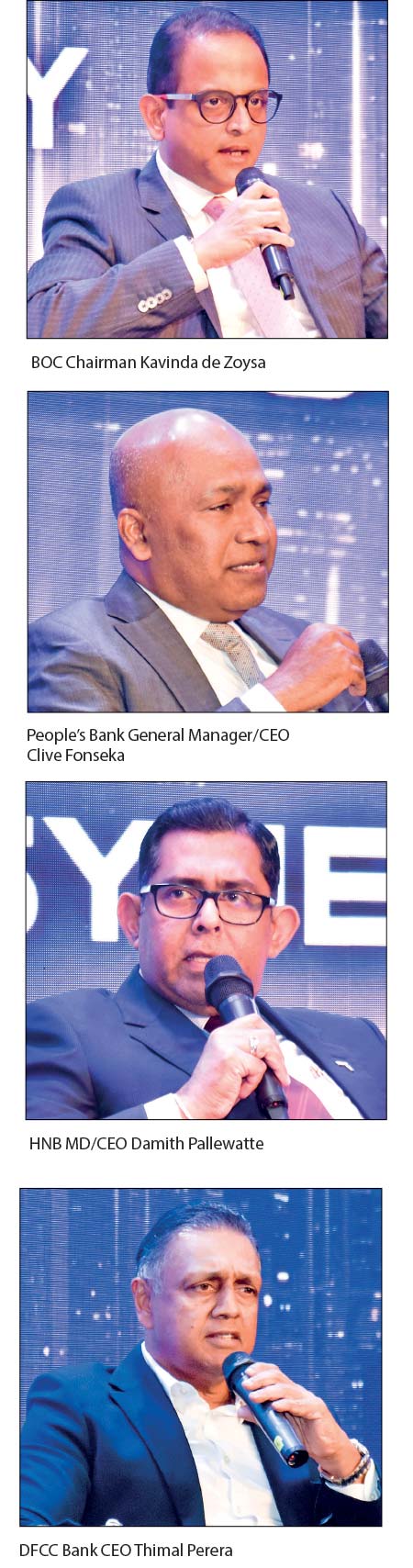
During a panel discussion titled “Navigating Complexity, Accelerating Impact through Regional Synergy” featuring top bankers comprising People’s Bank General Manager/CEO Clive Fonseka, Hatton National Bank PLC MD/CEO Damith Pallewatte, Bank of Ceylon Chairman Kavinda de Zoysa and DFCC Bank PLC CEO Thimal Perera belied a more cautious undertone. The economy may be stabilising, they suggested, but fragility persists beneath the surface.
For the Bank of Ceylon Chief, clarity begins with simplification.
“Large institutions face a complex web of challenges. The priority is to make things simple,” de Zoysa said, arguing that growth and profitability should flow from solving customer problems rather than from balance-sheet expansion for its own sake.
That philosophy extends to what he termed a “fortress balance sheet”, a posture focused on depositor safety, capital buffers and liquidity discipline. In an era still haunted by the collapse of Silicon Valley Bank, de Zoysa stressed the need to manage duration mismatches, interest-rate exposure and high-quality liquid assets with vigilance.
Sri Lanka’s banks, he argued, must balance national development priorities with private-sector agility, while meeting increasingly exacting regulatory and market standards. “Fundamentally, people want simpler, safer banks,” de Zoysa said.
HNB Managing Director and CEO described strategy less as expansion than filtration.
“In a tighter regulatory environment marked by margin compression and volatility, prioritisation does not come from doing more, it comes from choosing better,” he said.
His framework rests on three filters. First, strategic alignment: does an initiative strengthen the franchise, deepen digital capability or reinforce customer trust? If not, it is abandoned early. Second, risk-adjusted return and capital efficiency: growth that erodes value is self-defeating. Third, relevance: does the initiative solve a meaningful customer problem at scale?
“In today’s environment, relevance is more important than size,” Pallewatte noted, a quiet repudiation of pre-crisis growth models.
For People’s Bank CEO Fonseka, lending decisions remain tethered to market confidence and macroeconomic indicators—inflation, GDP growth, monetary policy, exchange rates and global trade dynamics.
However, DFCC CEO Thimal Perera urged caution against broad-brush judgments. “Sectoral risk must be assessed at the level of individual borrowers,” he argued.
He said even within a single industry, tea, for example export markets, buyer profiles and cash-flow resilience vary sharply. “You need to sit across the table and understand the customer’s specific circumstances,” he said, reflecting lessons from the past three years of upheaval.
Stability, while welcome, carries its own dangers. Complacency can seed future losses. “We are in a much better place than two or three years ago,” Perera acknowledged, “but the economy is still fragile.”
Commenting on balance-sheet resilience both de Zoysa and Perera opined liquidity coverage ratios, tiered capital buffers and prudent management of exchange-rate and interest-rate rise — as non-negotiable.
Sri Lankan banks, they suggested, have also become more active participants in domestic capital markets.
Bank of Ceylon Chairman said the State bank accounted for roughly a quarter of listed debt issuances on the Colombo Stock Exchange in 2025, while sustainable bond structures such as green, blue and sustainability-linked are gaining traction.
DFCC Bank CEO described sustainable finance as “here to stay”, pointing to the Central Bank’s evolving green taxonomy and the potential for such instruments to enhance Sri Lanka’s standing with foreign investors.
“The broader implication is that Sri Lanka’s banks are recalibrating, away from expansionary exuberance and towards disciplined intermediation. Growth remains the objective, but only within clearly defined guardrails,” Perera said.
Pix by Upul Abayasekara




