Tuesday Sep 29, 2026
Tuesday Sep 29, 2026
Monday, 28 September 2026 04:39 - - {{hitsCtrl.values.hits}}
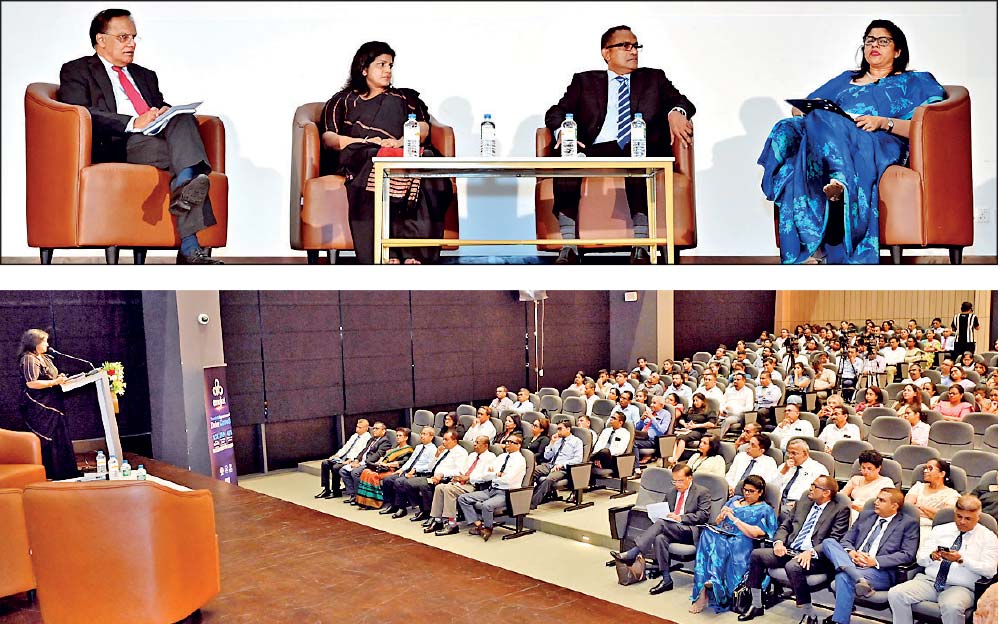

Sri Lanka’s banking and regulatory sectors must demonstrate that their safeguards against financial crime work in practice, not merely that the country has the right laws on paper, senior officials and bankers said at a recent industry forum.
The Association of Professional Bankers (APB) recently held another Continuing Professional Development and Competency program at People’s Bank Tower, bringing together more than 500 bankers across the country. The event focused on Sri Lanka’s preparations for its third mutual evaluation under the Financial Action Task Force framework.
The evaluation will be conducted by the Asia Pacific Group on Money Laundering, a Regional body that assesses countries’ implementation of international standards on anti-money laundering, countering the financing of terrorism and countering the financing of proliferation.
Sri Lanka’s on-site assessment with evaluators is scheduled for 26 October to 6 November 2026 where they will be discussing with both public and private sectors on effectiveness of AML/CFT/PF policies. A meeting with the evaluators on the initial draft report is expected in April 2027. Adaptation of Mutual Evaluation Report to be considered at the Asia/Pacific Group’s plenary meeting in July 2027.
From compliance to effectiveness
Speaking at the event, Central Bank of Sri Lanka Director and Financial Intelligence Unit Head Dr. Subhani Keerthirathne said the assessment would examine two distinct areas.
The first is technical compliance: whether the necessary legislation, regulations, policies and institutional arrangements are in place. The second is effectiveness: whether those measures produce meaningful results in identifying, investigating and preventing financial crime.
That distinction is increasingly important for financial institutions. A well-written policy or a complete file may demonstrate that a process exists, but it does not necessarily show that the process is identifying risks or disrupting illicit activity.
The assessment will consider the Financial Action Task Force’s 40 recommendations and 11 “Immediate Outcomes”. These cover areas including National Risk Assessment and co-ordination, supervision, preventive measures, beneficial ownership transparency, financial intelligence, investigations and prosecutions, confiscation, terrorist-financing prevention and sanctions relating to proliferation financing.
Shared responsibility
A panel discussion brought together Dr. Keerthirathne, Seylan Bank Chairman Justice Buwanaka Aluvihare, HSBC Sri Lanka Chief Compliance Officer Manique Kirialla Bandara, HNB Chief Compliance Officer Neil Rasiah.
The discussion emphasised the need for a shift away from documentation-led compliance towards a risk-based and outcome-focused approach. Regulators, banks and other stakeholders will need to show not only that controls are in place, but also that they are applied consistently and deliver measurable results.
APB President Dilshan Perera highlighted the importance that a successful review is the responsibility of the financial service industry as a whole and not limited to boards or compliance heads of bank. The confidence in the financial system in the country and its integration with the international financial community would be of critical importance while the country moves from stabilisation to growth.
With the evaluation approaching, the event highlighted the scale of the task facing Sri Lanka’s financial sector. The country’s ability to demonstrate effective implementation rather than simply technical adherence will be central to the outcome of the review.
APB is the most representative professional body for banking professionals in Sri Lanka since 1988. The Association was formed by senior bankers to create a common forum that promoted knowledge sharing and strengthens professionalism within the banking community.




