Thursday Oct 22, 2026
Thursday Oct 22, 2026
Friday, 16 January 2026 00:08 - - {{hitsCtrl.values.hits}}
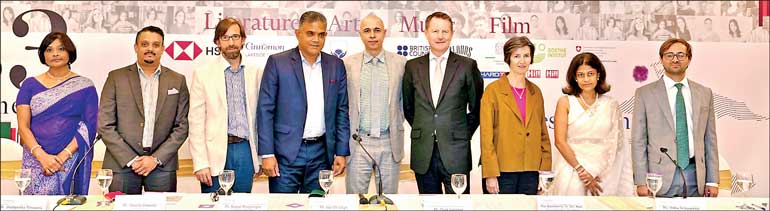
From left: John Keells Group Head of CSR Carmeline Jayasuriya, Cinnamon Lakeside General Manager Dushyantha Tittawella, British Council Sri Lanka Country Director Orlando Edwards, Cinnamon Hotels and Resorts Chief Operating Officer Kamal Munasinghe, HSBC Ceylon Literary and Arts Festival Director and Co-Founder Ajai Vir Singh, HSBC Sri Lanka CEO Mark Surgenor, Swiss Ambassador to Sri Lanka and Maldives Dr. Siri Walt, The Rukmini Tissanayagam Trust, Trustee Indhu Selvaratnam and the Embassy of Italy Deputy Head of Mission Alberto Arcidiacono
By Dilrukshi Fernando
On a warm Colombo afternoon at Cinnamon Lakeside, the language was unusually non corporate. The talk, unfolding against the stillness of the Beira Lake, was of books and theatre, of art, photography and film… and, beneath it all, of how culture quietly reshapes a city’s standing in the world. As the HSBC Ceylon Literary and Arts Festival prepares for its third edition, it is becoming increasingly clear that this is not merely a cultural gathering, but a carefully constructed statement of intent, to both strengthens its position as a cultural platform, while showcasing Sri Lanka’s Soft power through the lens of literature, arts, music and film.
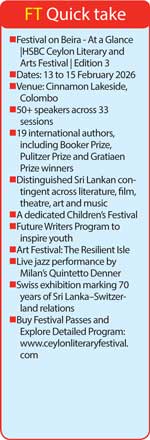
From 13 to 15 February 2026, the festival returns as the “Festival on Beira”, drawing writers, artists and performers into a lakeside setting that organisers see as symbolic. Colombo, they argue, is no longer only a commercial or transit city; it is positioning itself as a place where ideas arrive, linger, and circulate.
With over 50 speakers across 33 sessions, including 19 international authors, the festival has grown steadily in scale and ambition. Among those attending are Booker Prize, Pulitzer Prize and Gratiaen Prize winners; an assembly that signals literary seriousness rather than mere spectacle.
At the same time, the program makes space for popular and cinematic culture. Julia Quinn, whose Bridgerton series has reached global audiences both as books and a streaming phenomenon, will appear as a featured author, while Helen Macdonald, acclaimed for H Is for Hawk, Vesper Flights and Prophet, brings a quieter literary gravitas rooted in introspection and nature writing. Internationally renowned writer, podcaster and speaker Katherine May, author of the global bestsellers Wintering and Enchantment, joins the line-up with work that explores nature, spirituality, slow living and neurodivergence.
 The festival’s reach extends well beyond the page. Shabana Azmi, one of Indian cinema’s most respected and internationally acclaimed actors, will participate in conversations that bridge film, literature and social commentary. She is joined by a range of globally recognised Sri Lankan authors and artists, including Shyam Selvadurai, as well as film, television and theatre actor and playwright Nimmi Harasgama, reinforcing the festival’s emphasis on meaningful dialogue between local and international creative voices.
For the Director and Co-Founder of the festival, Ajai Vir Singh, this convergence is deliberate. The aim, he has said, is to enhance Sri Lanka’s soft power through literature, arts, music, theatre and film - by showcasing creativity not as ornament, but as national capability, building confidence at home while signalling outward-facing relevance. “Edition 3 is consistent with the main purpose of showcasing Sri Lanka’s Arts and Culture to enhance Sri Lankan Soft Power in the world. It is important to increase Sri Lanka’s influence in the region as it serves the purpose of building confidence at home in the creativity we have and to showcase ‘why Sri Lanka’ to the world”, said Singh at the official launch of the festival.
Responding to the Daily FT, Singh expanded on Colombo’s emerging role as a cultural capital for the region and beyond. “The idea is to position Sri Lanka as a space - a seat of interaction - where vibrancy and creativity are actively cultivated and given room to move forward,” he said. “Colombo plays a critical role from a tourism perspective as well; it is an ideal platform for destination marketing. High-net-worth travellers, in particular, are drawn to arts and culture. Sri Lanka already offers extraordinary natural beauty, from beaches to landscapes, but experiences and events of this nature add a deeper cultural layer.
They enhance the overall experience for travellers and give them more compelling reasons to engage with the country.”
That framing resonates strongly with the festival’s corporate and institutional partners. HSBC, now in its third year as title partner, positions the festival as an extension of its global role. “We’re about bringing the best of the world to Sri Lanka and the best of Sri Lanka to the world,” said HSBC Sri Lanka CEO, Mark Surgenor. Culture, in this sense, becomes infrastructure, a way of connecting markets, people and generations.
The Future Writers Program offers a tangible example. Its first-edition winner, Savin Edirisinghe, went on to become one of the youngest recipients of the Gratiaen Prize in 2025, a trajectory frequently cited as evidence that early exposure and mentorship can convert creative potential into recognised achievement. Free student passes and an expanded children’s festival reinforce this pipeline approach, positioning the event as an incubator rather than a one-off showcase.
If the intellectual architecture of the festival is one pillar, its physical and experiential setting is another. Cinnamon Hotels and Resorts, the venue and hospitality partner, views the festival as part of a broader destination narrative. Cinnamon Hotels and Resorts, Chief Operating Officer Kamal Munasinghe described Colombo as a city increasingly defined by experience rather than mere infrastructure.
“These conversations, these personalities, and these global voices add depth to Colombo’s appeal,” he noted. “They allow visitors and residents alike to engage with the city in a more meaningful way.”
Cinnamon Lakeside, overlooking the Beira Lake, has been positioned as more than a venue; it is intended as a cultural anchor point, with satellite experiences extending into the city. For the hospitality sector, the logic is clear: high-value travellers are drawn as much by culture as by beaches or business. Festivals such as this help convert Colombo into a destination where intellectual and creative engagement complements commerce.
That same logic underpins the Art Festival, presented in association with the John Keells Foundation for the second consecutive year. The exhibition, themed The Resilient Isle, features works by over 15 Sri Lankan artists and reflects on endurance, adaptation and transformation. John Keells Holdings Head of CSR, Carmelene Jayasuriya, framed the arts as both economic and social capital, supporting creative livelihoods while fostering dialogue and cohesion in a society shaped by complexity.
International cultural exchange adds further texture.
As part of Italy’s participation, the Embassy of Italy will present a live jazz performance by Quintetto Denner, an ensemble from Milan with over two decades of international performance experience. The concert takes on added significance as Sri Lanka and Italy mark 75 years of diplomatic relations in 2026.
Speaking at the launch, Italian representatives highlighted music as a universal language — one that transcends borders and fosters understanding in ways that policy and trade alone cannot. An unmissable highlight in the performing arts line up is an intensive theatre workshop by the UK’s Emma Rice Company, supported by the British Council, yet another initiative that brings cultural exchange and long-term capability into focus.
A similar sentiment was echoed by the Ambassador of Switzerland to Sri Lanka and the Maldives, Dr. Siri Wald, who spoke of cultural harmony as one of the festival’s quiet achievements. Switzerland’s participation this year coincides with 70 years of diplomatic relations and friendship between Sri Lanka and Switzerland, marked through the evocative exhibition “Nicolas Bouvier in Ceylon: 70 Years Later”. Drawing from rare archival photographs and literary reflections, the exhibition explores memory, travel and identity, underscoring how cultural encounters endure long after diplomatic milestones are marked.
As British Council representatives noted, globally, festivals are engines of creative economies, tourism and employment. Sri Lanka’s creative sector has already doubled its contribution to GDP in recent years, suggesting significant headroom for growth if supported by sustained platforms.
In that context, the HSBC Ceylon Literary and Arts Festival functions as more than a cultural weekend. It is a marker of Colombo’s evolving identity, a city investing in ideas, conversation and creativity as tools of influence. Soft power, here, is not merely philosophical and abstract. Instead it is reflected, spoken, written, performed, and increasingly, noticed by the world.
The HSBC Ceylon Literary and Arts Festival is supported by a host of distinguished partners. HSBC, as the title partner, exemplifies its commitment to cultural innovation and global artistic exchange. The venue and hospitality partner is Cinnamon Lakeside.
Key partners include the Rukmini Tissanayagam Trust, John Keells Foundation and Synamon Global. The British Council serves as the knowledge partner, alongside the Goethe-Institut. Cultural collaborations are supported by the Embassy of Italy in Colombo and the Embassy of Switzerland to Sri Lanka and the Maldives. Additional support comes from Sarasavi, Acorn Group and Teardrop Hotels, with Arienti as the merchandise partner. Media partners include Wijeya Newspapers, Daily FT, Daily Mirror, Sunday Times, Hi!! Online, Hi! Magazine, HiI!.



