Monday Sep 21, 2026
Monday Sep 21, 2026
Friday, 4 September 2026 00:29 - - {{hitsCtrl.values.hits}}
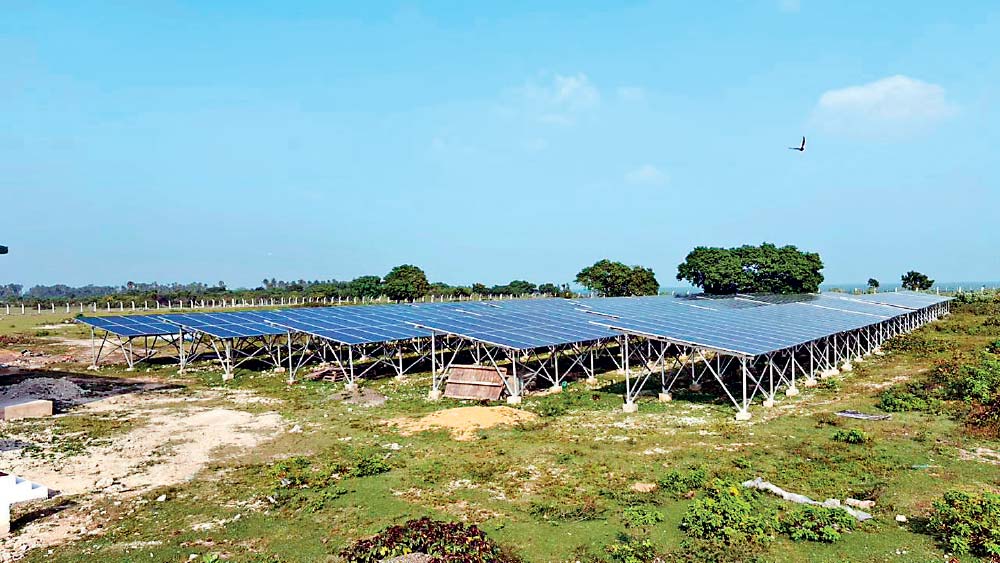
A new chapter is unfolding in the development of Sri Lanka’s Northern Islands, with the commissioning of a Hybrid Renewable Energy Project combining Solar Power, Battery Energy Storage and Generators at Delft Island recently.
The project marks a significant transformation in the way electricity is generated on the island, replacing the cumbersome and costly dependence on diesel-generator-based power generation with a modern, sustainable energy system.
More importantly, the project is expected to create opportunities far beyond electricity generation. Reliable and sustainable power can become the foundation for increased habitation, tourism, small and medium-scale industries, commercial activities and improved livelihoods across the three Northern Islands of Delft, Nainathivu and Analathivu.
The project is part of the Indian Government’s grant assistance to the Government of Sri Lanka for the development of renewable-energy systems in the three islands off the Jaffna Peninsula.
From energy constraints to development potential
Speaking on the successful completion of the Delft project, U Solar Project Manager Dinesh said the project was completed despite significant logistical and transportation challenges.
The equipment and systems had to be transported through a complex combination of sea, land, sea and inland road transportation, presenting considerable challenges in moving specialised equipment to a remote island location.
Despite these difficulties, the project was successfully completed and commissioned, demonstrating that modern renewable-energy infrastructure can be delivered even in geographically challenging island environments.
Delft already has capacity for future growth
According to Dinesh, the Delft system is capable of generating approximately 600 kW of electricity, while the island’s present consumption is only around 300 kW.
This means that the island has significant available capacity to accommodate future increases in electricity demand.
The significance of this surplus extends well beyond households. Reliable electricity creates the basic infrastructure required for new businesses, tourism facilities, cold-storage facilities, workshops, commercial establishments and other productive economic activities.
Analathivu and Nainathivu next
U Solar is expected to commission the Analathivu project within approximately one week, followed by the Nainativu project within approximately two weeks.
With the completion of all three projects, Delft, Nainathivu and Analathivu will move towards having reliable and sustainable electricity generation capacity with a reserve for future development, rather than merely generating electricity sufficient for their present requirements.
This changes the development equation for the islands.
Electricity can become a catalyst for a new Northern island economy
For decades, limited and costly energy availability has been one of the practical constraints to economic development in remote islands.
The availability of dependable electricity can now provide the platform for a new generation of development.
Tourism operators can consider new accommodation and hospitality ventures. Investors can establish businesses that were previously impractical. Local entrepreneurs can expand commercial activities. Fisheries and agriculture-related enterprises can introduce refrigeration, processing and value addition. Schools, health services and community facilities can operate with greater reliability.
Most importantly, improved energy availability can make the islands more attractive for future habitation, encouraging people to live, work and invest there rather than viewing the islands merely as remote destinations.
A new opportunity for tourism
The three islands possess distinctive natural, historical and cultural attractions. With reliable electricity now becoming available, the islands have the potential to develop a sustainable tourism economy based on their unique island environment.
Future development could include eco-tourism, beach and marine tourism, small-scale resorts, guesthouses, restaurants, recreational facilities, water-based activities and cultural tourism, provided such development is undertaken in an environmentally responsible manner.
The availability of electricity does not by itself create tourism. However, it removes one of the important infrastructure barriers to private-sector investment in tourism facilities.
The beginning — not the end — of Island development
The commissioning of these renewable-energy projects should therefore be viewed not simply as an electricity project, but as the beginning of a broader development opportunity for the Northern Islands.
The immediate achievement is sustainable electricity generation. The larger opportunity is what can be built around that electricity. With appropriate planning, improved transportation connectivity, telecommunications, water supply, sanitation and other essential infrastructure, Delft, Nainathivu and Analathivu could progressively develop into attractive places to live, visit, invest and conduct business.
The surplus energy capacity now being created provides an important foundation for that future.
From remote islands to emerging growth destinations
The commissioning of the three hybrid energy systems could ultimately represent a turning point for the Northern Islands — transforming them from locations constrained by energy limitations into emerging destinations for habitation, tourism and economic activity.
The message is therefore much bigger than the installation of solar panels, batteries and generators.
It is about creating the energy foundation for a new future.
A future in which families can choose to live on the islands, tourists can choose to visit them, entrepreneurs can choose to establish businesses there, and investors can see new opportunities for sustainable economic development.
With reliable renewable energy now becoming a reality, the three Northern Islands have the opportunity to write their next chapter — powered by clean energy and driven by people, tourism, investment and industry.
The entire end to end Projects logistics was handled by Expolanka Freight Project logistics divisions headed by Director Project Logistics and Finance Fazul Ansar and Head of Project Logistics Operations Ronald Figarado and Project Executives Team members Chathiru Nimsara, Thuhansa and Charith Premarathna.




