Saturday Oct 17, 2026
Saturday Oct 17, 2026
Monday, 25 May 2026 04:12 - - {{hitsCtrl.values.hits}}
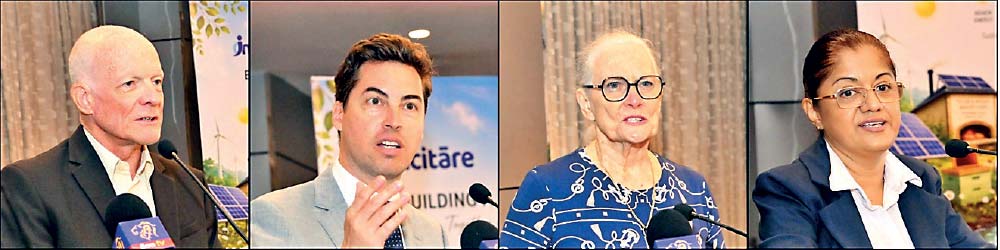
From left: GIZ Sri Lanka Representative Fabio Germano, Swiss Embassy to Sri Lanka and Maldives Deputy Head of Mission Olivier Praz, Incitare International and GRFC Founder and CEO Beris Gwynne and Incitare International Country Director Sri Lanka Cheryl Arndt
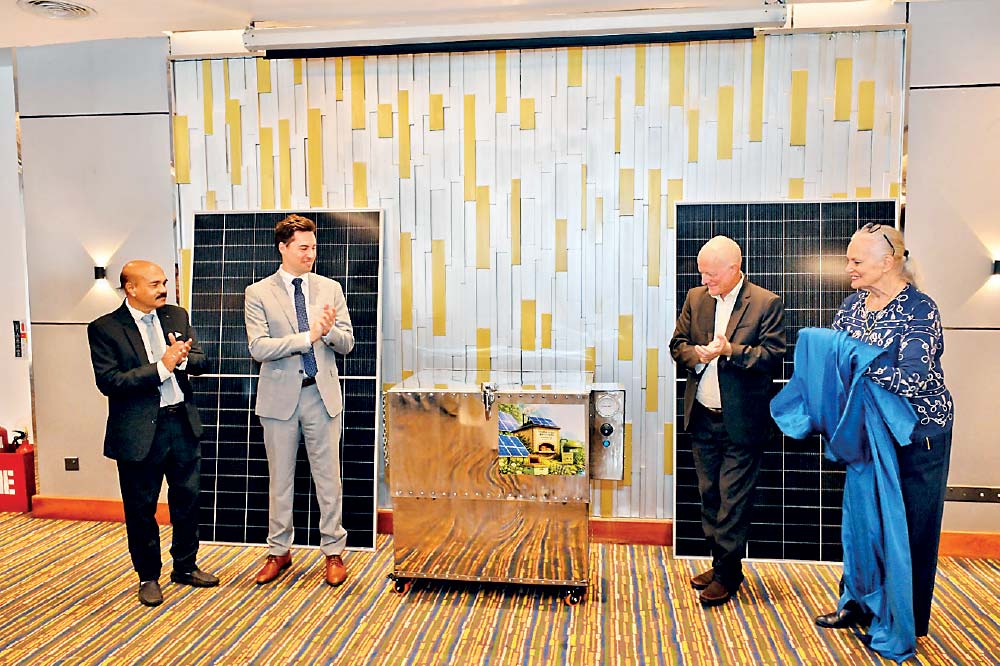
The official unveiling of the solar hybrid bakery oven
By Amira Cader
Sri Lanka last week unveiled South Asia’s first solar hybrid bakery oven, marking a major milestone in the country’s renewable energy and sustainable development journey.
The launch introduced a solar hybrid bakery oven integrating both solar and biogas energy sources, designed to ensure uninterrupted operations despite unpredictable weather conditions.
The initiative was spearheaded by Incitare Sri Lanka and the Global Rethinking Finance Collaborative (GRFC), in collaboration with German Tech Kilinochchi. The event was attended by the Embassy of Switzerland to Sri Lanka and Maldives Deputy Head of Mission Olivier Praz and GIZ Sri Lanka representative Fabio Germano.
Incitare International and GRFC Founder and CEO Beris Gwynne said the initiative had evolved from a bold idea into a functioning reality in Sri Lanka through strong commitment, collaboration and community-driven innovation.
“We are ready to present a hybrid solar oven that we believe has serious potential not only for communities, bakeries and eco-tourism establishments but also for training institutions. This technology can help reduce carbon footprints, produce goods that reduce import reliance and potentially establish a new export-oriented industry for Sri Lanka,” she said.
Embassy of Switzerland to Sri Lanka and Maldives Deputy Head of Mission Olivier Praz noted that innovations of this nature represented an important way forward for Sri Lanka, particularly at a time when the country continues to face energy-related challenges linked to the ongoing Middle East crisis.
“These students and young innovators have proven that Sri Lanka possesses the talent, creativity and determination needed to build sustainable solutions for its future. Supporting local innovation is not only a win for the people but also for the island’s economy,” he said.
GIZ Sri Lanka representative Fabio Germano described the initiative as a significant breakthrough in sustainable technology and regional innovation, highlighting its potential to transform livelihoods while addressing environmental challenges.
He said the technology, the first deployment of its kind in South Asia, would help reduce dependence on fossil fuels and lower carbon emissions, while also creating sustainable income opportunities for youth, women and rural entrepreneurs.
“This initiative demonstrates how innovation and collaboration can create practical, community-driven solutions that support both economic development and environmental sustainability,” he said.
Incitare International Country Director for Sri Lanka Cheryl Arndt said the program reflected years of determined work by communities, partners and institutions committed to driving meaningful change.
“What we are witnessing today is the result of years of quiet, determined work by communities, partners, and institutions who refused to wait for change and chose to create it. Sri Lanka has not just adopted a new technology. It has demonstrated that sustainable livelihoods and clean energy are not aspirations for tomorrow. They are happening right here, right now,” she said.
The initiative began in March 2025 with a national-level stakeholder dialogue at the National Youth Corps Head Office in Colombo involving representatives from the Export Development Board, Department of Samurdhi, National Institute of Plantation Management and several other public institutions.
The discussions led to three Memoranda of Understanding underpinning the program. The first enabled the National Youth Corps to donate two solar ovens, the second partnered with GIZ Sri Lanka to develop a low-cost, locally produced advanced solar oven using Sri Lankan materials and expertise, while the third focused on expanding inclusive livelihood opportunities for economically vulnerable communities through collaboration with the Department of Samurdhi.
Installations have already been completed in Dambulla and Kilinochchi, where technical trainers conducted training-of-trainers programs to equip local facilitators with the skills needed to independently sustain and scale operations.
At the ceremony, certificates were awarded to contributing teams from German Tech Kilinochchi and Incitare Sri Lanka in recognition of their role in transforming the initiative from concept to operational reality.
Incitare International, a Swiss and Australian-registered collaborative platform headquartered in Geneva, together with German Tech Kilinochchi and GIZ Sri Lanka, were recognised as key implementation partners behind the landmark initiative.




