Friday Mar 13, 2026
Friday Mar 13, 2026
Monday, 12 January 2026 00:01 - - {{hitsCtrl.values.hits}}
 The Draft National Electricity Policy (2025) contains multiple provisions that risk stalling or even reversing renewable energy development in Sri Lanka. These developments have raised serious concerns within the sector regarding potential bias toward fossil fuel-based generation
 We wish to highlight the exceptional contribution made by Sri Lanka’s solar industry in strengthening national energy security, delivering lower-cost electricity to consumers, and significantly reducing the outflow of foreign currency otherwise spent on imported fossil fuels.
Over the past several years, the solar industry has emerged as one of the most impactful contributors to Sri Lanka’s renewable energy transition. The sector currently provides direct and indirect employment to over 40,000 Sri Lankans and supports approximately 400 active companies across the renewable energy value chain. This progress is fully aligned with the Government’s long-term policy objectives on energy security, economic resilience, and environmental sustainability.
However, several provisions in the Draft National Electricity Policy, if implemented in their current form, pose serious risks to the stability and future growth of the renewable energy sector. Our key concerns are outlined below.
1. Uncompensated curtailment of renewable energy
(Reference: 1.3.3 – Draft National Electricity Policy)
1.1 Curtailment without compensation
1.3.3 of the Draft Policy permits the curtailment of electricity generation due to system stability or grid constraints without providing any financial compensation to generators. Given the inherently variable nature of solar, wind, and mini-hydro generation, these technologies are disproportionately subjected to curtailment during periods of excess supply.
This approach places an unfair and unsustainable burden on renewable energy developers, particularly solar power producers, who are already constrained by limited grid absorption capacity.
1.2 Impact on project bankability and investor confidence
The absence of “take-or-pay” or equivalent revenue assurance mechanisms in Power Purchase Agreements (PPAs), combined with uncompensated curtailment, significantly undermines the bankability of renewable energy projects. Financial institutions are increasingly reluctant to extend long-term financing under such conditions, further weakening already declining investor confidence in the sector.
Recommendation: The Solar Industries Association proposes the introduction of:
2. Impact of abolishing the Feed-in Tariff (FIT) mechanism
(Reference: Proposed policy shift for projects below 10 MW)
2.1 Replacement of FIT with competitive bidding
The Draft National Electricity Policy proposes replacing the existing Feed-in Tariff (FIT) mechanism for renewable energy projects below 10 MW with a competitive bidding framework. The Association is of the firm view that implementing this policy change will result in the effective collapse of the small and medium-scale renewable energy sector.
2.2–2.3 Evidence-based impact assessment
As of November 2025, Sri Lanka’s total installed renewable energy capacity stands at approximately 3,333 MW. Of this, nearly 3,042 MW (approximately 92%) has been developed under the FIT mechanism, rather than through competitive bidding.
This clearly demonstrates that FIT has been the primary enabler of renewable energy development in Sri Lanka. Its removal would therefore have a severe and immediate negative impact on the power sector.
2.4 Decline of Small and Medium-Scale investors
Rooftop solar, mini-hydro, and other small renewable energy projects are predominantly implemented by households, community investors, and small and medium-scale enterprises (SMEs). The removal of FIT will discourage rooftop solar adoption—currently a critical tool for households to manage rising electricity tariffs—and will severely undermine SME-led renewable energy businesses.
2.5 Inability to achieve 2030 renewable energy targets
Sri Lanka’s commitment to sourcing 70% of electricity from renewable energy by 2030 is heavily dependent on private-sector participation. Eliminating FIT will significantly reduce private investment, rendering this national target unattainable and reducing it to a purely aspirational statement.
2.6 Increased dependence on fossil fuels
A slowdown in domestic renewable capacity additions will inevitably be offset by increased reliance on high-cost diesel or coal-fired generation. This will result in higher electricity tariffs and increased foreign exchange outflows, directly contradicting national economic objectives.
2.7 Loss of competitiveness of local enterprises
Competitive bidding frameworks disproportionately favour large multinational corporations. Local SMEs will be unable to compete on equal terms, accelerating the decline of domestic entrepreneurship—contrary to the Government’s stated policy commitments in the election manifesto and the 2025 national budget to protect and promote SMEs.
2.8 Industry contraction and job losses
The cumulative impact of these measures threatens the closure of numerous renewable energy companies and the loss of thousands of skilled jobs across the sector.
2.9 Conclusion on FIT
The Feed-in Tariff mechanism has been the backbone of Sri Lanka’s renewable energy success. Its removal would severely undermine the country’s green energy future and reverse more than a decade of progress.
3. Foreign exchange risk in LKR-denominated PPAs
(Reference: PPA pricing framework in the Draft Policy)
3.1 Exchange rate exposure
The Draft Policy mandates that all new PPAs be denominated exclusively in Sri Lankan Rupees (LKR). However, the majority of renewable energy equipment—including solar panels, wind turbines, and hydro components—must be imported using US dollars. This places the full exchange rate risk on project developers and discourages foreign direct investment (FDI).
3.2 Risk premium and higher tariffs
Pure LKR-based pricing compels investors to incorporate a risk premium into tariffs, ultimately increasing electricity costs to consumers.
3.3 Proposed solution
The Association recommends that while payments may be made in LKR, tariffs should be indexed to the prevailing USD exchange rate at the time of payment, thereby protecting debt servicing capacity and improving project bankability.
3.4 Proven precedent
A recent wind power tender that achieved tariffs below USD 0.04/kWh successfully applied USD indexation, demonstrating the effectiveness and scalability of this approach.
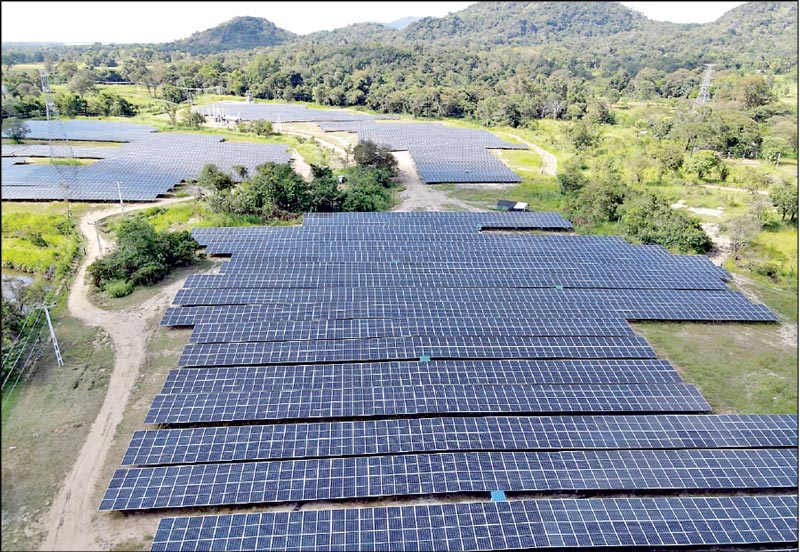
Solar industry has emerged as one of the most impactful contributors to Sri Lanka’s renewable energy transition. The sector currently provides direct and indirect employment to over 40,000 Sri Lankans and supports approximately 400 active companies across the renewable energy value chain
4. Tariff reduction upon PPA extension
(Reference: 1.5.2 – Draft National Electricity Policy)
4.1 Mandatory tariff reduction
1.5.2 stipulates that upon PPA extension, the applicable tariff shall not exceed 35% of the tariff offered to a new project.
4.2 Operational and financial risks
A revenue reduction of approximately 35% makes it economically unviable to maintain, refurbish, or upgrade existing renewable energy plants, potentially leading to premature decommissioning of operational green energy assets.
4.3 Recommendation
We recommend that the Ministry of Power and Energy appoint a technical evaluation committee to determine extension tariffs based on:
Final observation
The Draft National Electricity Policy (2025) contains multiple provisions that risk stalling or even reversing renewable energy development in Sri Lanka. These developments have raised serious concerns within the sector regarding potential bias toward fossil fuel-based generation.
The Solar Industries Association respectfully urges that the recommendations outlined above be given due consideration in the national interest. We remain fully committed to supporting the Ministry of Power and Energy through technical expertise, data-driven analysis, and stakeholder coordination.
(The author is the Solar Industries Association President.)




