Friday Oct 16, 2026
Friday Oct 16, 2026
Monday, 25 May 2026 04:10 - - {{hitsCtrl.values.hits}}
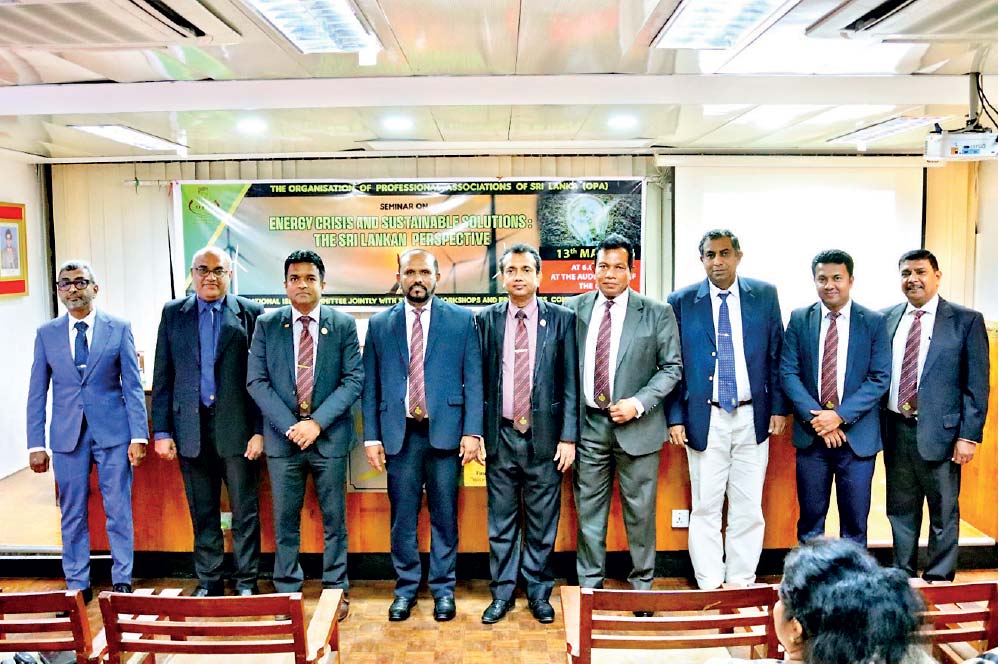
The Organisation of Professional Associations of Sri Lanka (OPA) successfully convened a high-level seminar on “Energy Crisis and Sustainable Solutions: The Sri Lankan Perspective” on 13 May at the OPA Auditorium, under the auspices of the National Issues Committee-(OPA), jointly organised with the Seminars, Workshops and Programs Committee.
A broad cross-section of OPA leadership, including its President, office bearers, past presidents, and members, came together in strong representation, reinforcing a national commitment to institutional strengthening, effective governance, and sustainable development.
In his keynote address, OPA President Jayantha Gallehewa emphasised that Sri Lanka’s energy crisis represents a long-term, multi-dimensional national challenge requiring integrated and sustainable solutions. He highlighted that energy is a fundamental driver of economic growth, social equity, and environmental stewardship, and stressed that the current situation cannot be addressed as a single-sector issue. Instead, it demands coordinated action across policy, planning, consumption behaviour, and national priorities. He further underscored the urgent need to transition away from a linear consumption model towards a more sustainable and efficient energy framework, noting that energy sustainability is no longer optional but an immediate national necessity.
In his introductory remarks, OPA National Issues Committee Vice President and Chairman Bhanu Wijayaratne, highlighted the importance of professional collaboration in addressing national energy challenges and strengthening evidence-based policy dialogue. He emphasised the growing energy demand across multiple sectors in Sri Lanka and the need to meet this rising consumption through technically sound and policy-driven approaches. He further stressed that sustainable energy planning must align with national development priorities, ensuring that technical, industrial, and domestic requirements are effectively balanced through coordinated and forward-looking strategies.
The seminar featured expert contributions from leading professionals in the energy sector, providing comprehensive technical and policy perspectives on Sri Lanka’s evolving energy landscape.
National System Operator Ltd. Director - System Control Eng. Buddhika Samarasekara highlighted that Sri Lanka’s power system is transitioning from a predictable hydro-thermal structure to a dynamic renewable energy–driven grid. He explained emerging operational challenges such as variable solar and wind generation, distributed energy resources, electric vehicle demand, and bidirectional power flows. He further emphasised issues including midday solar surplus, steep evening demand ramps. He also noted that electric mobility introduces significant new demand pressures, particularly evening peak charging, but stressed that smart charging strategies such as time-of-use pricing, demand response, and vehicle-to-grid (V2G) systems can transform EVs into grid-support assets.
He underlined the critical role of grid-scale battery energy storage in ensuring frequency regulation, peak shaving, ramp control, and renewable integration, concluding that the future grid will rely on digital intelligence, flexibility, and storage integration for stability and resilience. LECO General Manager Dr. Narendra De Silva addressed the multi-dimensional nature of Sri Lanka’s national energy crisis, identifying four key dimensions: hydro crisis, driven by variability in water resources; fuel crisis, arising from heavy dependence on imported fossil fuels; energy transition-related crisis, reflecting the structural and operational challenges of shifting toward renewable-based systems; and an entropic crisis, associated with systemic inefficiencies that impact cost, reliability, and overall supply stability. He further outlined the current energy mix comprising coal, hydro, thermal, and renewable sources, and emphasised the urgent need to reduce dependency on imported energy commodities while improving system efficiency and strengthening national energy security. He noted that, despite current constraints, the crisis presents a strategic opportunity for reform, innovation, and long-term sustainable growth through coordinated policy action, technological advancement, and improved energy governance.
Sustainable Energy Authority former Director General Eng. Harsha Wickramasinghe presented insights into renewable energy development in Sri Lanka, noting the rapid expansion of solar energy and the increasing contribution of small hydro systems. He highlighted that New Renewable Energy reached 2,060 GWh by end-2022, contributing 11.9% of total generation, with approximately 75,000 rooftop solar systems adding about 1,400 MW to the grid. He emphasised the importance of energy diversification, efficiency improvement, environmental protection, and the development of indigenous energy technologies, while stressing the need to move away from imported fossil fuels toward locally available renewable resources.
The session was further enriched through structured technical moderation and an interactive question-and-answer segment led by OPA Seminars, Workshops and Programs Committee Vice President and Chairman Eng. Chamil Edirimuni, fostering in-depth technical discussion and stakeholder engagement.
The proceedings were compered by NIC Committee Member B.A.H.S. Preena, and the seminar concluded on a high note, marking a significant contribution to the national discourse on energy sustainability, system resilience, and the future direction of Sri Lanka’s Energy sector.




