Wednesday Aug 26, 2026
Wednesday Aug 26, 2026
Monday, 6 April 2026 03:58 - - {{hitsCtrl.values.hits}}
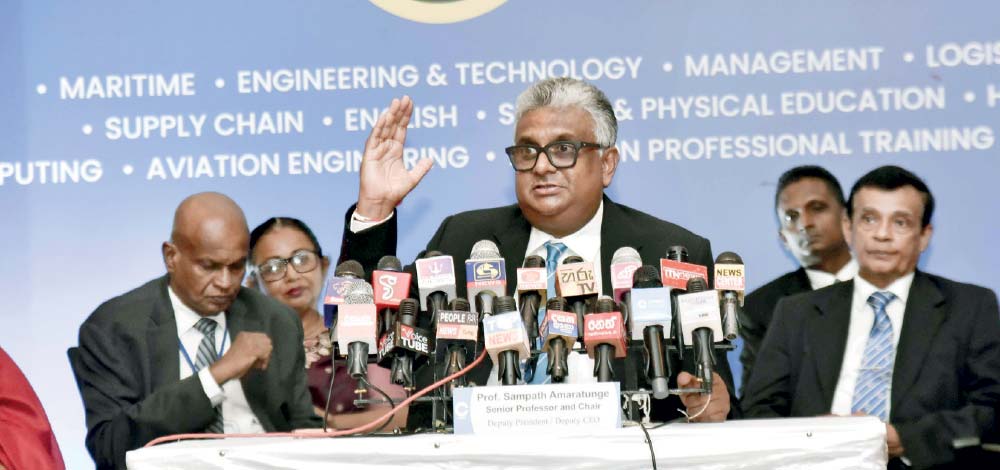
CINEC Campus Deputy President and Deputy CEO Prof. Sampath Amaratunga addressing the media
By Safna Malik
CINEC Campus is hosting its Open Week at the Malabe branch from 4 to 11 April, between 9 a.m..and 4 p.m. A walk-through of the campus provides an overview of available study options and insight into student life at CINEC. This week-long event offers an opportunity to network with experts regarding academic pathways and career options.
CINEC Campus Deputy Chairman and Deputy CEO, Senior Professor Sampath Amaratunge, said the initiative is designed to give students and parents access to academic information in one place, allowing them to explore study options and career pathways before making decisions. He noted that the April period is suitable as students and families are generally more available during this time.
According to Prof. Amaratunge, obtaining even three simple (S) passes at the A/L examination is a significant achievement, and the institution provides structured pathways for such students to pursue higher education. He added that alternative foundation routes are also available for those who do not meet direct entry requirements.
CINEC Campus offers more than 250 programs, including certificates, diplomas, higher diplomas, undergraduate degrees, and postgraduate degrees across eight faculties and three departments. These programs cover areas such as Maritime Studies, Engineering and Technology, Management, Logistics, Supply Chain, Marketing, Tourism and Hospitality, Law, Education, Health Sciences, Information Technology, Chemistry, Aviation, and Finance.
Established in 1990, CINEC Campus operates as one of Sri Lanka’s largest non-state higher education institutions. The institution follows an academic model that combines theoretical learning with industry exposure, with the aim of producing graduates who are prepared for employment.
He said CINEC focuses on maintaining academic standards while also ensuring practical relevance. He added that more than 20,000 students enroll annually across various programs, reflecting sustained demand for its qualifications.
The campus is equipped with lecture halls, laboratories, technical workshops, simulation facilities, and student support services. Dormitory facilities are available for approximately 280 students, while Malabe and surrounding areas offer a range of private accommodation options for students.
Prof. Amaratunge also stated that the CINEC does not impose hidden or unnecessary charges and maintains a fee structure that is comparatively accessible. He noted that installment payment options, bank loan assistance, and scholarships are available subject to conditions.
Beyond academic qualifications, CINEC has introduced the “Beyond a Graduate” program, which is funded through a portion of institutional overall profit and provided free of charge to students. He explained that the program focuses on English language skills, technology, social behaviour, and professional conduct, and awards an additional certificate upon completion. He added that this initiative is intended to support both personal and professional development.
He further stated that not all programs carry international university recognition, although selected courses maintain such links depending on program structure and approvals. The institution also aims to contribute to foreign exchange earnings through its education services.
Prof. Amaratunge said the long-term objective is to develop skilled professionals who can contribute to the national economy while also creating value in international markets. He noted that the institution focuses on building strong graduates capable of taking up roles in global environments.
Dean of the Faculty of Maritime Sciences, Captain K.D.A.P. Sedrick, also outlined the cadet training program conducted at the campus. He said the program is designed for students seeking careers at sea.
He explained that the cadet training program is a gateway to high-earning careers at sea that can range between US $ 3,000 to 4,000 per month. The career path allows students to eventually qualify as ship captains, offering immense job satisfaction and global travel.
He noted the program focuses on discipline, decision-making, and global exposure through maritime careers. Due to a current lack of awareness regarding these opportunities, female representation from Sri Lanka remains low. Consequently, the faculty is actively encouraging greater participation of female students in maritime studies to address this gap.
The Faculty of Management and Social Sciences offers degree programs including International Transportation Management and Logistics, Logistics and Transportation, Supply Chain Management, Tourism and Hospitality Management, Human Resource Management, Business Administration, Marketing, Banking and Finance, and Accounting. These programs are conducted over four years, including an internship component.
Students study core subjects such as Mathematics, Economics, English, Accounting, Information Technology, Statistics, Marketing, and Human Resource Management, along with specialised subjects related to their chosen field. Academic activities include lectures, field visits, seminars, workshops, and group projects.
Assessment methods include individual and group assignments, presentations, and semester examinations. The programs follow standards approved by local regulatory authorities, with some maintaining links to international institutions depending on specific arrangements.
Admission is based on GCE Advanced Level or equivalent qualifications recognised by the University Grants Commission, with a minimum of three passes in a single sitting required for direct entry. Alternative foundation programs are available for students who do not meet these requirements. Pending results may also be considered subject to faculty approval.
The CINEC stated that it offers multiple pathways for students from different academic backgrounds, including progression through diploma and foundation routes. While international transfer depends on the receiving institution’s criteria, the programs are government-approved and designed to be completed within Sri Lanka.
Academic support is provided through module coordinators, program coordinators, and heads of departments. The FMSS Quality Circle also serves as a formal forum where student representatives can raise concerns and provide feedback to the administration.
He reveals that CINEC Campus maintains quality management standards under ISO 9001:2015 certification. The institution states that its lecturers are qualified with postgraduate degrees and industry experience.
The campus also operates under core institutional values of wisdom, integrity, discipline, and competence. Facilities include classrooms, laboratories, technical workshops, simulation systems, and student amenities such as residential facilities, cafeteria, gymnasium, and swimming pool.
CINEC Campus operates branches in Nugegoda, Jaffna, and Trincomalee, expanding access to higher education across different regions. The institution also maintains maritime training facilities internationally in Fiji and the Seychelles.
CINEC future plans include a dedicated business school in Dehiwala offering UK-aligned MBA courses. This development reflects the institutional strategy to increase postgraduate education options.
The Open Week provides students and parents with an opportunity to explore academic programs, financial options, and accommodation facilities in one setting. Staff from admissions and academic departments are available throughout the week to provide guidance on course selection, entry requirements, and program structure.
Pic by Upul Abayasekara



