Saturday Jul 04, 2026
Saturday Jul 04, 2026
Thursday, 23 April 2026 03:54 - - {{hitsCtrl.values.hits}}
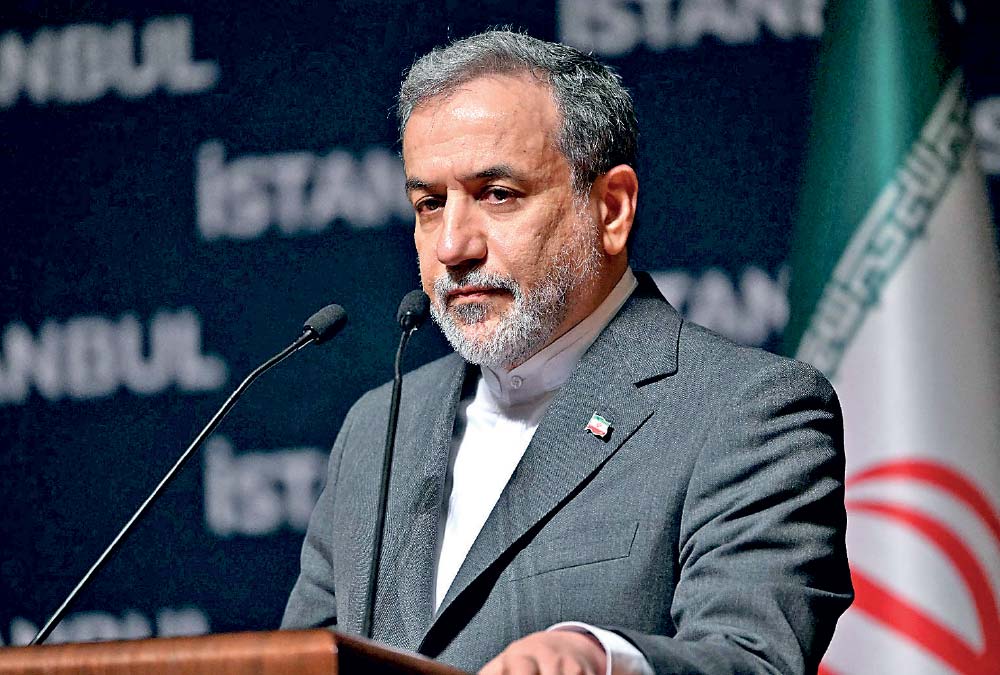
Iran’s diplomatic superstar Abbas Araghchi: world’s most admired Foreign Minister?
 India completely abdicated a diplomatic role during the ongoing crisis in West Asia. Foreign Minister Jaishankar remains silent and invisible. Prime Minister Modi (literally) embraced the US-Israel axis, hugging Israeli Prime Minister Netanyahu in the Knesset. India’s rival Pakistan has earned respect and gratitude for its historic and valiant peace efforts. The Anura administration has put all its eggs in one basket, departing from the traditional Sri Lankan diplomacy of close, ‘ambidextrous’ friendship with India and Pakistan
 Blowing a hole in a cargo ship, boarding and seizing it on the eve of expected negotiations with an adversary, isn’t helpful if anyone seriously desires a negotiated peace. But that’s what the US Navy did, as Islamabad readied to host round-2 of negotiations.
My puzzlement dissipates when I recall CENTCOM chief Admiral Brad Cooper publicly praise the partnership with Israel at a recent Pentagon presser flanked by Pete Hegseth and Gen Dan Caine, cryptically saying “we’ve asked Israel to be ready”.
President Trump’s threat to “bomb Iran back to the Stone Age” wasn’t original. When the US began bombing North Vietnam in 1965, US Air Force chief General Curtis Le May declared that the goal was to “bomb ‘em back to the Stone Age”. In 1975, the US withdrew in defeat and disgrace from Vietnam.
Victory in war is defined by one side successfully imposing its will upon the other. Defeat of the adversary is either complete destruction of its fighting forces or their submission to the will of the victor. History’s most formidable military machine, the USA and its powerful partner Israel have been manifestly unable to make Iran submit to its will.
Meanwhile Israel been unable to make Hezbollah or Hamas yield, or to crush either. Hezbollah has recovered its mettle as a fighting force and its resistance role has grown in public legitimacy beyond Lebanon’s Shia majority.
Chairman US Joint Chiefs Gen. Dan Caine declared that the US Navy will be active in the Pacific, interdicting ships to and from Iranian ports. Will this include Chinese ships?
The totality of three wars in the Middle East and Europe (US-Israel attacking Iran, Israel invading Lebanon, Russia-Ukraine) would have been unthinkable in their synchronicity a few years back. They confirm the irrationality which dominates the two major power-centres of the West: US and EU/UK
Anura’s abject alignment
In a move of enormous geopolitical and history-making consequence, our neighbour India has readied to make itself a shareholder of this island’s citizenry and voting population, by deciding to fast-track the grant of Overseas Citizen of India (OCI) cards to Sri Lankan citizens, as in Mauritius. 1.5 million Tamils of Indian origin are expected to obtain such status, with 500,000 applying immediately.
‘…Tamil leaders said the decision, which New Delhi unveiled as part of a larger bilateral package, would greatly expand India’s strategic footprint in Sri Lanka, with tens of thousands receiving OCI status across 12 districts, including Nuwara Eliya, Kandy, Badulla, and the capital, Colombo…’
(India Expands Footprint in Sri Lanka as Radhakrishnan Announces OCI Plan for Tamils)
Have our President and Government agreed to this and if so, why not disclose it publicly? If not, is such a unilateral measure of the most major consequences legal or legitimate? Shouldn’t this be debated in Parliament and a broad, multiparty national consensus arrived at?
India completely abdicated a diplomatic role during the ongoing crisis in West Asia. Foreign Minister Jaishankar remains silent and invisible. Prime Minister Modi (literally) embraced the US-Israel axis, hugging Israeli Prime Minister Netanyahu in the Knesset. India’s rival Pakistan has earned respect and gratitude for its historic and valiant peace efforts.
The Anura administration has put all its eggs in one basket, departing from the traditional Sri Lankan diplomacy of close, ‘ambidextrous’ friendship with India and Pakistan.
Sri Lanka has just allowed Colombo Dockyard to be acquired by an Indian company which is no mere corporate entity but is openly and officially part of India’s Defence Ministry.
‘Mazagon Dock Shipbuilders Limited (MDL), India's Defence Public Sector Undertaking under the Ministry of Defence, Government of India, announces that Colombo Dockyard PLC (CDPLC), Sri Lanka's largest shipyard, has become a subsidiary of MDL following completion of the acquisition of a controlling 51% stake. MDL's total investment is valued at $ 26.8 million. This is MDL's first international acquisition and a transformative step aligned with the Maritime Amrit Kaal Vision 2047.
The Board of CDPLC has been reconstituted with MDL nominees…’
(https://x.com/i/status/2042977780984614958)
India Today reiterates the importance of the deal:
‘* Historical Milestone: This marks the first time an Indian shipyard has acquired a controlling interest in an overseas shipbuilding and repair facility.
* Geopolitical Significance: This move is a centrepiece of India’s "Maritime Amrit Kaal Vision 2047," aimed at expanding India's strategic footprint in the Indian Ocean. By controlling Sri Lanka's largest shipyard—located within the Port of Colombo—India gains a critical hub for ship repair and maintenance along major global shipping routes.’
(https://youtu.be/wdEH_5B1NPU?si=YSm35Yb2ZwdRu8hM)
Unsatiated by that acquisition, India seeks to accelerate the Trincomalee energy hub project, which includes an oil pipe line running from Trincomalee to Tamil Nadu.
‘The project to transform Trincomalee into a major energy hub in South Asia with India’s cooperation should be completed expeditiously, Indian Foreign Secretary Vikram Misri has stressed. He said this while briefing the media on the two-day official visit of Indian Vice President C.P. Radhakrishnan. He said that the visit provided an opportunity to highlight the strategic importance of the project to the local authorities…Under the first phase, an oil pipeline is to be constructed between South India and Trincomalee and an oil tank project is to be implemented for oil storage.’
(India renews interest in Trincomalee oil tankers. - Sri Lanka News)
Entering this web of relationships including with the defence industries, indeed the Defence Ministry, of neighbouring India which has had armed conflict with two powerful Asian neighbours since 2020 (China, Pakistan), involves unforgivable strategic blunders:
 Tilting to one friend over and above two others.
Risking Sri Lankan locations/facilities being placed on target lists.
Iran’s retaliatory strikes on US targets in the Gulf states should surely teach us that latter reality.
During the decades of the Cold War, no Ceylonese/Sri Lankan Government entered into strategic entanglements with Cold War implications despite their own ideological sympathies and potential financial/economic benefits.
Consider this valuable recollection by Sunday Times columnist Neville de Silva, my paternal uncle, who was quite close to the UNP unlike his oldest brother Mervyn.
‘…In 1967, when some Southeast Asian countries were preparing to set up a regional organisation during the Vietnam War, Malaysian Prime Minister Tunku Abdul Rahman invited Prime Minister Senanayake to join what they were hoping to begin, an Association of South East Asian Nations (ASEAN). Mr Senanayake was on an official visit to Kuala Lumpur when Tunku Rahman offered Ceylon a place in ASEAN. Mr Senanayake left without committing himself.
When he returned to Colombo, I asked him at a press briefing why he turned down a founder membership in ASEAN. His immediate response was that they should think it over.
On the several occasions I accompanied Mr Senanayake on his agricultural tours across the country, I used to keep harking back to the ASEAN story. One evening…in quite a candid response, Prime Minister Senanayake said that had ASEAN been a genuine economic organisation, he would have had little hesitation in accepting the offer.
But to Dudley Senanayake, who was quite an astute student of international affairs, ASEAN was created as a bulwark against the feared expansion of Chinese communism in Asia. Since it was very much an American-sponsored organisation and he did not want any role in it.
Here was a prime minister from a pro-Western political party running the country but quite averse to lending itself to American diktats or policies, with the region already divided on geostrategic interests while the two superpowers were already involved in war-torn Southeast Asia and the Pacific…’
Anura and the JVP-NPP are playing a role objectively more imperialist-aligned, reactionary and right-wing than any leader or ruling party since 1948.
Postwar, the ultranationalist lobby derailed Mahinda Rajapaksa’s successful wartime formula ‘India-China-Global South-OIC’ (Organization of Islamic Cooperation), and aggressively pushed through a unilateralist foreign policy orientation mimicking Israel and hawkish US Republican leaders. By mid-2018, with the ascendant Gotabaya candidacy, ultranationalism had embedded itself in the SLPP
West’s irrationality, volatility
The totality of three wars in the Middle East and Europe (US-Israel attacking Iran, Israel invading Lebanon, Russia-Ukraine) would have been unthinkable in their synchronicity a few years back.
They confirm the irrationality which dominates the two major power-centres of the West: US and EU/UK.
Each power-centre is rational about the war the other is engaged in, but not its own war. Each has abandoned the realism that used to govern its own foreign and security policy in its current theatre of military engagement/involvement.
The US President seriously wanted to annex Greenland, having first boorishly propositioned Canada. He threatens to—and thinks he can—eliminate Iran’s civilization of several thousand years. However, Trump is far more rational on Russia-Ukraine.
Europe was a greater votary of détente with Soviet Russia (e.g., Willy Brandt’s ‘Ostpolitik’) than the US—because Europe shared a continent with a gargantuan Russia which also was a nuclear superpower. The tragic folly of the USSR’s suicide has truncated the power of Russia, but not in terms of comparative size and nuclear weaponry. And yet, NATO-EU leaders urge that the USA give Ukraine long-range Tomahawk missiles which can strike deep into Russia with a view to defeating it, completely ignoring Moscow’s new nuclear doctrine which leaves open the option of a first-strike if the Russian state perceives itself existentially threatened even by non-nuclear military aggression.
However, the NATO-EU positions on the US-Israel war on Iran and Israel’s attack on Lebanon are more rational than those of the USA.
The White House will have a more rational occupant in 2028, but two problems will remain for the world:
(a) The Democrats are more hawkish on Russia/Ukraine.
(b) After four years, the US could elect another ‘Trumpian’—even Pete Hegseth.
The irrationality of the West is also ruining Western/Northern societies. Colossal and needless military expenditure by the US on the Iran war and subsidizing Israel’s many simultaneous or rapidly segueing wars is hollowing out US social security and society itself. Similarly, NATO and the EU’s massive subsidizing of Ukraine’s war effort beyond sustaining defensive sufficiency and negotiating a realistic peace based on territorial compromise, is eroding European and British social spending.
Sri Lanka’s national interest
The trauma and crisis of the collective West in the face of the rise of China, the reassertion of Russia and multipolarity in general, is manifested in convulsions or cycles of aggressive irrationality which encompass the military-strategic (high-intensity wars) and economic realms (arbitrary tariffs, naval blockades of ports).
It is in Sri Lanka’s National Interest to diversify our dependence, reducing our overreliance on the West—our vulnerability to the Western vortex— by pivoting to Eurasia with Asia it is core. Eurasia denotes Asia plus Russia (the planet’s only Eurasian country). This zone manifests far greater policy stability and reliability. No Eurasian power is likely to impose legislatively-driven unilateral sanctions or arbitrary tariffs on us.
Sri Lanka’s external relations must be:
Global in perspective, diplomatic presence and participation.
Multidirectional and ‘multi-vector’ (Yevgeni Primakov) in outreach.
Asia-centric in focus, policy and priorities.
Balanced as between power-centres.
An Asia-centric policy must grasp Asia’s overarching interest; its interest taken as a whole, a totality, avoiding alignment with this or that Great Power in the competition within Asia.
UNP/SJB foreign policy
The SJB’s defence of the National Interest is tepid, not robust; a tepidity transmitted from the ‘parent party’ that kept the post-Premadasa UNP from ever being elected to the Presidency and figured in the UNP’s electoral erosion under Ranil Wickremesinghe which never gave it consecutive parliamentary majorities—only two terms 15 years apart.
The Ranil-Mangala UNP’s UNHRC Geneva 2015 ‘co-sponsorship’ was a contributory factor in:
The fissure with President Sirisena.
The massive shift of the SLFP parliamentary group to Mahinda Rajapaksa.
The crack-up of the Yahapalanaya coalition government.
The co-governing UNP’s collapse to 20% at the February 2018 local authorities’ election.
Gotabaya’s 2019 victory.
The SLPP’s 2020 landslide.
Nonetheless, the SJB’s neoliberal Rightists (e.g., Harsha, Eran) still follow Mangala Samaraweera’s foreign policy and remain so acutely allergic to ‘National Independence’ and ‘National Sovereignty’ that they cannot utter the terms.
Mahinda Rajapaksa was most amenable to both Kerry-Lugar and CR de Silva Reports which would have got our armed forces off the hook and Sri Lanka free and clear. But the bloc of upper bureaucracy and ultranationalist military officers and politicians rallying around Defence Secretary Gotabaya Rajapaksa was obdurately obstructionist
SLPP and MR’s foreign policy
When he posted me to Geneva, President Mahinda Rajapaksa instructed me to prioritise course-correcting the deviation by Mangala Samaraweera whom he had nudged out as Foreign Minister. Mangala had damaged Sri Lanka’s traditionally strong ties with Pakistan and Iran especially at the Conference on Disarmament (CD) in Geneva—and the leaders of both countries had protested to MR. As Ambassador to the CD as well, I rectified the error.
Postwar, the ultranationalist lobby derailed Mahinda Rajapaksa’s successful wartime formula ‘India-China-Global South-OIC’ (Organization of Islamic Cooperation), and aggressively pushed through a unilateralist foreign policy orientation mimicking Israel and hawkish US Republican leaders.
By mid-2018, with the ascendant Gotabaya candidacy, ultranationalism had embedded itself in the SLPP. Chatting to me the morning after the Viyath Maga-2 Shangri-la event, an appalled Mahinda Rajapaksa scornfully dismissed an expatriate Israeli-proxy academic and other speakers who had strayed into foreign policy. The ideological shift and policy pivot signalled by that event and the internal power-grab it prefigured, almost certainly helped motivate MR to enter the last-ditch, late-2018 centrist realignment with President Maithripala Sirisena.
In late-2009, the bipartisan Kerry-Lugar Report of the US Senate Foreign Relations Committee offered a trade-off: US support for post-war Sri Lanka and reduced pressure on wartime accountability, in exchange for devolution through the implementation of the 13th Amendment. In 2011, the Lessons Learnt report of the CR de Silva Commission presented the most reasonable proposals on accountability.
Mahinda Rajapaksa was most amenable to both Kerry-Lugar and CR de Silva Reports which would have got our armed forces off the hook and Sri Lanka free and clear. But the bloc of upper bureaucracy and ultranationalist military officers and politicians rallying around Defence Secretary Gotabaya Rajapaksa was obdurately obstructionist. They suffered from the delusion that defeating the separatist Tigers also enabled them to roll-back the 13th Amendment which emanated from India which they certainly hadn’t defeated in any war.
Today AKD has slipped out of the 13th Amendment by the only exit possible: the treacherous folly of ceding India strategic real estate on this small island.
Attitudes that alienated the Christian and Muslim minorities in Sri Lanka were introduced and practiced through the decade 2012-2022, impervious to the negative impact on the global Christian community of 2.6 billion people (1.4 billion Catholics) and Muslim community of 2 billion.
Effective Sri Lankan post-war diplomacy became increasingly dysfunctional. Chief incumbents and hawkish, insular laity of Buddhist temples formed lobbies and pressure groups which sought and often had influence on the Embassies, Defence attaches and diplomats—thanks to their access to the Defence Secretary in Colombo. But they had no influence and soft power in the societies of the countries they chose to live in.
As Geneva voting patterns showed, the dominance in foreign policy and diplomacy of ultranationalist ideological discourse eroded support in Sri Lanka’s international home constituency—the Global South, including Asia itself.
Having won decisively in 2009 on my watch, Sri Lanka shifted strategy and discourse, losing in 2012, 2013, 2014, 2021, 2022 in a UNHRC which had a built-in majority for the Asia-Pacific, Africa and Latin America.
Sri Lanka lost friends—there were critical OIC statements—and gained nothing, except an ugly profile.
Namal must re-locate the SLPP on a continuum with the progressive 1956 foreign policy tradition, especially represented by Lakshman Kadirgamar and the wartime MR presidency, rather than any aspirant local Pete Hegseth. If he fails to do so, a future SLPP Government will make Sri Lanka a sitting duck for war crimes charges under universal jurisdiction, unilateral economic sanctions, and separatism through foreign patronage.




