Saturday Jul 04, 2026
Saturday Jul 04, 2026
Thursday, 21 May 2026 04:44 - - {{hitsCtrl.values.hits}}
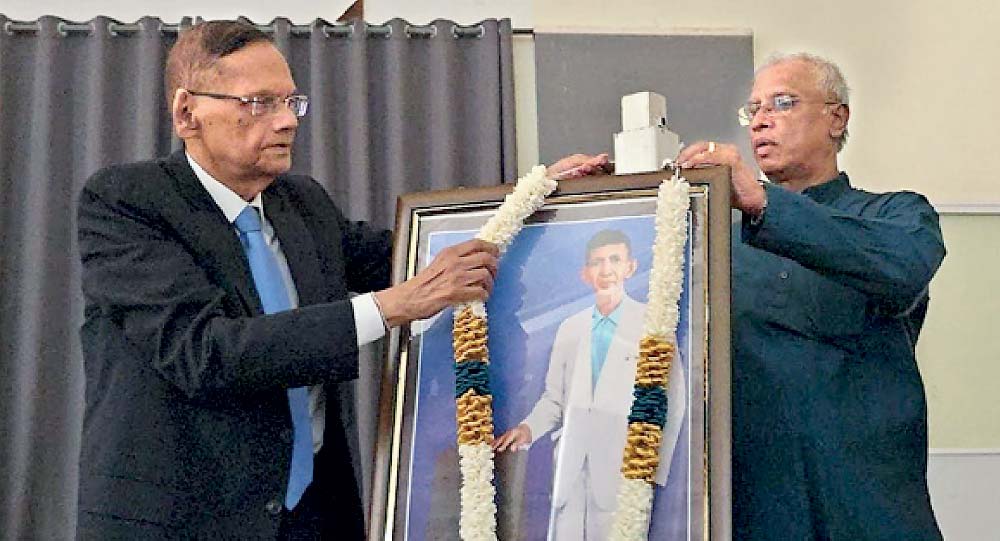
Prof. Peiris’ scholarly S.J.V. Chelvanayakam memorial lecture deserves critical scrutiny
 Was there another alternative; an intermediate reformist solution? Yes, absolutely. It is this fact that makes the leap to federalism in 1949 by S.J.V. Chelvanayakam, and its endorsement and mimicry decades later by President Chandrika Kumaratunga and Prime Minister Ranil Wickremesinghe, a grave political blunder, foredoomed to be a failure and tragic farce
 Another ‘great’ is gone. DBS Jeyaraj, the outstanding, strongly independent-minded journalist whose work was referred to by Mervyn de Silva as “indispensable reading” has died at 72.
Like Mervyn himself, DBS’ last piece (reviewing Mr Thanabalasingham’s memoirs as a journalist) appeared in print as the news of his death began to break.
Throughout the war and postwar decades, readers relied on him for ‘the real story’.
David Jeyaraj wrote the most solid ‘deep backgrounders’, the inside story. Nobody in mainstream English-language Sri Lankan journalism over the last four decades pieced together and produced a political or military story more factually knowledgeable and readable than he did.
An anthology of his best writings should be published as a handbook of contemporary Lankan history and textbook for young journalists.
Chelvanayakam revaluated
This year’s S.J.V. Chelvanayakam memorial oration by Prof. G.L. Peiris is a mandatory text. Following the methodological recommendation of the great Marxist cultural critic Walter Benjamin, I shall ‘brush against the grain’ of Prof. Peiris’ narrative and argumentation, to suggest another view of Chelvanayakam, Tamil politics, negotiations with the Tigers, and our postcolonial political history, all of which illumine and have implications for what I define as the foundational, fundamental problem of Lankan politics: constructing and defending an independent, sovereign, united, democratic, republican nation-State coextensive with the natural geographic configuration and materiality of this island.
My counternarrative takes us back 75-80 years, to 1949-1951. This period encompasses the births of two political projects:
 The founding by S.J.V. Chelvanayakam of the Federal Party (FP in English, ITAK in Tamil) in 1949, followed by the first national convention of the FP/ITAK in 1951.
The founding of the Sri Lanka Freedom Party (SLFP) by S.W.R.D. Bandaranaike.
Chelvanayakam opted in December 1949 for federalism. There was considerable ambiguity in the Tamil nomenclature of the Federal Party. It was Ilankai Tamil Arasu Kadchi (ITAK) which could be rendered as Ceylon Tamil State Party or Ceylon Tamil Kingdom Party.
Prof. Peiris sums up the cardinal significance of the federalist shift in 1949-1951:
‘…The formation of the Federal Party was a turning point…The party embarked on a journey which marked a radical departure from the conventional thinking of the past. This was plain from the text of seven resolutions adopted at the national convention of the party held in Trincomalee in April 1951. The foundation of these resolutions was the call to establish a Tamil State within the Union of Ceylon, and the uncompromising assertion that no other solution was feasible.
The path was now becoming manifest. The demand up to now had been for substantial power sharing within a unitary State. This was now giving way to a strident demand for the emergence of a federal structure, destined to be expanded in the fullness of time to advocacy of secession…’ (https://www.jaffnamonitor.com/untitled-draft-4/)
Prof. Peiris says ‘the demand up to now had been for substantial power sharing within a unitary State.’ Insofar as he means G.G. Ponnambalam’s 50:50 demand, dismissed by the Soulbury Commission with the famous statement to the effect that it had no power to turn a majority into a minority or vice versa, he is correct. However, it must be emphasised that there was no demand during the Donoughmore or Soulbury Commissions or after 1948, for ‘substantial power sharing within a unitary State’ in the sense that it is universally meant: territorial autonomy within a unitary system. Instead, Tamil politics took an early, direct leap to federalism with “the uncompromising assertion that no other solution was feasible”.
‘Substantial power sharing within a unitary State’ came only post-1956, in the form of the Bandaranaike-Chelvanayakam Pact and Regional Councils in 1957, fully eight years after the shift to federalism in 1949, and not as a preliminary demand. In 1949-1951 Chelvanayakam’s call was not for Regional Councils within a unitary State.
|
D.B.S. Jeyaraj, a great, indispensable journalist and courageous chronicler died at 72
|
For its part, the SLFP’s founding document of 1951 mentioned ‘social democracy’ but more importantly, there was no sign of ‘Sinhala Only’. The SLFP’s election manifesto of 1952 called for ‘the national languages’ (‘jathika bhaashaa’) – note the plural—to be made State languages (‘Rajya bhaasahha’). While Chelvanayakam posited a two-nation theory, doubtless echoing Jinnah, Bandaranaike posited a ‘two languages’ theory. In 1951, SWRD was far more moderate and enlightened than SJV.
Prof. Nalin de Silva, whose views and mine were antipodal from 1984 (as observed and commented on in print by Ajith Samaranayake), made an important and valid observation though. He characterised S.W.R.D. Bandaranaike as basically a Westernised liberal who founded a liberal-democratic party, the SLFP, which pivoted to Sinhala-Buddhist nationalism and ‘Sinhala Only’ in 1955 under pressure from the Sinhala-Buddhist civil society current fathered by Anagarika Dharmapala and with the General Election of 1956 on the horizon.
Certainly, the Marxist LSSP and CP would not have invited Bandaranaike to chair the public rally on Galle Face Green which kicked-off the August 1953 Hartal (uprising), had he espoused ‘Sinhala Only’ or any variant of Sinhala-Buddhist hegemonism.
Chelvanayakam opted in December 1949 for federalism. There was considerable ambiguity in the Tamil nomenclature of the Federal Party. It was Ilankai Tamil Arasu Kadchi (ITAK) which could be rendered as Ceylon Tamil State Party or Ceylon Tamil Kingdom Party
Premature federalism
The conventional narrative is that S.J.V. Chelvanayakam reacted to D.S. Senanayake’s disenfranchisement of the hill-country Tamils (1948), prophetically foreseeing Sinhala majoritarian discrimination against all Tamils on the island and therefore shifting the paradigm to irreducible political space outside the unitary State, i.e., federalism. This narrative needs questioning and amendment.
Firstly, the context has to be recreated (as Prof. Peiris has, though my interpretation differs). The Soulbury Commission had ruled out both 50:50 and federalism. The Commission was not only the most neutral of umpires—far more so than Norway in the Eelam War years—it also represented the ethos of the most progressive Government in the Western liberal-democratic world at the time: the postwar, post-Churchill, Labour Government of Clement Attlee.
While correct in its double rejection of 50:50 and federalism, the Soulbury Commission must also be commended for refraining from a ‘hard unitarian’ formulation, i.e., the State was by no means federal and was indeed unitary, but that was not inscribed as definition, i.e., not rubbed-in, in the Soulbury Constitution of Independent Ceylon, unlike in the Republican Constitution of 1972.
D.S. Senanayake reinforced the Soulbury Commission’s double rejection with a third—this time directed against narrow Sinhala nationalism. He flatly refused the demands articulated by Prof. G.P. Malalasekara of the All-Ceylon Buddhist Congress, accompanied by a delegation from the Buddhist Students’ Union, for official dominant status for the Sinhala language and Buddhism. As Prof K.M. de Silva recounts, D.S. Senanayake pointedly said that as a patriotic Sinhalese and Buddhist who has done much for both, he is keenly aware that the Buddhist Sinhalese, though a majority on the island, constitute a minority in the region. If the State officially emphasises its Sinhala-Buddhist character, entrenching majority privilege, the minorities would emphasise their identities too—and they vastly outnumber the Buddhist Sinhalese on the larger regional canvas. A common Ceylonese identity best served the long-term interests of the Sinhala-Buddhists.
True, the disenfranchisement of the hill-country Tamils in 1948 was discriminatory but the response to every act of discrimination against a minority within a State is not met globally and universally by a response that rejects the existing form of the State itself, which is what S.J.V. Chelvanayakam did as early as 1949-1951.
Was there another alternative; an intermediate reformist solution? Yes, absolutely. It is this fact that makes the leap to federalism in 1949 by S.J.V. Chelvanayakam, and its endorsement and mimicry decades later by President Chandrika Kumaratunga and Prime Minister Ranil Wickremesinghe, a grave political blunder, foredoomed to be a failure and tragic farce.
Submitting a Memorandum in November 1938 to the Advisory Committee on Imperial Questions of the Labour Party on the Demands for Reform of the Ceylon Constitution, Leonard Woolf (famously, author of ‘The Village in The Jungle’) urged that:
‘Consideration should also be given to the possibility of ensuring a large measure of devolution or even of introducing a federal system on the Swiss model…’
(Letters of Leonard Woolf, edited by Frederic Spotts, Wiedenfeld & Nicolson, London 1989, p 417).
Woolf, a progressive liberal sympathetic to socialism, intimately familiar with Ceylon and the Sinhalese especially of the South while also sensitive to Tamil apprehensions, saw two options, not one, “a large measure of devolution” being the first and federalism the second (“or even of”). To my mind, history has proven the first option the sole viable one.
In skipping over “a large measure of devolution” within the existing Soulbury Constitution’s unitary framework, and vaulting to a federal demand based on ethnonationalist claims including self-determination (with an ambiguous Tamil rendition suggestive of duplicity and open-endedness), S.J.V. Chelvanayakam and the Federal Party provoked a hardening of Sinhala-Buddhist majoritarian nationalism which transformed the State into a hegemonistic one, beginning in 1956, peaking in 1972, reaffirmed in 1978. Its structural reform came a decade later.
Logically, S.J.V. Chelvanayakam should have played the federal card only if and when the State was oppressively unitary and structurally discriminatory, but that wasn’t the character of the State at Independence.
The federalist move lacked political and historical legitimacy. The paradigm shift should either have been after Sinhala Only in 1956, or the embedding of the unitary form and the structural dominance of the Sinhala language and the Buddhist religion in the Constitution in 1972. Instead, Chelvanayakam pushed that button in 1949-1951, almost a quarter-century too early. Federalism would have been a legitimate response in 1972, but I’d argue that insistence on the implementation of the Bandaranaike-Chelvanayakam Pact by SWRD’s widow and her leftist allies would have been strategically smarter.
Having escalated to federalism as far back as in 1949-1951, Tamil politics left itself only one more rung on the escalation ladder: secessionism. The Vaddukkodai resolution of May 1976 followed by the election campaign of 1977 sought a mandate for a separate, independent Tamil state (‘Tamil Eelam’).
On an island where there was an overwhelming majority opposed to separation and which had nowhere to fall back but the Indian Ocean, it was a parabolic arc from a ‘cold start’ ethno-federalism in 1949 to the fiery finale of armed Tamil separatism 60 years later at Mullivaikkal 2009.
Woolf, a progressive liberal sympathetic to socialism, intimately familiar with Ceylon and the Sinhalese especially of the South while also sensitive to Tamil apprehensions, saw two options, not one, “a large measure of devolution” being the first and federalism the second (“or even of”). To my mind, history has proven the first option the sole viable one
Federalism and peace negotiations
Prof. Peiris’ lecture makes clear that the 1995-2005 negotiations attempted a grand bargain with the LTTE: a liberal federalism (closer to Canada than India’s quasi-federalism) in exchange for peace.
Why was a teleological federalism the goal of the CBK and Ranil Wickremesinghe efforts? True, there was the factor of historicity since 1949-1951. But there was another (two-fold) reality.
(I)Despite the ferocious military campaign of the LTTE and other separatists, the pressure from Tamil Nadu, and the ‘coercive diplomacy’ of India, the Sinhalese majority refused to accept federalism. A considerable number fought a bloody civil war even against non-federal provincial devolution. Why then did CBK, Ranil and Norway think the Sinhalese would go along with their federalist project?
(II)Prabhakaran and the LTTE had rejected the majority share and chairmanship of an Interim Administration in the North and East which gave them greater control than any federal Chief Minister anywhere. Why did Norway, CBK and RW think that a man who had fought the IPKF and assassinated Nehru’s grandson on Indian soil, would accept a federal solution within a united Sri Lanka?
When it was increasingly obvious that the Grand Bargain was a chimera, why didn’t Colombo fall back on what remained and could be strengthened, the Provincial Council system issuing from the Indo-Sri Lanka Accord, which would at least address and alleviate the Tamil Question, bolster the non-Tiger Tamils, and expand their base?
The main takers for a solution based on the 13th Amendment would have been Douglas Devananda/EPDP and D. Siddharthan/PLOT, because in the Tamil democratic nationalist mainstream, federalism had long degenerated from political formulation to dogmatic adherence, based on the a priori assumption that no solution is available or should be seen to be available, within a unitary state.
When the 13th Amendment was promulgated after years of war and Indian intervention, TULF leader Amirthalingam wrote to Prime Minister Rajiv Gandhi rejecting it on the basis that it was insufficient (despite which he was assassinated a few years later by the LTTE).
Chief Minister Vardarajahperumal’s administration passed a resolution literally as it sat in the Council, protesting the insufficiency of devolution which it had yet to exercise. This was despite the context: President Premadasa was battling a serious threat to State power in Colombo by the JVP which was thriving on Southern antipathy to the Indian presence and the Provincial Councils.
Rejection of serious political reform or negativism from the outset rather than grasping reform as an incremental process, flies in the face of rationality which requires repeated testing, practical experimentation and experience, before rejection.
Post-war federal fantasy
Despite crushing defeat in war, Mr. Sampathan’s ITAK refused in 2011 to regard the 13th Amendment as a framework or baseline of negotiations with a victorious President Mahinda Rajapaksa.
In 2013, newly-elected Chief Minister Wigneswaran declined to work the Provincial Council system because any success would have meant proof that a measure of autonomy can be achieved and improvement made even within a unitary State.
The addiction to the federalist fantasy was so severe that the ITAK sank its coalition partner the Yahapalanaya Government and especially its Wickremesinghe-led UNP component, by openly moving towards a non-unitary new Constitution in 2015-2019.
The federalist flag was unfurled 7 years before ‘Sinhala Only’. As Prof. Peiris (disapprovingly) quotes Sarath Muttetuwegama, a principled young Communist leader of enlightened views and public appeal, declaring in 1971/’72, "Federalism has become something of a dirty word in the southern parts of this country".
Chelvanayakam’s ‘Union of States’ terminology was transposed as a diaphanously disguised ‘union of regions’ by President Kumaratunga into her political package of 1995, dooming it to futility despite her landslide victory at the Presidential election the previous year.
Southern allergy to federalism is comprehensible when one takes into account the conclusion of the doyenne of Indian Lankanologist Prof. Urmila Phadnis who noted in her final book that uniquely in South Asia, the Tamil politics of Sri Lanka aberrantly displays an ‘autonomist-secessionist continuum’.
Symbolising this continuum, the father of Federalism in Tamil politics, S.J.V. Chelvanayakam was also the father of Tamil separatism (the Vaddukkodai Resolution May 1976).
Even in the wake of crushing military defeat, post-war Tamil politics failed to conserve and consolidate the already-achieved triad:
Parliamentary seats which reflect the Tamils’ real demographic weight thanks to Proportional Representation.
A degree of local autonomy through elected Pradeshiya Sabhas and municipalities.
A measure of large-unit self-government/self-administration/autonomy through elected Provincial Councils.
Today the Tamil nationalist movement is in a triangular trap instead.
Armed separatism has been decisively crushed.
Federalism is hopelessly infeasible.
Provincial devolution remains comatose because the AKD administration is as reluctant as the federalist Tamil parties are to accept provincial-level devolution as a solution.
S.J.V. Chelvanayakam absurdly demanded ethno-national federalism within a Ceylon recomposed into a ‘Union of States’, just one year after the country obtained Independence following 450 years of colonialism.
Derided by federal-addicted Tamil parties, Provincial Councils which were the lowest hanging fruit, are now out of reach. The federalist fantasy has run out of road.