Wednesday Sep 30, 2026
Wednesday Sep 30, 2026
Thursday, 11 June 2026 00:35 - - {{hitsCtrl.values.hits}}
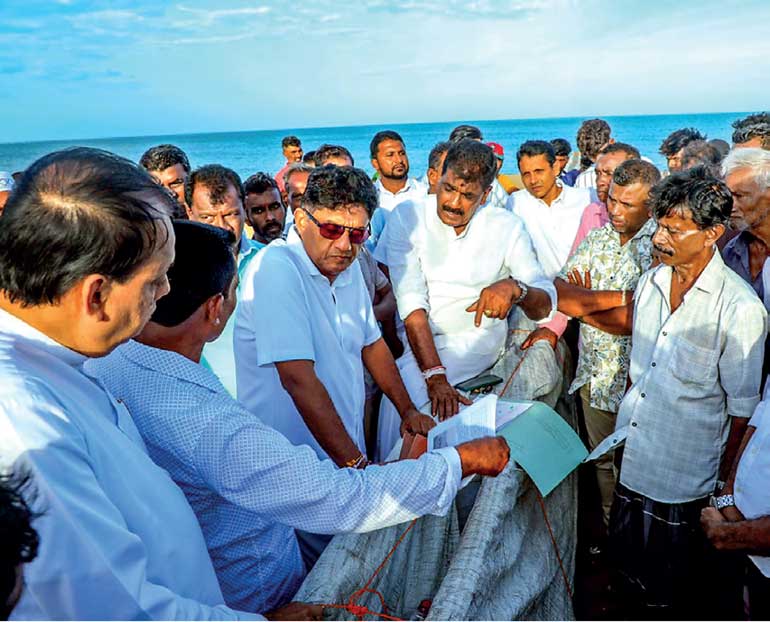
Sajith Premadasa: elite Western education, ‘organic’ popular touch
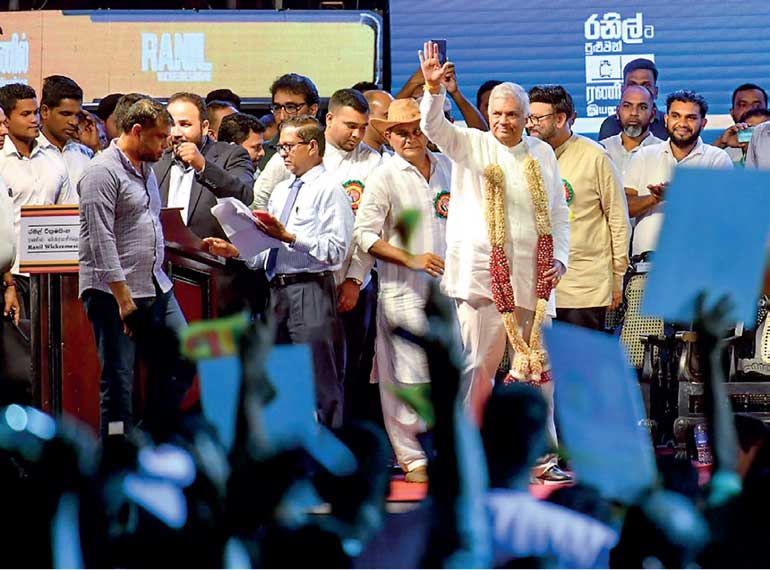
Ranil Wickremesinghe: took his best shot in 2024 and got 20%
 Sajith is the natural leader to appeal to the country’s contemporary and evolving social reality, and rebalance it in power. Where the UNP belongs is not as the ‘head/brain’ of an alliance but precisely as the ‘body’, i.e., at the mass base, where it adds to the vote
– Jesus Christ, in Matthew 9:13 –
 Anura’s JVP-NPP administration will enter history as the one which jailed the highest number of top officers of the war-winning Sri Lankan armed forces.
While Maj-Gen Suresh Sallay or any other suspect must be thoroughly investigated regarding the horrendous Easter Massacre, the written representations about his manifest maltreatment cannot be imaginary or a total lie. They depict a disgrace, which must cease.
Barbarism in wartime is bad enough but in peacetime, it is intolerable. History has shown civility and the JVP as oxymorons; barbarism and the JVP as twins.
Due process and civility must be transparently observed. Failure to do so could have tragic and dangerously destabilising consequences all round. Already, signs of emotional polarisation and anger are manifest.
The voices of Suresh Sallay’s mother, wife and son may come to haunt the ruling party long after it is out of office.
Meanwhile, the SLPP’s Manoj Gamage, lawyer, must know not to be imbecilic enough to confront on TV the Catholic Church and its spokesperson Fr. Cyril Gamini on the Easter Massacre, thereby subtracting Namal Rajapaksa’s and the SLPP’s potential Catholic/Christian vote at an election in which the Sinhala-Buddhist vote will be split at three, maybe four ways—SJB, SLPP, NPP, Sarvajana. Mahinda Rajapaksa maintained the most cordial relations with the Cardinal and the Catholic Church throughout his presidency and political career.
Freakish transplant
The frankly Frankensteinian formula of “Sajith’s body combined with Ranil’s head”, by which its proponent Navin Dissanayake explains he means “Sajith’s mass base and Ranil’s brain”, is getting it horribly wrong.
The SJB broke away from the UNP because of the latter’s serial electoral failure for an exceptionally long period under the leadership of Ranil Wickremesinghe. Logically, a coming together of the SJB with the existing residue of the same UNP under the same leadership, in a formula which implies Ranil’s de facto leadership (‘head’) of an SJB-UNP axis, could well repeat the situation of structural electoral failure that caused the original split.
The slogan ‘ Sajith’s body, Ranil’s head’, reveals that the UNP still cannot get its head around Sajith Premadasa as leader, just as Lalith-Gamini couldn’t really accept Ranasinghe Premadasa as leader. Today’s UNP wants Sajith to function once again as Deputy Leader under Ranil’s leadership. It is a continuation of the UNP elite’s failed attempt to use R. Premadasa to provide the mass base while a member of the UNP elitist old guard provides the ‘head/brains’—guiding ideas and ideology—and thus the leadership.
This formula crashed and burned when the UNP’s traditional ‘head’ i.e., the elite, led the country into two parallel civil wars and a foreign military presence, unforgettably encapsulated in the phrase of Prime Minister Premadasa when accepting the UNP Presidential nomination in October 1988 at the Sugathadasa stadium: “a torch ablaze at both ends”.
UNP General Secretary Ranjan Wijeratne had reported back to President Jayewardene that if the UNP were to avoid political and physical extermination, Premadasa should be the candidate. A lucid realist, Ranjan didn’t advocate a hybrid formula of Premadasa’s ‘body’ i.e., mass base, and Gamini Dissanayake’s or Lalith Athulathmudali’s ‘head’ i.e., brain-power.
Premadasa won, becoming the most authentic non-elite President Sri Lanka has had, qualitatively far surpassing Anura Kumara Dissanayake in substantive progressivism in triple senses:
 Breaking the double-glazed class-caste glass ceiling
Restoring/defending national independence and sovereignty
Launching policies and programs which actually reduced inequality and shifted real income to the have-nots.
With Prabhakaran’s assassination of Premadasa, the social counterrevolution which had erupted in the form of the impeachment conspiracy and been defeated by Premadasa, reappeared and recaptured the UNP. Successor-president D.B. Wijetunga inducted the DUNF consisting of those whose project the impeachment had been. As the LTTE kept killing UNP leaders and suddenly stopped, Ranil Wickremesinghe became the UNP leader and remains so till today, 32 years on.
Under Ranil, De-Premadasaisation of the UNP’s policy and State policy was completed. That caused and corresponded to the UNP’s ‘end of history’ of popular election to the country’s leadership.
Due process and civility must be transparently observed. Failure to do so could have tragic and dangerously destabilising consequences all round. Already, signs of emotional polarisation and anger are manifest. The voices of Suresh Sallay’s mother, wife and son may come to haunt the ruling party long after it is out of office
|
Former Intelligence chief Maj-Gen Suresh Sallay deserves due process, civilised treatment
|
Head examined
Ranil’s ‘head’ that is sought to be grafted onto Sajith’s ‘body/mass base’, is precisely the organ that saw the reduction of the UNP from the island’s largest single party to the pathetic puddle it has been reduced to today.
The last time the UNP was popularly elected to lead the country was in 1988 when Ranasinghe Premadasa won. That’s almost 40 years ago.
The case for the SJB-UNP alliance is based on a single statistic: Sajith got 32%, Ranil 20%—if they had been together they’d have won. Unpack this and it isn’t so simple. Ranil’s 20% came from SLFP-SLPP dissidents/moderates/right-wingers who formed the ‘gas cylinder’. They brought in non-UNP votes. At the Parliamentary election that 20% disintegrated. Thus, the calculation is based on Ranil’s 20% which wasn’t entirely his, and doesn’t exist anymore. The SLFP-SLPP vote will probably go to Namal.
Ranil took his best shot and failed. He ran as incumbent President who had stabilised the economy and ‘saved the country’. He got all of 20% which evaporated for the UNP at the Parliamentary election. Sajith got 32% at the presidential and the SJB 20+% at the parliamentary elections.
It is precisely Ranil’s ‘head’ that kicked-off the economic crisis by resorting massively to the private international money markets. That’s the most intractable core of our foreign debt that we are struggling to pay back. What Mahinda Rajapaksa borrowed, he paid back within his term because the economy on his watch was sufficiently productive to generate the hard currency to do so.
It is also Ranil’s head/brain that was in charge of the country’s economics when the Central Bank Bond scam and attendant drain of resources took place.
Ranil was heading (pun intended) the Yahapalanaya Government’s economics when the UNP decided to halt all Chinese projects (including the Port City) which provided the economy its engine, its dynamism. The ideologically-motivated abandonment racked-up such a huge bill that Ranil had to hock Hambantota Port and its environs for 99 years to China, triggering Indian pressure for equivalent or larger concessions.
Throughout his leadership of the UNP, Ranil’s head/brain took the wrong side of a patriotic war, appeasing the LTTE, and therefore was never popularly elected to the Presidency.
Ranil’s head came up with the over-stuffed legislation in 2017 that has prevented Provincial Council elections being held to this day.
A majority of people just don’t vote for the technocratic economic solution Ranil represents. He was elected to the Prime Ministership twice with a 15-year gap in-between because he was never re-elected even as PM to a second (consecutive) term.
Ranil’s ‘head’ implemented as unelected President, an austerity program so harsh that UN analysts and local researchers characterised it as the most severe in the world. The citizens rewarded him with a mere 20% at the 2024 presidential election—large enough to sabotage Sajith’s challenge to Anura and put the JVP-NPP candidate over the top.
The statistic a realist would always keep an eye on is 20%. In Feb 2000, Sirisena Cooray was interviewed by Krishantha Cooray for Business Today. In that cover story Ranasinghe Premadasa’s right-hand man prophesied that Ranil’s leadership would reduce the UNP from the country’s largest single party to a ceiling of 25% of the vote. While in office the UNP fell to 20% in February 2018 at the local authority’s election and never recovered. That UNP vote was inherited by the successor SJB, which also remains stagnant at 20+%.
An SJB-UNP realignment cannot increase that 20+%, and can only recycle that ‘generic Green’ vote—unless the policies and profile change. But in what direction? Sajith Premadasa scored 42% in November 2019 and 32% in Sept 2024. The SJB and UNP must move more in the direction of Sajith’s progressive-centrist policies than pull Sajith down into their (right/centre-right) orbit.
Dr. Frankenstein-type surgery and suture of Ranil’s head/brain on top of Sajith’s body/mass base is not going to help, because the SJB will have to carry the weight of social memory for everything from wartime appeasement/collaboration, post-war Geneva 2015 ‘co-sponsorship’ treachery, the Central Bank Bond scam, private foreign debt etc.
As for an SJB-UNP bloc, Mr. Wickremesinghe cannot expect a status similar to Lee Kuan Yew, an indubitably spectacular success as a leader—which the former is manifestly not.
The suggestion that Sajith Premadasa should play second fiddle to Ranil Wickremesinghe on grounds of seniority, is plain silly.
In the first place, if one wants to get into that kind of thing, Ranil worked for Sajith’s father and was given the opportunity to be Leader of the House and Cabinet spokesperson.
In the second place, Sajith isn’t rejoining the party he once belonged to. The SJB is a new party of which Sajith is the founder-leader, formed by hiving-off from the UNP—just as the CP broke away from the LSSP, SWRD’s SLFP did from DS Senanayake’s UNP, Vijaya Kumaratunga’s SLMP did from Sirimavo’s SLFP, Mahinda Rajapaksa’s SLPP did from the SLFP, the JVP did from the Ceylon Communist Party and the FSP from the JVP. Seniority in the old party is irrelevant in a united front or bloc between the two. What counts are relative current strengths.
In the third place, seniority plays no part in serious politics: Opposition MP R. Premadasa aged 48, rebelled against UNP leader and former Prime Minister Dudley Senanayake, forming the Citizens’ Front/Puravesi Peramuna (1972-3). Chandrika Bandaranaike Kumaratunga rebelled against her mother, the legendary Sirimavo Bandaranaike, twice—when she formed the SLMP together with Vijaya in 1984 and when she successfully bid for leadership in 1991-1994.
Any SJB-UNP bloc must reflect respective shareholder strengths. The SJB polls over 20%; the UNP’s vote is negligible.
At the significant Multi-Purpose Cooperative Society (MPCS) elections in diverse parts of the country, as with the election of chairpersons of Pradeshiya Sabhas with an Opposition majority, the SJB has exhibited a pronounced winning streak with support from all anti-JVP-NPP Opposition parties and voters. The latest is (traditionally left) Akmeemana in the South. That’s because the SJB is the main Opposition force on the ground. The UNP being invisible, UNPers feel more comfortable voting for the SJB than for the NPP or SLPP. An SJB-UNP bloc cannot be an equation between equals, because it isn’t.
In an SJB-UNP alliance or any Opposition alliance within a Presidential system, who is to be the Presidential candidate? Sajith Premadasa has obtained far more votes than anyone else and leads the largest Opposition party, but should be the leader not only of the SJB but also any SJB-UNP bloc, for a far more fundamental reason
Social reality, political leadership
Sajith Premadasa was defeated three times precisely by/because of ‘Ranil’s head’.
Having beaten Mahinda Rajapaksa, twice, in the Deep South at the turn of the century/Millennium, Sajith began losing to the Rajapaksas the moment Ranil signed his notoriously lop-sided CFA with Prabhakaran.
Sajith lost in 2019 because Ranil gave him nomination after Gotabaya was named SLPP nominee and had toured the country twice. Ranil also popped up like electoral Kryptonite on Sajith’s platform as J.R. Jayewardene never did when Sajith’s father ran in 1988.
Sajith lost in 2024 because Harsha de Silva and Eran Wickremaratne repeatedly endorsed (unelected) President Wickremesinghe’s economic philosophy, upheld as models of success his record in 2001-2004 and 2015-2019, and applauded the IMF program including unprecedentedly harsh austerity measures.
In an SJB-UNP alliance or any Opposition alliance within a Presidential system, who is to be the Presidential candidate? Sajith Premadasa has obtained far more votes than anyone else and leads the largest Opposition party, but should be the leader not only of the SJB but also any SJB-UNP bloc, for a far more fundamental reason.
Unlike anyone else in Sri Lankan politics today, Sajith is a unique fusion of valuable—even essential—characteristics, factors, qualities:
Active concern for the non-elite, the underprivileged; a discourse and symbolism (President Premadasa’s programs) which can appeal to them; practical programs for their upliftment (qualities inherited from his parents).
An elite Western private school education (British ‘public school’) followed by Western university education.
Knowledgeability and rootedness in Buddhism and Buddhist culture, devoid of ultranationalist majoritarian chauvinism.
Coexistence or hybridity of both ‘organic’ and ‘cosmopolitan’ components or aspects.
Those in the Sri Lankan public arena who have the first quality i.e., an ‘organic’ popular base lack the second , i.e., westernised, cosmopolitan socialisation, and vice-versa. Sajith has both aspects, non-elite and elite, which makes him unique and irreplaceable as leader.
This is underscored by the ‘third statistic’ I signalled early in this column. It captures the stark social reality which must determine any viable strategy for electoral victory.
Uncontradicted statistics show that those who fall into the category of ‘the poor’ have risen to 30% and counting (and will soon exceed one-third of the populace).
The socioeconomic picture shows that those ranging from ‘core middle-class’ across or down to the poor, comprise a clear, considerable majority of the citizenry. The super-rich and upper-middle class comprise a minority.
1 of every 5 children, i.e., 20%, are malnourished. (Dr. Anil Jasinghe)
Electoral strategy has to be predicated on winning over the overwhelming majority of the majority. In this case, the majority must be grasped as the socioeconomic majority, not the ethnoreligious or ethnonational majority, though given demographics, there is considerable overlap.
Electoral strategy has to be predicated on winning over the overwhelming majority of the majority. In this case, the majority must be grasped as the socioeconomic majority, not the ethnoreligious or ethnonational majority, though given demographics, there is considerable overlap
This socioeconomic reality isn’t a conducive environment for “Ranil’s head/brain”. The two widely separate terms during which he was PM and the UNP ran the economy, show neither a single major development project as growth-engine nor a pro-poor social upliftment project. His policies ensure neither growth nor equity, let alone both—only a technocratic macroeconomic stabilisation (2022-2024) which the same officials would have pushed through anyway, having been appointed pre-Ranil by GR and continued post-Ranil under AKD.
Sri Lanka’s current socioeconomic reality is home turf for a classic Ranasinghe Premadasa paradigm of growth with–not after—equity which prioritises what he called ‘the base of the social pyramid’.
But what about all the weaknesses of the Premadasa leadership and candidacy? I don’t say that the way he is going, Sajith is firmly on track for a win at the next presidential election.
Firstly, he should be on far more talk-shows and podcasts.
Secondly, when the party’s candidate has certain gaps in his popularity, ‘the ticket’ should be balanced. Sri Lanka doesn’t have a Vice-Presidency but Sajith needs a de facto running mate—a Prime Ministerial candidate—who can broaden the appeal of the SJB leader, regaining the swing vote which went MR-Sirisena-GR-Aragalaya, not narrow it to the centre-right ‘globalist’, urban UNP as Dr Harsha de Silva would. I’d suggest Dayasiri Jayasekara or Hirunika Premachandra.
Given the socioeconomic reality of the country which will worsen each passing month and be more unequal an polarised by 2029, all Sajith needs to do to win, is to turn his back firmly on the right-wing neoliberal globalists in his party and in civil society who never had any part in or experience of development still less people-centric development.
Sajith is the natural leader to appeal to the country’s contemporary and evolving social reality, and rebalance it in power. Where the UNP belongs is not as the ‘head/brain’ of an alliance but precisely as the ‘body’, i.e., at the mass base, where it adds to the vote.
Ranil’s ‘head’ implemented as unelected President, an austerity program so harsh that UN analysts and local researchers characterised it as the most severe in the world. The citizens rewarded him with a mere 20% at the 2024 presidential election—large enough to sabotage Sajith’s challenge to Anura and put the JVP-NPP candidate over the top
https://dayanjayatilleka.webflow.io/