Saturday Oct 24, 2026
Saturday Oct 24, 2026
Thursday, 9 April 2026 00:40 - - {{hitsCtrl.values.hits}}
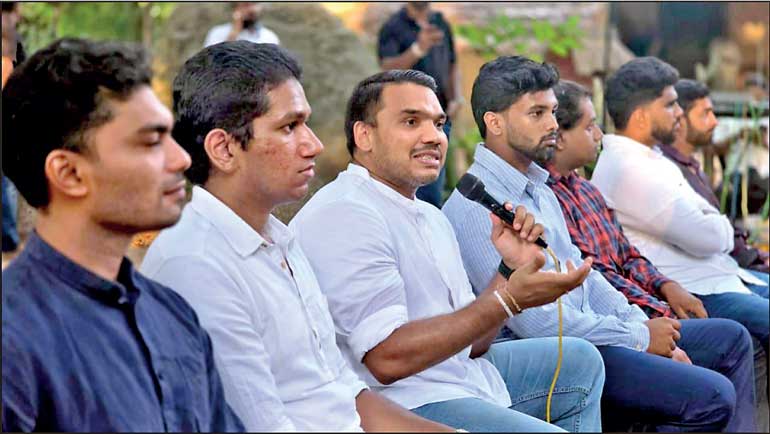
Namal rebuilding the party at the grassroots—but the ideology is unclear
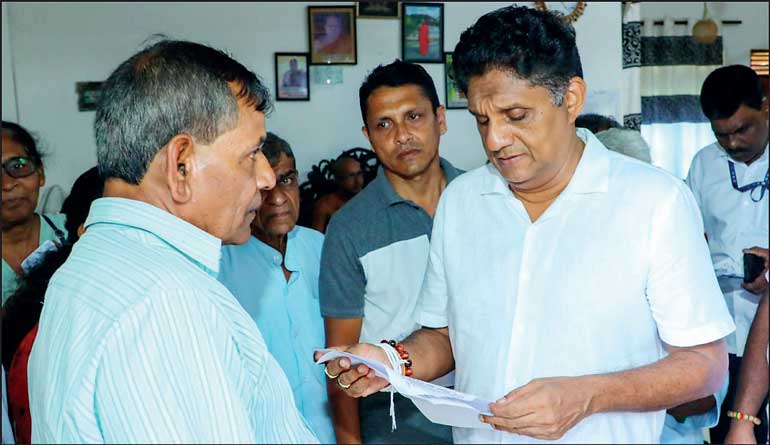
Sajith among the people—but his party needs orientation
 Speaking in Vavuniya on the 55th Anniversary of the April 1971 Uprising, JVP General Secretary Tilvin Silva expressed a sentiment with the most ominous implications.
‘...Silva said some countries in the world such as Singapore and China took about 10 to 25 years to change those countries.
“It takes years to change the entire society. We need to protect the Government until we achieve the objectives of forming the Government. We cannot finish the work within five years,” he said...’
(https://www.dailymirror.lk/latest-news/Government-must-be-protected-until-objectives-of-forming-it-achieved-Tilvin/342-337193)
The writing is on the wall, but the ‘ostrich’ Opposition just isn’t reading it.
Sri Lanka is fortunate in having Sajith Premadasa and Namal Rajapaksa, two, not just one youthful, intelligent democratic politician who can occupy the roles of President or PM and turn the country’s fortunes around dramatically. But neither is in anything like top form. Neither is standing up adequately to the JVP leadership. Neither is battling the JVP-NPP sufficiently. Neither is close to fulfilling their actual potential. Both leaders have considerable room to improve and much work to do.
What Namal needs to do
Personal appeal is a necessary but not sufficient factor for political and electoral success. If an attractive personality—great personal appeal—is all that you need, then Kamala Harris should have been the US President.
Namal Rajapaksa and the SLPP have pulled up their socks and been engaged in reorganising the party at the grassroots. But this has its limits. Given Namal and the SLPP’s actual circumstances, what they need to do is to start removing the electoral rubble that they’ve been buried under, not once but twice in just under a single decade: 2015 and 2024.
A prelude to this is deep collective rethinking as to why these defeats occurred and what must be done to avoid repetition.
This process doesn’t seem to have been undertaken. If it had, the SLPP should be noticeably changed, positioned differently, and sound different.
When Mahinda Rajapaksa took over the SLFP, the country knew this wasn’t the earlier, Chandrika-led, federalist package-pushing SLFP. Earlier, when Chandrika wrested the leadership of the SLFP, she made it clear it was no longer the statist closed economy SLFP of her mother.
Namal has definitely shown a degree of difference from the SLPP he inherited, but they are too subtle. What is the SLPP’s brand and ideology: MR 2005, 2010 or GR 2018-2022?
Removing the rubble that the SLPP has been buried under in 2022-2024, requires a backhoe, not a trowel. Namal has not dug deep and uprooted the reasons that led to two electoral defeats and an overthrow by uprising in between, in under 10 years (2015-2024). If he fails to do so, a significant number of voters will not see a sufficient degree of difference—except personality and style—between his SLPP and Gota’s SLPP that was overthrown and then electorally compacted.
 Namal Rajapaksa must face the fact that the entire politico-electoral strategy of 2019 has been blown to bits and cannot be recomposed. That strategy, formulated by the Gotabaya Project ‘masterminds’ rather than Mahinda Rajapaksa, was that of a pan-Sinhala or ‘Sinhala Only’ victory.
What history has proved is that even if the Presidency is won only with the votes of the Sinhalese or the Sinhala Buddhists (as per President Gotabaya’s Anuradhapura address), power cannot be retained because the structural imbalance makes for chronic disequilibrium. Gotabhaya was easily overthrown because his powerbase was unreflective of the country as a whole. It was a four-legged stool trying to stand on one leg.
The next election will be a three-way race: SJB, SLPP, JVP-NPP. With the Sinhala vote splitting, there is no way in which anyone can win based only on the Sinhala vote. How are Namal and the SLPP going to win back an adequate segment of the Muslim, and Catholic/Christian votes which Mahinda Rajapaksa had in 2005 and 2010, but was divested of by ultranationalist lobbies within his own ranks in his second term, and completely abandoned by/lost to the SLPP at the 2019/2020 and 2024 elections?
To win back at least a sizeable segment of those two minorities, Namal will have to credibly distance himself from the disastrous Gotabaya phase, pivot back to the classic MR line and then push forward.
But can Namal do it while the SLPP still occupies a political space and exists in a ‘nationalist’ milieu/environment in which the dominant discourse remains basically that of Gotabaya’s 2019-2022 and defensive of that disastrous experiment?
Does Namal have what it takes to do what Chandrika did with Mangala Samaraweera’s help in 1991-1994, i.e., project a completely different profile, and rupture from the party’s old discourse which had made it unelectable for 17 years?
Has Namal done enough or is he doing enough, and fast enough, to reassure the voters that the SLPP bearing his candidacy is very different from the SLPP of the Gotabaya period, with absolutely no danger of a return to those toxic years?
It is amusing to hear the explanations of the Aragalaya and the ouster of Gotabaya Rajapaksa which attribute the key causative role to the US Ambassador Julie Chung—because that was exactly the same explanation given by the LSSP and CPSL for the splitting of the United Front coalition Government and subsequent electoral decimation. They attributed it to Prime Minister Sirimavo Bandaranaike’s friendship with US Ambassador Chris van Hollen and West German ambassador Gundi (Hildegunde) Feilner, and the influence they allegedly wielded on the PM’s political trajectory (‘turn to the Right’).
For over a decade and a half, so long as ‘external conspiracy/influence’ was the main explanation, while Mrs. Bandaranaike’s economic policies of ‘self-sufficiency’ resulting in scarcity continued to be praised, the Sri Lankan citizenry refused to vote for the SLFP—because the ‘imperialist influence’ excuse was itself evidence that the SLFP-LSSP-CP just hadn’t understood what they had done wrong and where they had gone wrong. Thus, they were not trusted enough to be voted back into office because they might relapse into the same dreaded policies.
So long as the SLFP remained unrepentant and stuck to the same policies and leadership, it was relegated to the Opposition. It was only after a new leadership publicly abandoned the disastrous economic policy of the last SLFP Government and adopted a new one (‘Open Economy with a Human Face’), that the people reinstated the party in Government.
The lesson for Namal’s SLPP is clear. Unless the ‘foreign conspiracy’ excuse is dropped and the roots of the catastrophic fertiliser policy, as well as payment of interest on foreign debt without adequate foreign currency to pay for the import of fuel, are uncovered, Namal will needlessly have to carry the burden of public memory of the last SLPP Government headed by his uncle.
 The SLPP and Namal can get far more votes, especially of the younger generation, with an honest, open-minded, balanced view of the Aragalaya than by a truculently defensive conspiracy theory.
Anti-Mahinda mastermind(s)
Here is the bitter truth that Namal and the SLPP must face and deal with.
The last real politico-electoral peak of the SLFP-SLPP was Mahinda Rajapaksa’s victory over Sarath Fonseka in 2010. The Sinhala vote had been split by the brilliant strategist and tactician SF, who was also backed by Ranil’s UNP and Anura’s JVP, but Mahinda still triumphed because: (a) the people correctly gave the greater credit to the nation’s historic top political leadership and (b) MR was not relying exclusively on the Sinhala vote in its entirety; he also won Muslim and Christian votes.
Gotabaya’s win in 2019 was mostly because of MR, and anyway proved a ‘bubble’ in 2022.
The downfall of the SLFP/SLPP from 2010 till 2024, is sourced in the dismantling of MR’s winning 2005 and 2010 electoral blocs by systematically breaking away the Muslim and Christian components.
This was not done from outside and could not be have been. This was done by those within the ruling bloc who wanted to discredit and marginalise Mahinda and ensure his defeat, clearing the way to install Gotabaya as leader and instrument of an ultranationalist-militarist project (inspired by Netanyahu’s Israel and the US Republican Tea Party movement culminating in Trump 2016).
Muslims as a community had actively supported the Sri Lankan state and the military throughout the war, or else we couldn’t have retained the East militarily and politically. Meanwhile, all Muslim countries had supported us in the diplomatic arena, and some had done so militarily and economically. Mahinda’s proximity to the Muslim community and nations built on the SLFP’s strong Muslim support dating back to Sirimavo Bandaranaike’s leadership, enhanced by his own prominent solidarity with Palestine. The cruel paradox was that in the postwar period and MR’s second term, organised Islamophobia and anti-Christian sentiments were unleashed—which just couldn’t have come from MR because there was no reason to turn against parts of his own base, nationally and internationally.
Starting with the ‘grease yakka’ (‘grease devil’) phenomenon which involved camouflage-painted stalkers and home invaders targeting Eastern Muslim communities, and the announcement of an imminent ‘Dolahey karalla’ (‘2012 Rebellion’) which led to threat-filled online Islamophobia (including in offices) threatening a ‘second war’, came the BBS and other smaller militant organisations inspired by Myanmar’s Wiratu. Muslim stores like No Limit were threatened, some attacked. There was an imbecilic scare about infertility-inducing ‘kottu roti’ and female underwear, followed by televised debates about Muslim birthrates and the danger of the Sinhalese being swamped.
In 2013 Secretary/Defence Gotabaya Rajapaksa spoke at the opening of a BBS-affiliated ‘political academy’ and expressed his sympathy with the ideas of the BBS. He reiterated this strongly in an interview in the Daily Mirror.
In 2014 Muslims were physically attacked in Aluthgama, one year before the scheduled Presidential election.
A shocked Mahinda who had been overseas, rushed from the airport and toured the areas with Dr. Rajitha Senaratne. He was about to issue an arrest order for the agitators from the BBS and smaller, nastier, organisations, but was stopped by the top Defence official who told him that Intelligence reports predicted Sinhala Buddhists would riot if he did so.
All this was before Zahran Hashim began organising for terrorist violence.
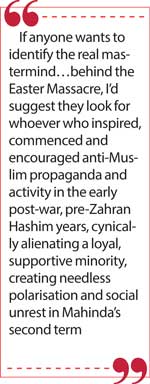
 The extremist succession project seems to have been to artificially create anti-Muslim sentiment, provoke hitherto non-existent Muslim militancy and bring forward a suitable candidate as the next hero to combat it and ‘save the nation’. If that postwar anti-Muslim conspiracy wasn’t set rolling, no Easter Massacre would have occurred years later. So, if anyone wants to identify the real mastermind, i.e., the originator, the creator, behind the Easter Massacre, I’d suggest they look for whoever who inspired, commenced and encouraged anti-Muslim propaganda and activity in the early postwar, pre-Zahran Hashim years, cynically alienating a loyal, supportive minority, creating needless polarisation and social unrest in Mahinda’s second term.
As for the Christians, a Catholic nun belonging to the Order of Mother Theresa was disgracefully locked up by the Police, until Mahinda Rajapaksa was informed by the Cardinal that he would not attend the traditional Christmas event hosted by the President unless the nun was released. MR berated the security bosses who had authorised the arrest, and the nun was freed.
The Catholics finally exited the Rajapaksa electoral bloc with two incidents: the lethal Rathupaswela shootings when the military fired into a church and made nuns kneel at gunpoint, and the assault on High Commissioner Chris Nonis by Presidential Advisor on International Relations, Sajin Vass Gunawardena.
The original plan was probably to present the Islamophobic extremist candidacy in 2015, but Mahinda sought to halt sibling rivalry over succession by announcing he would himself run for the third time. Deprived of Muslim and Catholic votes, he lost.
The Mahinda-Maithripala rapprochement of 2018 which may have meant a Maithripala run for re-election, was not merely resisted by the UNP and JVP, it was sabotaged from within, to pre-empt a Maithri-Mahinda progressive ticket with MR as a strong PM under the 19th Amendment. Only Namal and Vasudeva robustly supported Mahinda during the ‘52 Days’.
The Easter Massacre operationally perpetrated by Zahran Hashim and his followers—we are as yet unsure of inspiration, planning, technology, training, target-selection and facilitation through deliberate negligence—took place in 2019 against this backdrop. As a byproduct (at the least), the candidacy, campaign and Presidential election became a slam-dunk for the extremist project.
The Gotabaya project openly ran on extremist rails from at least mid-2018 (Viyath Maga II at the Shangri-La hotel, the ‘Be a Hitler’ controversy etc.) through the post-Easter massacre Presidential election campaign (the Dr. Shafi/fallopian tube-tying allegation) and the Gotabaya Presidency (forced cremation of Muslims).
The true character of the extremist project dating back at least to 2011/12 was revealed by its endgame: President Gotabaya’s 20th Amendment which removed all power from Mahinda as Prime Minister, having earlier posed—and reaped votes—as Mahinda Aiya’s nominee and proxy.
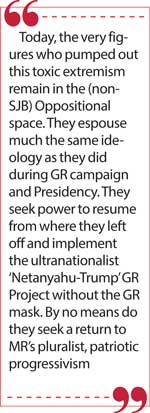
Today, the very figures who pumped out this toxic extremism remain in the (non-SJB) Oppositional space. They espouse much the same ideology as they did during GR campaign and Presidency. They seek power to resume from where they left off and implement the ultranationalist ‘Netanyahu-Trump’ GR Project without the GR mask. By no means do they seek a return to MR’s pluralist, patriotic progressivism.
To restore its viability the SLPP must restore its credibility. That needs:
An economic, social, cultural, educational and foreign policy program prepared by experts other than the disastrous Gotabaya team of the Crash of 2022.
Renouncing the toxic extremism and extremist elements that delinked the Muslim and Catholic voters from MR and ensured his defeat in 2015.
If Namal fails to ‘relocate’ to a center-left, moderate nationalist, progressive space, he will be unable to win back the minorities or swing the Aragalaya generation.
 Sajith’s unfinished tasks
Sajith Premadasa needs to:
Pull his party out of the 20+% trough it genetically inherited from the UNP, without allowing his party to drag him down from his 30%-40% which he could turn into a launchpad for victory.
Neutralise/counter the garrulous incantation by Dr Harsha de Silva that Sri Lanka should integrate economically and energy-wise with Tamil Nadu. Given the piratical invasions of our waters and massive theft of our fish, demands to repossess Kachchatheevu, deification of Prabhakaran, etc., it is clear that Tamil Nadu is to Sri Lanka what Florida is to Cuba. Harsha’s slogan would provide a large target during an election campaign for a propaganda ‘missile-strike’ from Dilith Jayaweera, Wimal Weerawansa or Champika Ranawaka.
Teach the SJB that the primary critique of AKD-NPP economics is not that “you were opposed to it when we tried to do it under Ranil in 2001 and 2015, but now you’re doing it”, but rather, the unfair, imbalanced policy itself.
If Sajith strongly plugs his own economic philosophy and program inspired by his father’s development doctrine and model, he could win his (Presidential) election.
If the SJB fails to follow Sajith’s progressive-centrism and prefers Harsha’s right-wing liberal economics, it could lose the parliamentary election to Namal’s SLPP, making for an interesting ‘cohabitation’.




