Thursday Oct 15, 2026
Thursday Oct 15, 2026
Saturday, 6 June 2026 01:40 - - {{hitsCtrl.values.hits}}
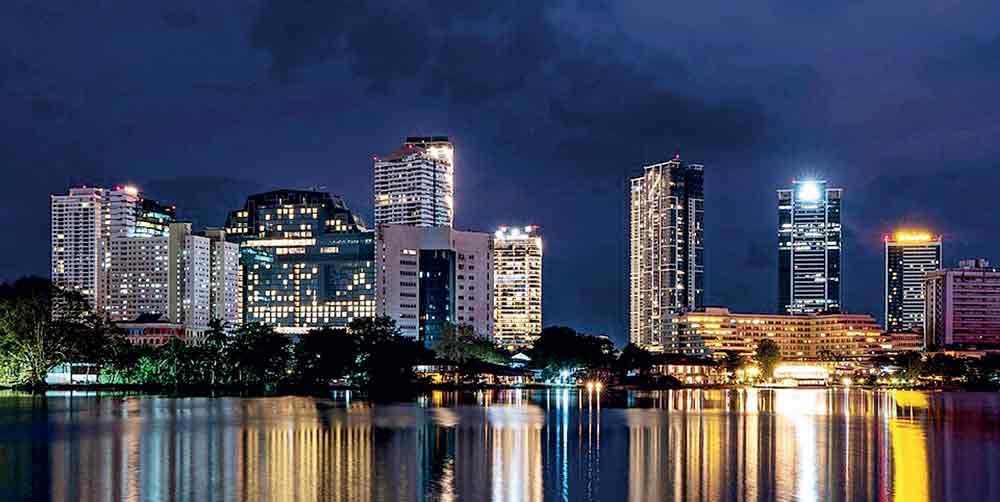
Sri Lanka is well-poised and well-positioned and has transformed the image and profile it had two decades ago as a war- and terrorism-stricken, unsafe nation
Definition and significance of Image Trap
 Over two and a half centuries ago, the primary author of the Declaration of Independence and third President of the US, Thomas Jefferson, said: “Love your neighbour as yourself and your country more than yourself.”
Geo-politics and geo-economics often discuss, debate and analyse many traps, such as the Thucydides Trap (an existing power is challenged by an emerging power), Thalassocracy Trap (power and sphere of influence are derived through naval/maritime supremacy, commerce and domination of less powerful nations, which is quite similar to the Thucydides Trap), Middle-Income Trap, Debt Trap, De-coupling Trap (dismantling economic, commercial, financial and technological interdependence, thus disrupting the less-endowed nation), Resource Trap (a more powerful nation would endeavour to extract critical natural endowments from a less developed nation to advance and fuel its economy) and Weaponisation of Interdependence Trap (a more powerful nation would use its currencies, financial leverage, and critically vital medicines and technology to its advantage and impose unreasonable and unwarranted conditions on the less powerful nation), amongst others. These traps are concepts that, needless to state, could have lasting and insidious geo-economic and geo-political implications, leading less-endowed nations to be disrupted or suffer.
Many developing as well as less-developed nations have become embroiled or enmeshed in the so-called “Image Trap”. In other words, historically, since the Egyptian or Chinese civilisations, let alone the Roman civilisation, well over six millennia ago, no country has ever developed economically or commercially without changing, enhancing or “embellishing” its image nationally, regionally and globally. This particular “Image Trap” is mostly intrinsic, both in nature and substance, and has to be addressed and elevated by political leaders, corporates, academia and civil society, amongst others. The Image Trap could be described, in simple terms, as the manner in which neighbouring countries, regions and the global community view and profile a particular nation, and their impression, perception, understanding and standing of that country in their minds and souls. It is interesting to observe that during the last century, many nations have escaped the Image Trap, while many others have become trapped in it or have been relegated or “degraded” back into it.
How to overcome and breach the Image Trap
In this context, it is imperative to accentuate that political leaders, policymakers and corporates, amongst others, have an influential and pivotal role to play in aggrandising and boosting the image and profile of a given nation. Fundamentally, when a country progresses and advances its governance, internal security and safety, rule of law, macro- and micro-economy, infrastructure, connectivity, commercial advancement and tourism, external trade, competitiveness, socio-economic indicators, travel documents (passport), and standards of living of its populace in all spheres, amongst others, leading to higher GDP and GDP per capita, the inherent image of the country too gets elevated. It is indispensable to comprehend the fact that the augmentation of image/profile and economic development, including human capital, of a given country occur simultaneously and in unison. Literally and symbolically, one would not take place in isolation from the other.
 All these countries share a common denominator in their economic advancement and ability to breach the “Image Trap”. To varying degrees, they possessed exceptional levels of dedication, nationalism, fidelity, loyalty, national pride and identity. Further, they consciously refrained from belittling or making disparaging remarks about their respective countries, except on specifically identified issues. Primarily, they possessed an indomitable and resolute love for and pride in their country and did not engage in reproaching or unjustly rebuking political leaders and policies, but instead focused on long-term vision and development
As a matter of fact, if one observes the comity of nations, ranging from highly advanced and developed to developing and least-developed, the integral image, perception and profile of those nations would, to a great extent and with reliability, be compatible and consonant with their degree of economic development. This issue is crucial for a nation to develop or move up to the next echelon, thus enhancing its image vis-à-vis the geopolitical and geo-economic realm. In order to illuminate and edify, the author wishes to illustrate and clarify, with actual examples, nations that have factually and metaphorically breached the “Image Trap” since World War II. The author has selectively chosen India, Singapore and Japan, where he served as Deputy Ambassador/Senior Diplomat, and South Korea and Vietnam, where he served as Ambassador.
Restoration of image and rise of India
With regard to India, when the author was a young student studying in Los Angeles, US, in the 1980s, people generally used to ask the typical question of where he had come from. The author would usually respond that he hailed from Sri Lanka, and the follow-up question would be: where was Sri Lanka? The author would say it was at the tip of India. Most often, those who posed the question would remark, “India is a poor, poverty-stricken nation infested with disease, malnourishment and suffering. Do they have food to eat and clothes to wear?” This was only about four decades ago, before India liberalised its economy in 1991.
Since then, less than three decades later, the remarks in North America and the West have become: “It’s a country with exceptional potential, promise, economic opportunities and commercial vistas, with some of the smartest people in the world, particularly in the sphere of IT.” India, despite having a population of close to 1.5 billion, has been able to change perceptions of the country within a relatively short period of three decades.
 In order to break the “Image Trap”, any country needs good governance, rule of law, controlled inflation, a stable economy, investment in human resources (education), FDIs and exports, political and economic stability, zero or minimal corruption and nepotism, and transparency. These factors would help achieve and boost the image and perception of the country by breaching the vicious “Image Trap”
Today, some of the largest global behemoths/corporates are run by Indian CEOs, including Microsoft, Alphabet (Google), FedEx, IBM, Novartis, Palo Alto Networks, Barclays Bank, Adobe, Micron, YouTube, Chanel and the World Bank, as well as eminent scientists at NASA, medical specialists and academics, including both the former Dean and current Dean of Harvard Business School, amongst others. Just 35 years ago, when India liberalised its economy under the then noted Minister of Finance Manmohan Singh and Prime Minister Narasimha Rao, its total official reserves ($ 2 billion) were less than two weeks of imports. Today, India boasts foreign reserves of close to $ 700 billion ($ 690 billion) and is among the top five countries with exports exceeding $ 900 billion in 2025, higher than Japan and South Korea. It recorded double-digit to exceptionally high growth in the early 2000s for well over a decade, thus becoming the fifth-largest economy with a GDP of $ 4.2 trillion.
India is a global leader in digitalisation, IT and ITES, outsourcing, manufacturing including pharmaceuticals, and is known as the “Pharmacy of the World”. It also has a stable and progressive Government, projects soft power through Bollywood and cuisine, and has invested in human capital and innovation leading to a knowledge economy, attracting total FDI/FII of around $ 95 billion in 2025, amongst others. The total market capitalisation of India’s equity/stock market is close to $ 5 trillion ($ 5,000 billion), the sixth-largest in the world. At the beginning of the century, it was hovering around $ 100 billion.
When Tata Steel acquired UK/Netherlands-based Corus Steel, one of the largest steel companies in the world, for $ 12.9 billion in 2007, and Tata Motors acquired the iconic UK-based automaker Jaguar Land Rover for $ 2.3 billion in 2008, India pivoted seismically from being essentially an aid-dependent nation to one that committed FDI overseas to acquire global corporates. The global business community and nations took notice and recognised that India had become a nation to be reckoned with, which further boosted its image and perception globally.
The image and perception of India today, both regionally and globally, have been fundamentally and manifestly enhanced and aggrandised, positioning it among the fastest-growing major economies as well as a political, diplomatic, military, manufacturing and economic powerhouse on the global stage.
How Japan and Singapore became iconic
Japan was yet another unique and cogent manifestation of how a nation could enjoy a stellar global image during World War I and World War II, lose it following Hiroshima and Nagasaki, and then regain it within less than a generation (25 years). In 1945, Japan was reduced to absolute devastation at the end of World War II, but by 1968, it had become the second-largest economy in the world in a mere 23 years. It maintained this status for 42 years until China surpassed it in 2010. Japan invested in manufacturing and economic activity with unwavering and unparalleled commitment and fidelity from its populace, which the world has probably never witnessed before.
With regard to Singapore, when it gained independence from British rule in 1965, its GDP per capita was around $ 500. Despite this being a respectable figure in 1965, the country had virtually no natural endowments, economically impactful industries, or even land. It only had a strategic location, human capital and a visionary leader, Lee Kuan Yew. Singapore focused on its strategic location and invited and wooed global players from the West and other developed nations. While investing heavily in human capital, education, petrochemicals and FDIs, Singapore focused tenaciously on manufacturing and trade, becoming one of the three busiest ports in the world and recording exports of nearly $ 1 trillion in 2025. Geographically, the country is 1/90th the size of Sri Lanka, at only around 750 sq. km., having previously been 1/100th the size.
The author is yet to come across a single Singaporean who would state that “our country is a small country and a poor country”. This is a nation that ascended from being underdeveloped to becoming an advanced economy in less than a generation. Even a Singaporean may find it difficult to identify Singapore on a blank world map. If one says he or she is from Singapore in any continent of the world, nobody asks where Singapore is located. Today, it is among the three wealthiest countries in the world in terms of GDP per capita, which exceeds $ 90,000 and is higher than that of any G7 nation.
Transmogrification of South Korea and Vietnam
Both South Korea and Vietnam share parallels to some degree, as both were devastated by two ferocious and brutal military conflicts. In the mid-1950s, South Korea was the poorest country in Asia, while after the Vietnam War, Vietnam was also one of the poorest countries in the world in the mid-1970s. South Korea, under the leadership of Park Chung-Hee, focused on manufacturing, external trade, innovation, education and FDIs, amongst others. He ruled the country from 1962 to 1979, during which period South Korea recorded unprecedented growth and fostered chaebols, or major corporates, such as Samsung, SK Group, Hyundai, Lotte and LG, amongst others. Today, South Korea is home to two of Asia’s three trillion-dollar market-cap corporates, namely Samsung and SK Hynix, and belongs to the same league as the “Magnificent Seven” corporates.
The transformation and “transmogrification” of South Korea from a backward, agriculture-dependent and underdeveloped nation into one of the most innovative and advanced economies is often described as the “Miracle on the Han River”. In 2025, South Korea exported goods and services worth over $ 710 billion, whereas total exports in 1980 were only $ 18 billion. Vietnam’s rise over the last three decades has also been driven by the attraction of FDIs and foreign corporates, exports, manufacturing, tourism, SMEs and services. In 1980, Vietnam’s total exports were around $ 800 million, similar to Sri Lanka’s exports in the same year. By 2025, exports had reached $ 475 billion, while bilateral trade exceeded $ 925 billion, larger than its GDP. Today, Vietnam is often described as “China Plus One” and a “Mecca for investment, trade, manufacturing and tourism”.
Untapped latent potential of Sri Lanka
All these countries share a common denominator in their economic advancement and ability to breach the “Image Trap”. To varying degrees, they possessed exceptional levels of dedication, nationalism, fidelity, loyalty, national pride and identity. Further, they consciously refrained from belittling or making disparaging remarks about their respective countries, except on specifically identified issues. Primarily, they possessed an indomitable and resolute love for and pride in their country and did not engage in reproaching or unjustly rebuking political leaders and policies, but instead focused on long-term vision and development. In order to break the “Image Trap”, any country needs good governance, rule of law, controlled inflation, a stable economy, investment in human resources (education), FDIs and exports, political and economic stability, zero or minimal corruption and nepotism, and transparency. These factors would help achieve and boost the image and perception of the country by breaching the vicious “Image Trap”.
Today, Sri Lanka is well-poised and well-positioned and has transformed the image and profile it had two decades ago as a war- and terrorism-stricken and unsafe nation, against which developed countries customarily imposed travel advisories, into a country with evident potential, an optimistic future and prospects for development, accountability and transparency, amongst others. Few countries in the world are as endowed as Sri Lanka and are awaiting their potential to be unleashed. Similar to the economic evolution of South Korea, hopefully in the foreseeable future, Sri Lanka could be described as the “Miracle on the Kelani River”.
The author wishes to conclude with the sagacious words of Idowu Koyenikan, renowned author of Wealth for All Africans: “Your pride in your country should not come after your country becomes great; your country becomes great because of your pride in it.”
(The author is a former career Ambassador, Professor of International Economics with specialisation in Geo-politics and Negotiations, Board Member and Strategic Advisor. He earned an MBA from San Francisco State University/University of California, a PhD from the Indian Institute of Technology (IIT) Delhi, and is a Senior Fellow at Harvard. He can be reached at [email protected])




