Tuesday Sep 29, 2026
Tuesday Sep 29, 2026
Tuesday, 29 September 2026 04:39 - - {{hitsCtrl.values.hits}}
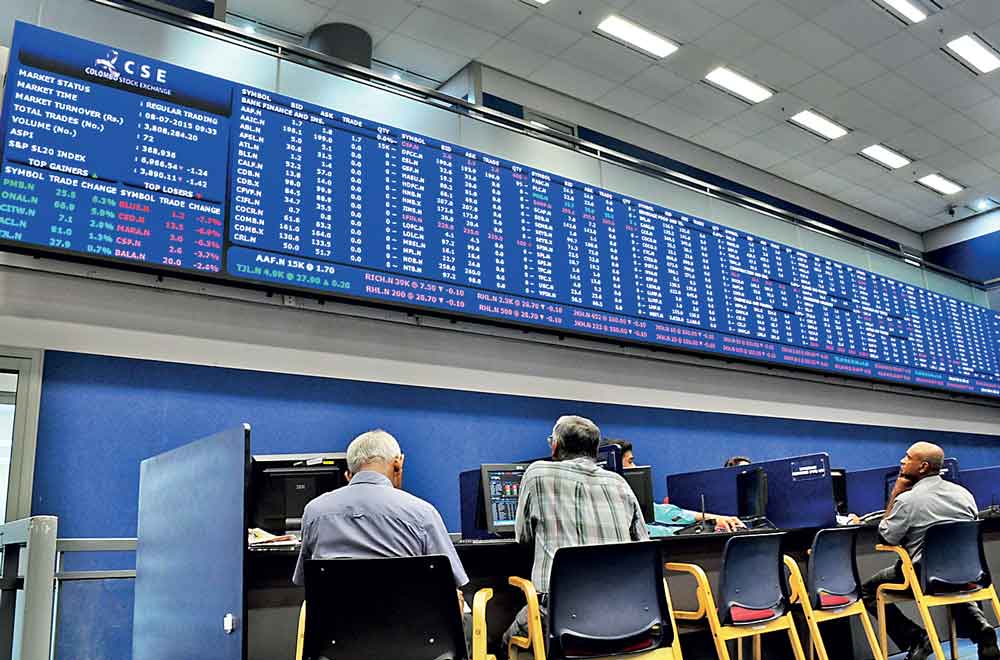
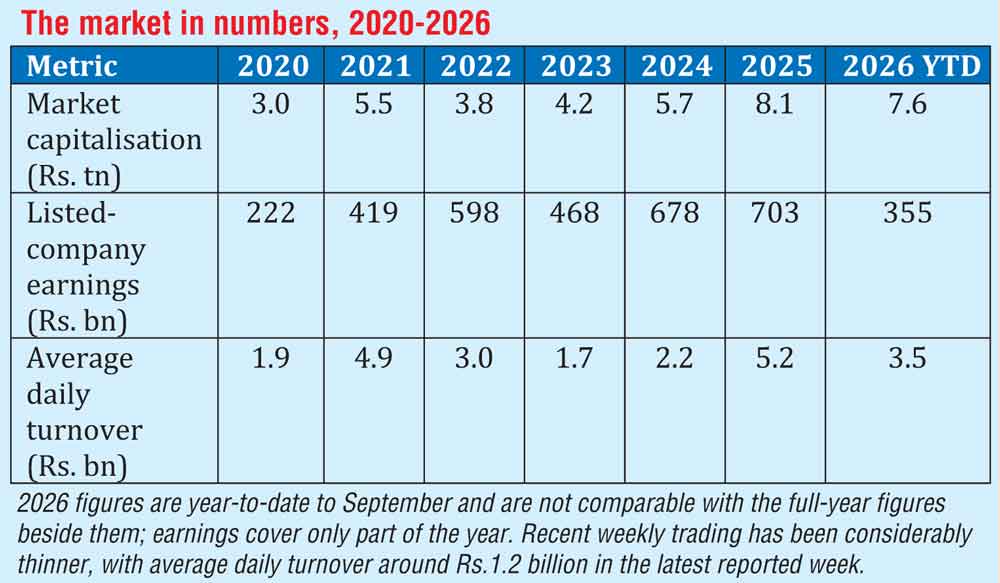
 Having spent decades participating in Sri Lanka’s capital market, I believe we are at an important inflection point. The All Share Price Index has climbed above 21,000, while market capitalisation stands at around Rs.7.6 trillion. On paper, the market has recovered strongly. And yet, through much of this recovery, foreign investors have been walking out the door, with cumulative net foreign outflows reaching approximately Rs.57 billion during the first nine months of 2026. Foreign participation in market turnover, which was around 40% before the crisis, has fallen to approximately 9%.
This is the paradox we need to confront: a market rising in value while a significant part of the international investment community remains on the sidelines. In my view, this is not simply a cyclical problem. It is a structural chicken-and-egg cycle that has constrained the Colombo Stock Exchange for more than two decades.
Foreign investors wait for a bigger, more liquid market before they commit. The great domestic funds, including the EPF, ETF and SLIC, wait for greater depth before shifting more of their money into shares. Large private companies hold off listing while valuations and liquidity remain uncertain. Ordinary Sri Lankans stay away because financial literacy and confidence remain low.
Everyone is waiting for someone else to move first. I believe Sri Lanka now needs to break that cycle deliberately.
A market that has grown, but not deepened enough
Look closely and the weakness is structural. The listed universe has barely moved in 25 years, from around 240 companies to a peak near 300 between 2016 and 2021, and approximately 289 today. New arrivals have largely replaced companies that left, rather than adding materially to the breadth of the market.
Market capitalisation, meanwhile, has risen from roughly Rs.2–3 trillion to more than Rs.7.5 trillion. Much of that increase has come from the higher earnings and valuations of companies already listed, rather than from a sustained expansion in the number and scale of listed businesses. Measured in US dollars, the increase is also more modest because periods of rupee depreciation have eroded part of the gain.
The participation problem
Foreign participation in market turnover: approximately 40% before the crisis → approximately 9% today.
 Net foreign selling in 2026: approximately Rs.57.1 billion by late September
Listed companies: peak near 300 → approximately 289 today
Adults who actively invest: only around 2–3%
Recent weekly average daily turnover: approximately Rs.1.2 billion
This will not correct itself through market movements alone. But the moment to act has arrived. Real GDP grew 5.1% in the first quarter of 2026 and a further 4.2% in the second quarter, extending the recovery. Government debt as a share of GDP had fallen to approximately 88.8% by June 2026, from around 95% at end-2025. Gross official reserves reached approximately $ 6.9 billion by end-August 2026.
The rupee has depreciated during 2026, but the extreme currency instability of 2022 has not returned. The fears that drove investors out in 2022—a collapsing currency and a shortage of Dollars—have eased materially. Sri Lanka has rebuilt a significant degree of macroeconomic stability.
The question now is: how do we turn that stability into investment, liquidity and broad-based wealth?
The 10 steps
I do not believe there is one magic solution. The ten measures below are interlocking. Each reinforces the others. But one measure could provide the initial catalyst: bringing selected State-owned enterprises to the market.
 If we can create a deeper, more liquid and more internationally credible capital market, the benefits will extend far beyond the CSE. It can help mobilise domestic savings, attract foreign capital, improve corporate governance, create new investment opportunities and allow millions of Sri Lankans to participate in the growth of their own economy. The opportunity is much larger than increasing the market capitalisation of the Colombo Stock Exchange. It is about creating a culture of ownership in Sri Lanka. We have rebuilt considerable economic stability. We now need to build the financial architecture that allows that stability to translate into long-term prosperity
List selected State-Owned Enterprises
This could be the most powerful initial catalyst available. The Government can create a professionally run holding company on the model of Singapore’s Temasek Holdings, or list selected enterprises individually. Either way, the State could retain ownership comfortably above 80% and offer only 10–20% to the market, so control remains firmly with the State.
The 51 major State-owned enterprises recorded combined profits of approximately Rs.444 billion in 2025, while the broader group excluding CEB generated about Rs.483 billion. With cost-reflective pricing, restructuring and continued reform, there is potential for aggregate earnings to move substantially higher, potentially towards Rs.700–750 billion.
At a hypothetical 10-times earnings valuation, Rs.750 billion of earnings would imply approximately Rs.7.5 trillion of market capitalisation. Selling 20% of that illustrative value would raise approximately Rs.1.5 trillion, or around $ 4.5 billion at an illustrative exchange rate. The precise valuation and proceeds would depend on the businesses, profitability, governance and market conditions at the time of listing.
The benefits extend beyond the proceeds. Public listing would bring greater transparency, disclosure and shareholder scrutiny, potentially improving governance, profitability, dividends and tax contributions over time.
Put institutional money to work
The EPF, ETF and SLIC collectively manage several trillion rupees, with the overwhelming majority invested in fixed income. A carefully phased increase in listed-equity exposure—subject to fiduciary duties, risk limits, governance and proper asset-allocation policy—could inject significant long-term liquidity into the market.
The gains could run in several directions at once: deeper liquidity, sharper price discovery, greater confidence and potentially better long-term returns for pension holders. It would also reduce concentration risk from having such a large pool of national savings in a single asset class.
Keep lifting the sovereign credit rating
Sri Lanka’s sovereign ratings remain in the lower speculative-grade range, although the direction has improved following debt restructuring and macroeconomic stabilisation. A steady, multi-year climb towards investment-grade territory, built on continued fiscal consolidation, reserve accumulation and credible policy, would change how the world prices the country.
The benefits could compound: more foreign investment, a lower country-risk premium, a cheaper cost of capital and stronger valuation multiples across the market. Sovereign-credit improvement and capital-market development can reinforce each other.
Let interest rates settle lower over time
This is a structural point, not a call to cut rates tomorrow. Monetary policy must continue to protect price and financial stability. But as inflation stabilises and the sovereign trajectory improves, the cost of government borrowing should ease over time, and that has consequences for shares.
A high risk-free rate is the stock market’s most direct competitor for capital. When Treasury bills yielded above 30%, few investors would hold equities. At around 10% and stable, shares regain some of their relative appeal, while lower discount rates can support valuations. A predictable, normalising rate environment is a genuine tailwind.
Create the conditions for larger IPOs
Once liquidity and valuations improve, the incentive to list changes for large private companies that have long stayed on the sidelines. Apparel, tea, IT, tourism, renewable energy, manufacturing, healthcare and logistics all contain candidates capable of coming to market at meaningful scale.
A stronger IPO pipeline would then feed back into the market, adding capitalisation and liquidity—a virtuous circle that replaces the vicious one the market is caught in today.
Win back foreign institutions
International investors are not mysterious in what they want: enough liquidity to enter and exit, an investable market large enough to matter, sound governance, transparent regulation and macroeconomic stability.
As those improve, foreign participation can recover from today’s approximately 9% level, and Sri Lanka can position itself over time for greater inclusion in global emerging-market and frontier-market indices that channel institutional capital.
The urgency is real. Foreign investors have been net sellers of Sri Lankan equities by approximately Rs.57 billion so far in 2026. A deep, liquid equity market is one of the channels available for attracting portfolio capital, while a well-run market signals to other investors that the country is open for business.
Tap the diaspora in foreign currency
Close to three million Sri Lankans live abroad, and their savings and networks are considerable. Yet little of that money reaches the domestic capital market, for one simple reason: bringing it home means accepting the risk that the rupee will fall, and many people will not take that risk.
The answer is to allow suitable investment structures in which investors can retain foreign-currency exposure, subject to appropriate regulation. India has demonstrated the potential scale of such a mechanism through its FCNR(B) deposit mobilisation measures and related currency-swap support. Sri Lanka could never mobilise on that scale and does not need to. Even a few billion dollars of long-term diaspora money would add depth and ease pressure on external financing.
The tools could include foreign-currency deposits, a government-backed development bond of the kind used by countries such as Israel and India, and a carefully designed Central Bank swap facility working behind the banking system. That last piece must be introduced cautiously and in stages, because the currency risk it lifts from banks does not disappear—it moves to the Central Bank.
Bring in ordinary Sri Lankans
Only around 2–3% of adults actively invest in shares, extraordinarily low by any international measure. The causes are well known: limited financial literacy, little understanding of equity investing, years of negative publicity and an insufficiently coordinated investor-education effort.
A national programme bringing together the SEC, CSE, universities, schools, the media, stockbrokers and financial institutions could broaden participation substantially and set millions of households on the path to long-term wealth. Investor education should focus not on speculation, but on ownership, diversification, compounding, valuation and risk management.
Market Sri Lanka to the world, after the reforms are real
Once the structural work is done, the country should launch a coordinated global campaign aimed at institutional investors, sovereign wealth funds, international fund managers, the diaspora and multinationals.
The sequence is everything. Marketing must follow reform, never precede it, because credibility depends on investors seeing genuine change before the message is amplified. A promotion campaign that runs ahead of the substance does more harm than good.
Demutualise the Colombo Stock Exchange
The exchange’s governance structure should continue moving towards an independent, professionally governed corporate model that separates exchange governance from the commercial interests of market intermediaries.
Demutualisation would strengthen governance and create the possibility of strategic international participation, potentially bringing world-class trading technology, settlement infrastructure and international credibility. A future strategic stake for an international exchange or market-infrastructure partner could help accelerate modernisation and strengthen the credibility needed to attract foreign institutional capital.
It would also signal that Sri Lanka’s capital market is ready to operate to international standards.
The prize: turning stability into ownership
Put these measures together and the prize is transformational. As SOE listings, a stronger flow of IPOs and continued earnings growth take hold, the total profits feeding the market could increase substantially. A deeper, better-regulated market could then support a much larger capitalisation and the daily trading depth that global capital demands.
Illustrative long-term scenario
Listed earnings within 2–3 years: ≈ Rs.1 trillion
Potential SOE profits under a successful reform scenario: ≈ Rs.700–750 billion
Potential additional profits from larger IPOs and market expansion: ≈ Rs.250 billion
Illustrative total potential corporate earnings: ≈ Rs.2 trillion
Illustrative market capitalisation at 15× earnings: ≈ Rs.30 trillion
Illustrative daily turnover range: Rs.35–70 billion
These figures are an illustrative scenario rather than a forecast. They show the scale of the opportunity if structural reforms, new listings, earnings growth, liquidity and investor participation reinforce one another.
The time to break the cycle is now
Having spent decades participating in Sri Lanka’s capital market, I believe we are at an important inflection point. The country has spent the past few years rebuilding macroeconomic stability. The next challenge is to convert that stability into investment, liquidity and long-term wealth creation.
We should not wait for foreign investors to return before we deepen our market. We should not wait for larger companies to list before creating liquidity. And we should not wait for ordinary Sri Lankans to become investors before providing them with the education and confidence to participate.
Someone has to move first.
The Government can provide the catalyst through selected SOE listings. Institutional investors can provide depth. Large private companies can provide new listings. The SEC and CSE can strengthen market infrastructure and investor confidence. The Central Bank can help create appropriate mechanisms for diaspora capital. And the business community has a responsibility to bring more successful Sri Lankan enterprises into the public market.
These actions are not separate initiatives. They are pieces of the same solution.
If we can create a deeper, more liquid and more internationally credible capital market, the benefits will extend far beyond the CSE. It can help mobilise domestic savings, attract foreign capital, improve corporate governance, create new investment opportunities and allow millions of Sri Lankans to participate in the growth of their own economy.
The opportunity is much larger than increasing the market capitalisation of the Colombo Stock Exchange. It is about creating a culture of ownership in Sri Lanka.
We have rebuilt considerable economic stability. We now need to build the financial architecture that allows that stability to translate into long-term prosperity.
The chicken-and-egg cycle has continued for long enough. Someone must move first. I believe that time is now.
(The author is a longstanding investor in the Colombo stock market and Founder and Group Chairman of Almas Holdings Ltd.)



