Thursday Oct 22, 2026
Thursday Oct 22, 2026
Saturday, 28 February 2026 00:00 - - {{hitsCtrl.values.hits}}
“Even if you are a minority of one, the truth is the truth” Mahatma Gandhi
By Praetor Cornelius
A youngish lawyer and his wife are shot to death at a supermarket car park, execution style. Although we are yet to have the full picture of the perpetrators, the motives or of the master minds, as usual in Sri Lanka speculation is rife. With amazing authority propositions are thrown about; the criminal underworld, T56 rifles, the diseased lawyer’s professional record all being freely discussed
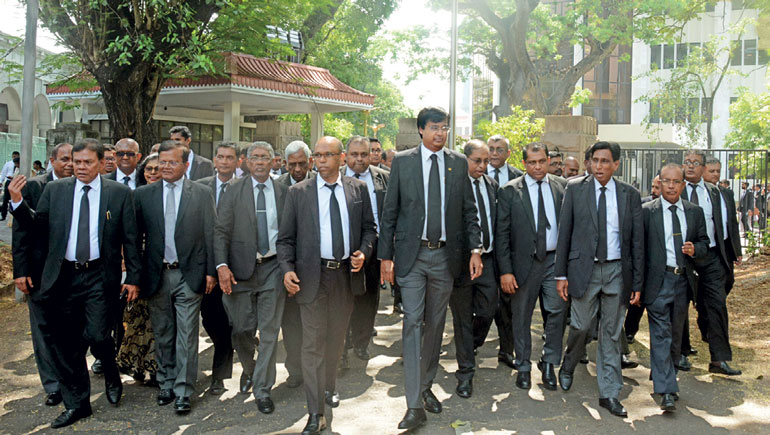
The shooting took place on a Friday, the lawyers’ organisation met on the immediate Sunday and decided on collective action, boycott courts the next day, Monday.
Needless to emphasis, in our notoriously slow legal system, a day’s stoppage of the process of court will further burden the unfortunate thousands enmeshed in legal wrangles. It would mean more days in remand custody, families left without maintenance money, boundary disputes unresolved, landlords waiting for their house, commercial clarifications left hanging, violations of rights, the list of the affected is lengthy.
Learned professions do not react knee-jerk style; they are deliberate, they are responsible; precipitous as it was, we assume all matters were duly considered by the lawyers gathered on Sunday.
In our notoriously slow legal system, a day’s stoppage of the process of court will further burden the unfortunate thousands enmeshed in legal wrangles. It would mean more days in remand custody, families left without maintenance money, boundary disputes unresolved, landlords waiting for their house, commercial clarifications left hanging, violations of rights, the list of the affected is lengthy
Professions such as medical or legal, when transplanted in our part of the world, came with an already established ethos in the originating culture. In mature societies no profession claims the status of a sacred cow; they work diligently to earn their spurs. Not only in the professional dress, but also by the quality of the legal literature emanating from those countries, they define the profession to this day.
These professions enable the practitioner to make a living, but in adherence to a code of conduct. Every act of a professional should show why he is different to the milling crowd, that he is not one of them, remaining a light unto himself. But it appears that in the Sub-continent, the professions have often become a mere money-making technique, taking advantage of the system as well as the culture. Furthermore, in the continent of holy cows, groups are inclined to claim a special status, based not on the quality of their service, but on who they are.
In a war situation, a doctor serving at the front cannot refuse to treat a wounded enemy. Minutes before, the young enemy soldier may have been shooting at your own men with the intention of killing them. But now the enemy soldier is himself injured. If he is true to his calling, the doctor must be faithful to his Hippocratic oath here; not only must he treat the injured enemy to the best of his ability, but the doctor must also see to the welfare of his patient, respecting the confidentiality of his service.
In the famous Nuremberg war crime trials following the Second World War we saw some fundamental concepts of the practice of the law highlighted. Many of the accused were facilitators/guards at Nazi concentration camps committing mass scale genocide, routinely gassing to death thousands of people in places like Auschwitz and Belsen. Among the unfortunate victims were judges, lawyers and doctors, mainly of the Jewish race. There were women and children too. However, during the trials against the perpetrators not only were they provided with medical facilities, but every effort was made to ensure that the accused were defended by competent lawyers. Legal representation is the bedrock on which the justice system stands.
The legal profession does not fit itself to easy unionisation, or collective catharsis. It is a profession thriving on individuality, intelligent men with opinions of their own and an uncompromising sense of independence
The lawyers appearing for the genocide culprits made a spirited effort on behalf of their clients, arguing that they were German soldiers and were only carrying out orders. This defense was rejected by the international tribunal. However imperfect, these tribunals sought to rise above the barbarism of the accused before them. The courts asserted the superiority of civilisation over the dark forces of human depravity.
Taking the broader view, the legal profession does not fit itself to easy unionisation, or collective catharsis. It is a profession thriving on individuality, intelligent men with opinions of their own and an uncompromising sense of independence. The dialectics of the process of the law; opposing ideas placed before a tribunal, opportunity to appeal to other tribunals; at every point an original opinion may prevail. We associate the legal profession with cosmopolitan dispositions and wide reading. In every country, the lawyers stand out for their clarity of mind and felicity of word. The difference between an architect and a mason; a man working with a big picture versus a repetitive humdrum work process.
Occasionally we see in our courts, particularly in high profile politically sensitive cases, very large numbers of lawyers appearing for a party, sometimes there is no room in the courthouse to accommodate them all. Of course, only one of them will address the court, others we assume are showing solidarity. In a good legal system, numbers do not sanctify. Again, as Gandhi observed “Strength of numbers is the delight of the timid, the valiant in spirit, glory in fighting alone”
There is no country without crime. In many countries we now have what is generally referred to as organised crime. In America, in England, in Russia and even in clean Japan there are underworld elements. Often, they are in activities like drugs, smuggling, vice and even garbage collection. These criminal elements sometimes commit murder. They kill all kinds of people; policemen, judges, jailers; it is even suggested that the American mafia had a hand in the assassination of the popular President John F Kennedy. The professions that the various victims belonged to were sad, even outraged, but they did not go on strike. They cooperated with the law enforcement to find the perpetrators.
There is no country without crime. In many countries we now have what is generally referred to as organised crime. In America, in England, in Russia and even in clean Japan there are underworld elements. Often, they are in activities like drugs, smuggling, vice and even garbage collection. These criminal elements sometimes commit murder. They kill all kinds of people; policemen, judges, jailers; it is even suggested that the American mafia had a hand in the assassination of the popular President John F Kennedy. The professions that the various victims belonged to were sad, even outraged, but they did not go on strike. They cooperated with the law enforcement to find the perpetrators
The cowardly shooting of a lawyer and his wife deserves unreserved condemnation. The perpetrators must be found, and the law must follow its course.
From what we learn, the Sri Lankan police are conducting a tireless investigation into the shooting, and the news is that already some suspects have been taken into custody. The police must be commended for their investigative competence.
Each of us faces the question, do we add to the confusing din of our troubled times, or become a light that illuminates a darkening sky?




