Friday Oct 02, 2026
Friday Oct 02, 2026
Monday, 1 June 2026 00:06 - - {{hitsCtrl.values.hits}}
By Lighthouse Guard
 The Sri Lankan Supreme Court decision ordering Singapore-based X-Press Feeders to pay US$1 billion in interim compensation for the X-Press Pearl disaster has reignited debate over one of the most devastating environmental incidents in Sri Lanka’s history. While no reasonable person disputes the need for accountability and environmental restoration, questions are increasingly being raised about due process, consistency in the administration of justice, and the credibility of the institutions responsible for handling the aftermath of the disaster.
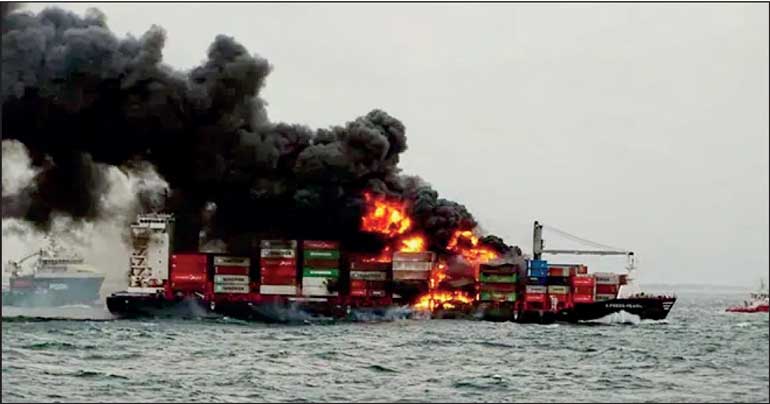
The X-Press Pearl fire and sinking in 2021 resulted in unprecedented marine pollution along Sri Lanka’s coastline. The environmental damage was immense, and affected fishing communities deserved prompt compensation. However, justice must not only be done; it must also be seen to be done fairly and impartially.
X-Press Feeders has publicly argued that the recent court ruling effectively assigns blame to the vessel’s master and local agents before the conclusion of criminal proceedings. The vessel’s master has reportedly remained in Sri Lanka for more than four years under travel restrictions, separated from his family and unable to continue his profession. Whether one agrees with the company’s position or not, prolonged restrictions without the conclusion of legal proceedings raise legitimate questions regarding procedural fairness.
Equally important are the unanswered questions concerning the actions of various authorities before and during the incident. Reports indicate that inspections were conducted before the fire without identifying an imminent threat. Questions have also been raised regarding the handling of the leaking nitric acid container and decisions made by relevant officials during the emergency response.
The Supreme Court itself acknowledged shortcomings by certain state agencies in its findings. Yet many observers are asking whether accountability has been applied evenly across all parties whose actions or omissions may have contributed to the scale of the disaster. If private actors are subjected to extensive scrutiny, should the same standard not apply to public officials entrusted with protecting the nation’s environment and maritime interests?
Particular attention has been drawn to the role of officials responsible for harbour operations and environmental protection. It has been reported that investigations were conducted by the Commission to Investigate Allegations of Bribery or Corruption (CIABOC) into certain officials connected with the incident. However, the apparent absence of publicly known enforcement action has fuelled public speculation and concern. Transparency regarding the outcomes of such investigations would help strengthen public confidence.
These concerns are amplified by the fact that criminal proceedings relating to the disaster are still ongoing before the High Court of Colombo. In any democratic society governed by the rule of law, judicial outcomes must be based on evidence tested in court and not on public pressure, political considerations, or media narratives. Maintaining this principle is essential not only for the parties involved but also for the reputation of Sri Lanka’s legal system.
Sri Lanka has every right to seek compensation for environmental damage and economic loss. At the same time, the country must be mindful of the message sent to international investors, shipping companies, and trading partners. A perception that legal processes are unpredictable or that liability is imposed without full due process could have long-term consequences for trade, investment, and maritime commerce.
The X-Press Pearl tragedy should ultimately serve as a lesson in accountability for all stakeholders: shipowners, operators, regulators, port authorities, environmental agencies, and policymakers. Selective accountability risks undermining public trust. Comprehensive accountability strengthens it.
As Sri Lanka continues its pursuit of environmental justice, the nation must ensure that fairness, transparency, and the rule of law remain at the centre of the process. The credibility of our institutions depends on it.



