Sunday Sep 13, 2026
Sunday Sep 13, 2026
Monday, 8 June 2026 03:08 - - {{hitsCtrl.values.hits}}
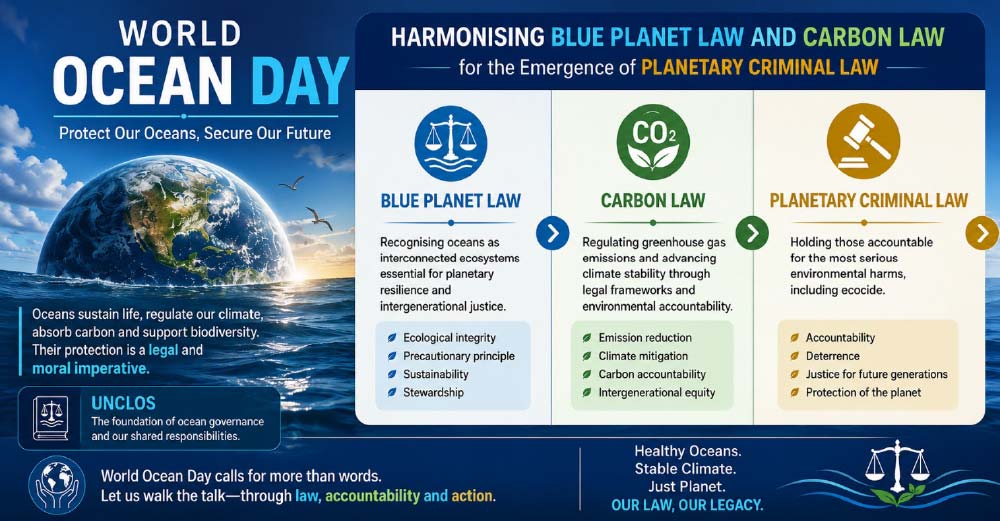
Blue Planet Law offers a compelling conceptual approach. It reframes oceans not as territorial or resource spaces alone but as interconnected ecological systems essential to planetary stability and intergenerational justice. This conceptual framework challenges conventional legal fragmentation by advocating integrated governance across climate, biodiversity, and ocean law. It calls for a shift from sectoral regulation toward systems-based legal thinking that reflects the realities of Earth’s ecological interdependence
 World Ocean Day and the Ocean Crisis
As the world marks World Ocean Day on 8 June, global attention is once again directed toward the oceans that sustain life on Earth yet remain increasingly vulnerable to accelerating environmental pressures. Oceans regulate planetary temperature, generate oxygen, support biodiversity, and absorb a significant proportion of anthropogenic carbon dioxide emissions. In doing so, they function as the Earth’s largest climate stabiliser and a foundational component of the global ecological system Descibed by Intergovernmental Panel on Climate Change (IPCC) 2019.
However, this critical regulatory system is under unprecedented strain. Rising ocean temperatures, acidification, plastic pollution, overfishing, and biodiversity collapse collectively signal a deepening planetary crisis. The scientific consensus is clear: without urgent intervention, marine ecosystems may undergo irreversible transformation with cascading consequences for climate stability and human survival.
In this context, World Ocean Day is more than a symbolic observance. It is an annual reminder that oceans are not infinite reservoirs of resilience but finite, fragile systems requiring robust legal and governance frameworks. Their protection is therefore not merely an environmental objective but a legal, ethical, and intergenerational imperative.
Oceans as climate regulators and planetary systems
The ocean is central to the Earth’s climate system. It absorbs approximately one-quarter of global carbon dioxide emissions and captures over 90% of excess heat generated by greenhouse gas emissions. This buffering capacity has slowed the pace of atmospheric warming but has also led to significant ecological disruption within marine environments. Ocean warming contributes to coral bleaching, shifts in fish migration patterns, and the destabilisation of marine food webs. Ocean acidification, driven by increased carbon absorption, threatens calcifying organisms such as corals and shellfish, undermining entire ecosystems and coastal economies.
These changes illustrate a fundamental reality: the ocean is not external to the climate system but constitutive of it. From a legal and governance perspective, this interconnectedness challenges traditional sectoral approaches to environmental regulation. Climate change law, biodiversity law, and ocean governance must now be understood as interdependent domains requiring integrated regulatory responses.
United Nations Convention on the Law of the Sea (UNCLOS), and the architecture of ocean governance
The principal international legal framework governing the oceans remains the United Nations Convention on the Law of the Sea (UNCLOS), adopted in 1982 and in force since 1994 by united Nations. Often described as the “constitution for the oceans,” UNCLOS establishes rights and obligations relating to maritime jurisdiction, navigation, marine resource exploitation, and environmental protection.
UNCLOS represents a landmark achievement in international law. It codifies maritime zones, affirms sovereign rights over exclusive economic zones (EEZs), and sets out duties to protect and preserve the marine environment. However, despite its normative significance, UNCLOS reflects the scientific and political context of its time. It was developed before the full emergence of contemporary climate science and before the recognition of planetary-scale ecological crisis.
As a result, UNCLOS faces structural limitations in addressing modern environmental challenges. Its enforcement mechanisms are weak, its environmental provisions are broadly framed, and it lacks explicit integration with climate change governance. These limitations are increasingly evident as marine biodiversity declines and climate impacts intensify.
In particular, the fragmentation of international environmental law has hindered coherent governance of ocean-climate interactions. While UNCLOS addresses marine protection, climate treaties such as the Paris Agreement operate separately, creating institutional silos that limit regulatory effectiveness.
Emerging trends in ecological ocean governance
Despite these limitations, international environmental law is undergoing a gradual but significant transformation. A shift toward ecological governance is evident in the expansion of marine protected areas (MPAs), the negotiation of biodiversity beyond national jurisdiction (BBNJ) agreements, and the increasing use of climate litigation to enforce environmental obligations.
The adoption of large-scale marine protected areas reflects growing recognition that conservation must extend beyond isolated ecosystems to encompass broader ecological networks. Similarly, the BBNJ Agreement represents an important step toward protecting marine biodiversity in areas beyond national jurisdiction, addressing long-standing governance gaps in the high seas regime.
Climate-related litigation has also emerged as a powerful mechanism for environmental accountability. Courts in multiple jurisdictions have increasingly recognised the connection between state responsibility, emissions reduction, and environmental protection obligations. These developments signal a judicial willingness to interpret environmental law in light of evolving scientific knowledge and ecological necessity.
Together, these trends indicate a transition from resource-centric ocean governance toward ecologically grounded legal frameworks that prioritise planetary resilience.
Blue Planet Law as conceptual framework for integrated governance
Within this evolving legal landscape, Blue Planet Law offers a compelling conceptual approach. It reframes oceans not as territorial or resource spaces alone but as interconnected ecological systems essential to planetary stability and intergenerational justice.
Blue Planet Law emphasises three core principles. First, ecological interdependence: recognising that marine systems are deeply integrated with atmospheric, terrestrial, and climatic systems. Second, precautionary governance: prioritising preventive action in the face of scientific uncertainty where risks of environmental harm are severe or irreversible. Third, intergenerational responsibility: acknowledging that current environmental decisions directly affect the rights and wellbeing of future generations.
This conceptual framework challenges conventional legal fragmentation by advocating integrated governance across climate, biodiversity, and ocean law. It calls for a shift from sectoral regulation toward systems-based legal thinking that reflects the realities of Earth’s ecological interdependence.
Harmonising Blue Planet Law and Carbon Law: A scholarly contribution
In this context, the recent work Harmonising Blue Planet Law and Carbon Law responses to Climate Change represents a timely and significant scholarly intervention that advances the argument that ocean governance must be understood in direct relation to global carbon cycles and climate regulation.
A key insight of this doctrine is that oceans function as both regulators and victims of climate change. They absorb carbon emissions and heat, thereby mitigating atmospheric warming, but simultaneously suffer ecological degradation as a result. This dual role underscores the need for legal frameworks that recognise oceans as central actors in climate governance rather than passive environmental spaces.
The doctrinal integration between ocean law and climate law, proposing that legal systems must evolve to reflect ecological reality rather than institutional convenience. In doing so, it contributes to a growing body of scholarship advocating for climate-responsive ocean governance grounded in scientific understanding and normative commitment to sustainability.
World Ocean Day as legal and ethical reflection
World Ocean Day serves as a global moment of reflection on humanity’s relationship with marine ecosystems. Beyond public awareness campaigns, it raises fundamental questions about legal responsibility, ecological stewardship, and intergenerational justice.
At its core, the day invites reconsideration of whether existing legal frameworks are sufficient to address the scale and urgency of ocean degradation. It challenges policymakers, scholars, and institutions to move beyond declaratory commitments toward enforceable legal obligations.
The ethical dimension is equally significant. Oceans sustain life across generations, yet their degradation disproportionately affects vulnerable coastal communities and future populations. This raises profound questions of environmental justice, equity, and responsibility.
From rhetoric to enforcement: The future of ocean governance
Despite progress in international environmental law, a persistent gap remains between normative commitments and effective implementation. Many environmental treaties rely on voluntary compliance, weak enforcement mechanisms, and fragmented institutional structures.
Bridging this gap requires strengthening accountability mechanisms, enhancing international cooperation, and integrating climate science into legal interpretation. It also requires rethinking governance frameworks to reflect ecological interdependence rather than political boundaries.
Future ocean governance must therefore move beyond symbolic commitments and embrace enforceable, science-based legal regimes. This includes strengthening marine protection measures, aligning climate and biodiversity frameworks, and ensuring that ocean governance is embedded within broader planetary sustainability objectives.
Walking the walk of ocean stewardship
World Ocean Day ultimately underscores a simple but urgent truth: the survival of marine ecosystems is inseparable from the survival of humanity itself. Oceans are not distant or abstract entities; they are central to the Earth’s life-support system.
The future of ocean governance depends not merely on “talking the talk” of sustainability but on genuinely “walking the walk” through enforceable, integrated, and ecologically grounded law. As Blue Planet Law and Carbon Law perspectives increasingly demonstrate, the oceans must be recognised as foundational to climate stability and intergenerational justice.
The challenge ahead is not conceptual clarity but political and legal will. The task is to transform scientific understanding into binding governance structures capable of protecting the oceans for present and future generations.
World Ocean Day is therefore not only a commemoration—it is a call to action.
(The writer is the author of Doctrinal Responses to Anthropogenic Climate Change and an Environment Law and Policy Researcher)




