Thursday Nov 05, 2026
Thursday Nov 05, 2026
Thursday, 5 November 2026 00:02 - - {{hitsCtrl.values.hits}}
 Sri Lanka’s construction industry is entering a period of major opportunity. The 2027 public-investment programme has already been allocated approximately Rs. 2 trillion, while four highway projects have also been allocated local funding. But winning the work is only the beginning.
A large order book does not automatically translate into a successful construction business. Every new contract creates immediate demands on cash flow, people, plant, materials, project management and commercial controls. The challenge is therefore not simply to win more contracts. It is to finance, execute and complete them profitably. The scale of the programme may create substantial opportunities, but contractors will need to manage growth carefully to prevent the same expansion from creating financial and operational pressure.
Strengthen contracts, claims and commercial management
Profitability can be lost through delays, variations, weak documentation, poor claims management, payment delays and uncontrolled cost increases. Major projects should have strong capability in: contract administration; quantity surveying; planning; variations; extensions of time; payment certification; claims; delay and disruption records; subcontract management; and dispute avoidance.
CIOB recommends clearer treatment of labour, material, fuel and exchange-rate shocks, together with early-warning mechanisms, dispute boards and faster dispute resolution. Contractors should therefore document project events as they happen, rather than attempting to reconstruct them once a claim emerges.
A strong project team should bring together:
Project Manager + Quantity Surveyor/Commercial Manager + Planning Engineer + Contracts/Claims capability + Finance from the start of the project.
 Protect cash flow like a strategic asset
Construction companies fail because cash arrives too late. A growing order book can increase this risk because every new project creates immediate expenditure on: mobilisation; materials; labour; plant; subcontractors; fuel; insurance; guarantees; and finance costs. Contractors should therefore maintain project-by-project rolling cash-flow forecasts, rather than relying solely on company-wide accounts. Contractors should nevertheless maintain sufficient liquidity to withstand reasonable payment delays. The objective is simple: Never allow a payment delay on one project to destabilise another project.
Use digital systems to manage scale
Managing two, five or ten major projects through spreadsheets and disconnected paperwork becomes increasingly difficult as the order book expands. The Ceylon Institute of Builders (CIOB) identifies BIM, common-data environments, digital site records, e-measurement, e-invoicing, cost and schedule controls, drones and digital progress dashboards as important elements of construction productivity. At management level, contractors should be able to see, ideally in real time:
Contract value → Planned cost → Actual cost → Physical progress → Certified work → Receivables → Variations → Claims → Cash position
This creates management visibility across the entire portfolio.
Prepare specifically for highway opportunities
The four locally funded highway projects deserve particular attention. Highway projects require significant capacity in: earthworks; heavy plant; aggregates; asphalt and bitumen; haulage; drainage; surveying; traffic management; environmental compliance; skilled labour; and quality and programme control. Contractors seeking this work should undertake a dedicated Highway Readiness Assessment. Where capabilities are missing, strategic partnerships or joint ventures should be considered.
Build partnerships instead of trying to build everything internally
The scale of the programme may create opportunities for stronger cooperation between:
local contractors + specialist contractors + international partners + equipment providers + technology companies + financial institutions.
A contractor may have strong local execution capability but require additional financial or technical capacity. Another may have specialist technology but limited local networks. Strategic partnerships can allow companies to participate in larger projects while spreading risk and strengthening capability.
Do not confuse a bigger order book with a healthier business
Perhaps the greatest risk during a construction boom is the pursuit of volume at the expense of commercial discipline. Contractors should know, before bidding: expected project margin; financing cost; material-price assumptions; labour-cost assumptions; productivity assumptions; contingency requirements; likely payment delays; and consequences of project extension. CIOB identifies overbidding, underpricing and excessive concentration as risks associated with uneven work distribution. Winning more contracts is not the ultimate measure of success.
Winning work that the company can finance, execute and complete profitably is.
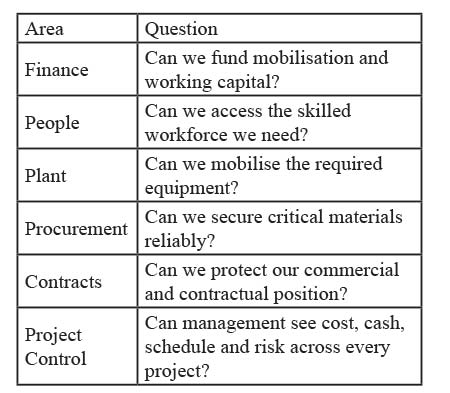 A Contractor Readiness Test for 2027
Before the program accelerates, every contractor should be able to answer YES to six questions:
These should be converted into measurable indicators and reviewed regularly at board and senior-management level. The industry must prepare before the tender arrives.
Sri Lanka now has a rare opportunity to convert public allocations into procurement, physical progress, completed assets and measurable public outcomes, while addressing contractor liquidity, labour, supply chains, contract management and implementation bottlenecks. For contractors, that means 2027 preparation should begin now. prepare the contracts team, prepare the cash-flow model, and prepare the digital systems, prepare the partnerships.
Because when the tenders arrive, it will be too late to start building capacity. The objective is not simply a larger order book. It is a construction business capable of financing, executing and completing major projects without sacrificing commercial viability. Rs. 2 trillion is the opportunity. Contractor readiness will determine what we can deliver.
(The author is the President of Ceylon Institute of Builders)




