Monday Oct 12, 2026
Monday Oct 12, 2026
Friday, 24 April 2026 04:32 - - {{hitsCtrl.values.hits}}
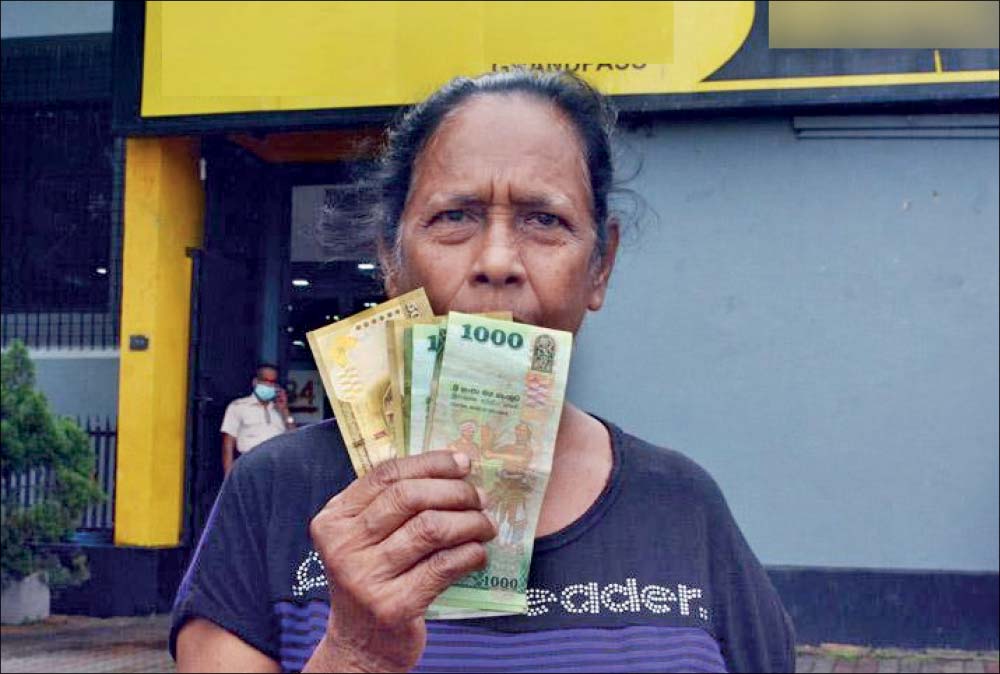
An Aswasuma recipient
 The fundamental idea of Aswasuma is good and important to address the poverty in the country and take away the political patronage. It is intended to determine the eligibility to receive Government cash transfer based on data, as opposed to one’s political affiliation
 Conversations about Aswasuma have sparked again with much criticism in social media for the Government decision to increase the cash transfer allowance in April. Many complained that undeserving ones are getting it, and the selection is politically biased. However, Aswasuma was designed to take away patronage politics, and it achieved that task way better than the previous social protection system, Samurdhi.
To understand the origin of Aswasuma, it is important to trace the contemporary history of social protection reforms. While social protection reforms were a much discussed topic, it formally started with Social Safety Net Project (SSNP), which was a World Bank funded project commenced in 2016. Under the project, it was proposed to establish a centralised welfare system that determines eligibility to receive social protection based on data (and objective criteria) instead of relying on the recommendation of local politicians or Samurdhi officials. Under Samurdhi, there was significant political intervention both through local Government politicians and Samurdhi officials who were political appointees. As a result of that, just 39% of households in the poorest of the country were estimated to received Samurdhi assistance in 2016. Therefore, a new system was required. The proposed system was to determine eligibility to social protection through Welfare Benefit Board (WBB) which would collect data and establish Welfare Benefit Integrated System (WBIS). This database then is expected to be used not just for cash transfer such as Aswasuma, but also to provide other subsidies by identifying the ones that are poor and vulnerable, or prone to different economic risks. However, the progress of this process was slow because neither politicians nor Samurdhi officials liked it as it adversely affected their power. But after economic crisis and default in 2022, the International Monetary Fund (IMF) and World Bank insisted on the implementation of this system, making it a condition to provide the loans. Thus, the Government had no option but to implement it. At this point, many politicians strongly resisted the implementation of the project. It was the external push that saw this new social protection system through. Aswasuma was the name given to this scheme by the Ranil Wickremesinghe Government. Former Minister Shehan Semasinghe led the project from the Government, in spite of the opposition within the Government.
As a result of the rush to implement it, Aswasuma scheme resulted in issues in its design and implementation. As a result of these issues, there are higher level of inclusion and exclusion errors (deserving people not getting cash transfer while underserving ones with higher income getting it)
Delayed reforms and rushed implementation
Aswasuma implementation was rushed because the Sri Lankan Government was required to fulfil the task of implementation of the social safety net program as part of the IMF program. It was one of the targets in the IMF program. First target was a minimum spending on social safety nets. IMF Staff Level Agreement on March 2023 states the following.
“The program will set a floor on Social Safety Net (SSN) spending of Sri Lankan Rupees (LKR) 187 billion in 2023 (0.6% of Gross Domestic Product (GDP), indicative target). Beyond 2023, the authorities will maintain SSN spending at least at 0.6-0.7% of GDP. “
In addition to the minimum spending, IMF insisted on the institutional reforms pertaining to social protection. Consequently, setting up new eligibility criteria, establishing social registry (database) and distributing cash transfers through the WBB was an IMF condition. IMF Staff report in 2023 March states,
“In parallel, the authorities will implement broader institutional reforms to improve efficiency, coverage, and targeting of the SSN. The authorities have made the Welfare Benefits Board (WBB) operational as the legal entity responsible for coordinating all SSN programs and reforms. They have also populated a new Social Registry, an electronic database of SSN beneficiaries, and obtained parliamentary approval of the new eligibility criteria for selecting beneficiaries for SSN programs. The eligibility criteria, developed with support from the World Bank, are based on objective and verifiable characteristics of households. Parliamentary approval of the welfare benefit payment scheme and application of the new eligibility criteria are expected by May 2023 (structural benchmark), which will allow the WBB to start selecting SSN beneficiaries using the new eligibility criteria. By January 2024, beneficiaries who are ineligible according to the eligibility criteria would no longer receive Samurdhi cash transfers. These reforms will be assisted by the World Bank and will help ensure that the SSN is well targeted and covers all eligible low-income and vulnerable household”
This external push however was crucial as the increasing poverty rates in Sri Lanka required the country to have a better social protection system, which had been put off for decades. Sri Lanka’s poverty rates increased from 11.3% in 2019 to 25% in 2022. So, the implementation of new social protection system had to be rushed. However, as a result of the rush to implement it, Aswasuma scheme resulted in issues in its design and implementation. For example, data collection for the first phase had issues as it was done in a rush which was made more difficult by Grama Niladari officers pulling off from the data collection. Thus, the data had issues. Subsequent studies show that eligibility criteria also need improvements. As a result of these issues, there are higher level of inclusion and exclusion errors (deserving people not getting cash transfer while underserving ones with higher income getting it).
Parliamentary approval of the welfare benefit payment scheme and application of the new eligibility criteria are expected by May 2023 (structural benchmark), which will allow the WBB to start selecting SSN beneficiaries using the new eligibility criteria
How to fix the issues
These have to be fixed to make it a better social protection program. However, the fundamental idea of Aswasuma is good and important to address the poverty in the country and take away the political patronage. It is intended to determine the eligibility to receive Government cash transfer based on data, as opposed to one’s political affiliation.
So the question is how to make it better and improve from its current status ?
First the Government (WBB as the responsible institution) should collect better data and verify those. This means that well trained individuals should collect data and those data should be verified whenever possible. For example, the WBB can use the electricity consumption, water consumption and ownership of assets as proxies to determine one’s wealth and income. These can be done through verifying collected data through the Ceylon Electricity Board (CEB), National Water Supply and Drainage Board (NWSDB), land registry, and the Department of Motor Traffic (DMT). WBB already verifies data with CEB.
Secondly, it is important to revise the indicators to assess the poverty and how such indicators are used in determining the eligibility. Currently, each indicator is assigned a specific weightage and based on that WBB calculate what is called ‘deprivation score’. This deprivation score is expected to reflect one’s poverty level, and based on that poverty level, the eligibility for Aswasuma is determined. Therefore, a change of indicators and weightage assigned to each indicator can change the deprivation score, thereby changing the result on eligibility to receive Aswasuma. Thus, it is important to revise the indicators as well as the weightage assigned to indicators to reduce inclusion and exclusion errors, or to prevent underserving people getting Aswasuma benefits.
This is not a novel practice. Most countries revisit the indicators and the weight assigned to it to improve the eligibility, and it is the sensible action to take. For example, Pakistan had done, Brazil had done it to name a few examples.
Social protection is not just about supporting the ones that are poor and vulnerable in long term, but also to support those who require short term Government support to get back on their feet. It should function as an unemployment benefit scheme. It is the responsibility of the Government to protect its people, and Sri Lanka has such a low labour demand. This means it is quite difficult to find employment, particular for those who live in rural areas
To this end, the Government can take a few actions. Firstly, it needs to assess the issues with existing indicators and weightage assigned to indicators, and revise those accordingly. This can be done by assessing the complaints received on Aswasuma, and by further verifying the data with CEB, DMT and other institutions. This will help the Government to identify where exactly the selection has gone wrong.
Secondly, the Government can conduct a new survey on all the applicants (and any new ones) based on revised indicators and weightage. This will provide an improved ‘deprivation score’ thereby improving the selection.
Thirdly, the Government needs to prepare a comprehensive method to assess one’s exit from Aswasuma and how long one should receive Aswasuma. The Government needs to decide how long the Aswasuma cash transfers will be provided before next assessment through a survey. Alongside, it is essential to support the recipients of Aswasuma to improve their capacity to find employment, thereby encouraging an exit from the program. It is important to communicate to recipients about the importance of exiting from the program, and incentives of it. However, there will always be set of people who will not exit from Aswasuma such as the elderly who are unable to work, and those who have severe disabilities and so on. They will be assessed, but will continue to receive cash transfers.
Fourth, the Government need to link Aswasuma with Samurdhi to empower the recipients through supporting for livelihood development. Fifth, Aswasuma should have a mechanism to support people who lose their jobs or income temporarily. Such people cannot wait till next survey or assessment, and their eligibility should be determined quickly, ensuring that they receive short term support. Social protection is not just about supporting the ones that are poor and vulnerable in long term, but also to support those who require short term Government support to get back on their feet. It should function as an unemployment benefit scheme.
The key to make these changes is to provide WBB with capacity and leadership both within the institution and the Government. There have to be one or two Government Members of Parliament (MPs) driving this program and these changes. WBB on the other hand should take ownership of clear communication and improving Aswasuma scheme. For this, the institution must be provided with sufficient capacity to carry out these tasks. WBB simply doesn’t have the required capacity to carry out the above-mentioned changes. Without ownership and capacity, you can’t do structural transformations.
So what’s gonna happen with revised assessment and data?
My guess is that total number of people who receive Aswasuma will not change significantly because inclusion errors are likely to be offset by the exclusion errors. That is to say some people who are currently getting it will not become eligible, while some people who are currently not getting Aswasuma will receive it. Some people will lose Aswasuma while new set of people will get it. Thus, it is unlikely to have any impact on the total Government spending to provide Aswasuma which anyway has a minimum limit of 0.6% of GDP as a part of the IMF program. The reality is that this amount of spending is going to remain the same as poverty rates are likely to remain doubt digit for a substantial period of time. It is the responsibility of the Government to protect its people, and Sri Lanka has such a low labour demand. This means it is quite difficult to find employment, particular for those who live in rural areas.
Govt. needs to assess the issues with existing indicators and weightage assigned to indicators, and revise those accordingly. This can be done by assessing the complaints received on Aswasuma, and by further verifying the data with CEB, DMT and other institutions. This will help the Government to identify where exactly the selection has gone wrong. Government also needs to prepare a comprehensive method to assess one’s exit from Aswasuma and how long one should receive Aswasuma
Conclusion
Thus, Aswasuma which is a result of years’ work on social protection reforms is a good system. It has many loopholes to fix, but those are to do with the program design and implementation. The current system, although it has been subject to much criticism, is much better than the previous system of Samurdhi scheme that had way more political influence. Aswasuma addresses that issue at its core. It needs improvements to make it a better and more efficient system. Good social protection schemes are not ready-made ones. Examples from other countries show that those systems improve over time by being open to change and enhancing the capacity of the institutions. Sri Lanka should do the same. We must work towards to improve the existing system, not to abandon it.
As often said, “don’t throw the baby out with the bathwater”
(The author is a researcher currently reading for his PhD in Development Policy and Management at the Global Development Institute (GDI), University of Manchester. He was a former lecturer at the University of Colombo, and Research Analyst in Finance Ministry. He can be reached via [email protected] )




