Why revenue dip amidst rising tourist arrivals is not necessarily a bad thing

Monday, 23 November 2026 00:26 -     - {{hitsCtrl.values.hits}}

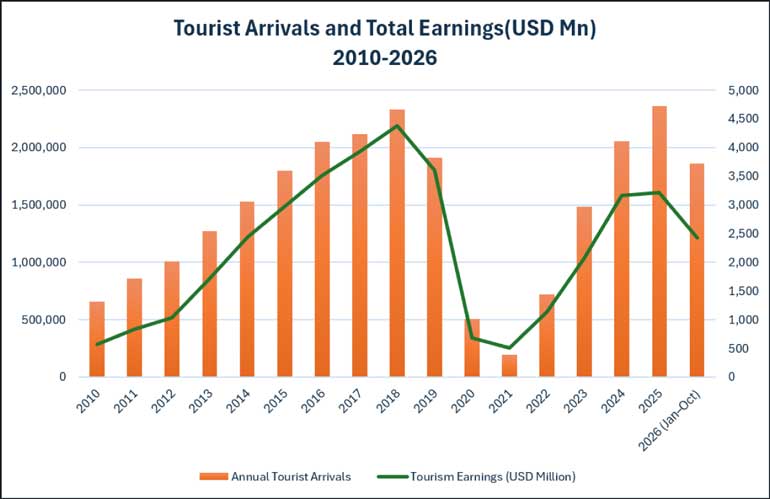
Note: 2026 figure is an estimation as per the September 2026 SLTDA report

Source: CBSL


Annual tourist arrivals are expected to hit an all-time high, at 2.4 million by the end of 2026. However, the revenue numbers tell a different story. Per tourist spending has reduced dramatically. The average spending for 2026 is expected to be roughly the same.


If we pass the 2.4 million mark in 2026, it will be an all-time high.

Why is per day spending getting lower?

Methodology revised to obtain realistic estimates, which is lower

The Central Bank of Sri Lanka (CBSL) in its External Sector Performance Report in February 2026, mentioned how the Sri Lanka Tourism Development Authority has changed their estimations based on Departure Surveys. 

Now, the SLTDA takes tourist arrivals, average stay period and average spending per day into account.

They have also considered the seasonality of average stay per tourist. Therefore, average spending per day is revised from August 2025. 

These revisions will give a more accurate, rather low figure of spending than previous.

LKR/USD Exchange Rate depreciated fast and service quality dropped due to rising inflation

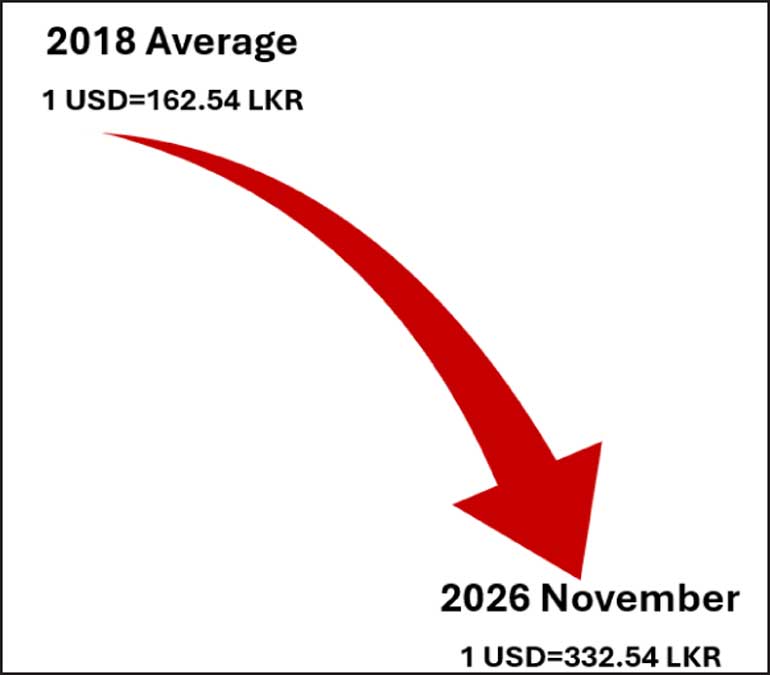
Therefore, fewer dollars are needed to purchase goods in Sri Lanka. The country was already grappling with many structural issues, mounting debt and the exchange rate ballooned out of control in 2022. 

As the products get ‘cheaper’ more budget travelers would opt to visit. Also, the imported goods fetch a very high price, then the quality of service begins to drop, foreign service providers, travel operators pull out their investment due to uncertainty. ‘High-end’ tourism will no longer be supported.

Informal sector leakages 

Informal sector transactions are very difficult to trace the flow. Most are cash and ledger books are not maintained. No records are kept. The services do not get captured in the GDP. 

Actual spending is less 

What the figures say, could be the plain truth. Tourists spend less than before. The latest reports show that the inflow from Western European countries have eroded, while India and China grab the top spots in source markets. Indian tourist arrivals make the largest share, close to 30%. 

For Indian and other Asian tourists, the cultural experience, the climate and surroundings are familiar to their home country. Therefore, the spending could be mostly on key, planned visit, or pre-determined at a package rate.

However, ‘unplanned’ sporadic spending can be expected from the Western tourists, outside their basic needs, owing to the different cultural experience.

On a brighter note

The money could be actually flowing into local communities, smallholder establishments

Another view is that the tourists are opting for smaller, informal service establishments/vendors. Their transactions are off record and mostly in cash. While State Revenue may not benefit, the local value chains could be thriving on this. However, there is little data to confirm this fact.

Frequent use of QR pay is an option

If the sector needs systematic, resilient growth, promoting digital payment methods is a must. It is not always about being captured for tax purposes, but also for transparency and safety of both service providers and the tourists. 

Microdata-driven analysis of service providers

Rather than solely relying on Tourists Surveys, a closer look of the characteristics of the service providers, amenities, surrounding can give a better perspective. And to cross-reference the survey data. Such a data driven exercise can give insights as to the quality of one of Sri Lanka’s main export.

(The author is an independent researcher in development and economic policy. The views expressed here are her own and do not necessarily reflect those of any organisation she is affiliated with) 

Recent columns

COMMENTS