Wednesday Oct 21, 2026
Wednesday Oct 21, 2026
Wednesday, 21 October 2026 00:22 - - {{hitsCtrl.values.hits}}

 Introduction
Most people associate me with tourism or my interest in wildlife. But before hotels and elephants took over much of my working life, I studied and trained as an electrical power engineer. With several people asking me why we are having power cuts again, I thought I would dust off that old engineering hat and attempt a simple explanation. I will leave the detailed diagnosis to those who operate the system today. But the basic principles have not changed.
What happened on Saturday?
The first thing to understand is that Saturday’s sudden blackout and the scheduled power cuts that followed are two different problems. The blackout occurred when the electricity system lost its balance. The subsequent cuts are being introduced because, with the coal station unavailable, there is insufficient generation available to meet demand during certain hours.
Electricity is rather unforgiving in this respect. At every instant, the amount being generated must closely match the amount being used. We cannot simply produce a little extra in the morning and leave it sitting in the wires until evening. To keep it for later, we need storage.
According to the explanation given by the National System Operator at the Ministry of Energy briefing, the output of Generator No. 1 at Norochcholai suddenly fell from 187 megawatts to less than 5 megawatts at around 11.43 a.m. on 17 October. In ordinary language, the system abruptly lost roughly 185 MW of supply, while consumers were still drawing electricity.
When this happens, the remaining generators initially take the strain and begin to slow. The electrical frequency, normally maintained around 50 hertz, falls. Other generators must respond quickly, or some demand must be disconnected automatically. If the imbalance is not arrested, more generating units can disconnect to protect themselves, making matters worse until the system collapses. That is the broad mechanism of a cascading blackout. The investigation must establish the exact sequence in this case.
Losing one generating unit should normally be a disturbance the system can survive. Power systems are designed to allow for this. Equipment can fail but the rest of the system must be prepared for that possibility. So identifying the first unit that lost output is only part of the explanation. We also need to know why the available reserves and protective control mechanisms did not contain the failure.
Different sources, different limitations
Our electricity comes from a mixture of sources, each with its own strengths and limitations. Norochcholai has three coal-fired units of 300 MW each, giving it a nameplate capacity of 900 MW, with about 810 MW used as its net capacity in planning. This accounts for almost 1/3 of our generating capacity. Therefore it is evident that we are very dependent on the coal plant for our base load requirements.
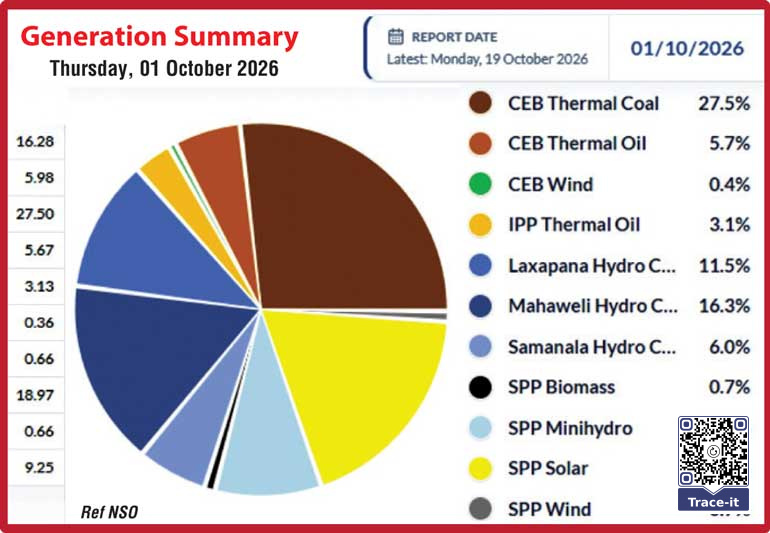
We also have a substantial hydroelectric capacity, oil-fired engines and turbines, and growing solar and wind generation. These are not interchangeable machines that can all be switched on and off in the same way. The generation sources for 1 October 2026 is shown in the graph.
Coal is generally suited to supplying a steady block of electricity over prolonged periods at low cost. A coal station is a large steam-producing system where water must be heated, steam generated, and the turbine brought up to speed and loaded carefully. It is not like starting a diesel generator at the flick of a switch. A brief trip in the coal generation system can sometimes permit a hot restart, but faults, inspections and restoration procedures can keep a unit out for days. In this instance, the entire station is expected to remain unavailable for several days.
Oil-fired engines and some gas turbines can respond much more quickly. The downside is the cost of fuel. They are useful for meeting peaks and filling gaps, but extensive replacement of coal generation with oil is expensive.
Hydro is particularly valuable because reservoir stations can change output quickly. However, the water in a reservoir is a finite stock. Its use today affects what remains for tomorrow, and some reservoirs also have irrigation and other obligations. Rainfall determines how that stock is replenished. With uncertain weather and the risks posed by climate change, we cannot operate as though the next rains are guaranteed to arrive on schedule.
What replaced the coal?
The figures for two recent Sundays show what happened when coal disappeared. On 11 October, coal supplied 29.4% of the day’s electricity and oil only 0.8%. On 18 October, coal supplied nothing, while oil’s share rose to 23.7%. Hydro, including mini hydro, supplied 52.4%, and solar contributed 22.2%. The system was being kept supplied through a very different combination of sources, with much greater dependence on oil and water.
Why more solar is only part of the answer
People understandably ask why we cannot simply install more solar panels. Solar is useful because it reduces imported fuel consumption and can allow operators to save reservoir water during daylight for use in the evening. But panels generate according to sunlight, rather than according to when we switch on our appliances. After sunset, their direct contribution disappears, just as households are switching on lights, cooking and adding to the evening demand.
On a sunny Sunday or public holiday, the opposite difficulty can arise. Industrial and commercial demand is lower, while solar output may be strong. Operators must reduce other generation or limit some solar output. Coal units cannot be turned down indefinitely, and shutting them down creates another set of problems as explained earlier. Taking too many conventional generators offline can also reduce the system’s ability to absorb sudden disturbances, unless other equipment supplies the necessary support. This does not make solar a bad technology. It means the rest of the electricity system must be developed alongside it.
There is another complication on such days. Solar output can fall quickly when cloud cover moves across an area. Consumers continue using electricity, so other sources must promptly make up the difference. When many solar installations are spread across the country, these local changes tend to smooth one another out. But cloud cover affecting a large concentration of panels can cause a substantial drop. On a low-demand weekend, when fewer conventional generators may be running, there may be less immediate support available. Batteries and responsive hydro can help bridge that gap. Passing clouds should be a manageable operating condition, but without sufficient fast response they can add to the risk of instability. This is a general operating challenge.
Storing electricity for when we need it
Storage helps connect these two situations: electricity available at midday and electricity needed after sunset. Batteries can store energy and return it later. Properly configured, they can also respond very quickly when frequency begins to fall, but their size and operating arrangements matter. Our current available battery fleet (Battery Energy Storage System BESS) is only around 30 MW, as indicated in the figures being discussed, that is about 1% of a 2,800 MW evening peak.
We must also ask how long the batteries can deliver their output. A 30 MW battery capable of operating for one hour is quite different from a 30 MW battery capable of operating for four. Announcing megawatts without stating the storage duration leaves out half the story. Larger schemes are being procured, but a project on a procurement list cannot supply electricity tonight.
Pumped storage: Old idea still waiting
Then there is pumped storage, an idea Sri Lanka has discussed for years. It is fairly straightforward where electricity is used when it is plentiful to pump water from a lower reservoir to a higher one. When demand rises, release the water back through turbines to generate electricity. Some energy is lost in the process, but we gain the ability to use the remainder when it is more valuable.
JICA-supported pumped-storage planning studies were undertaken in 2013–2015, and CEB’s generation plan identifies a 600 MW Maha Oya scheme with storage for about six hours at full output. The need was recognised well over a decade ago. These projects require substantial investment, environmental assessment and construction time, but those requirements make timely decisions more necessary. So we are still talking about the pumped storage scheme.
Why the power cuts continue
For the public, the immediate answer is therefore fairly simple. Saturday’s blackout began with a sudden loss of generation that the system failed to contain. The evening power cuts that followed are intended to reduce demand while a major source of supply (the coal plant) remains unavailable. Disconnecting selected areas in a controlled manner is a way of avoiding another uncontrolled collapse, until the coal plant can be re-started.
There is no single machine that will solve all these problems. We need dependable generation, well-managed water reserves, adequate storage and controls that can contain a sudden failure. Consumers can help by moving suitable activities into daylight hours, encouraged by sensible tariffs. But responsibility for matching generation investment with the equipment and reserves needed to operate it securely rests with those planning and managing the system.
The consumer should not have to understand any of this to expect a reliable supply. For those responsible for providing it, however, counting the megawatts installed is insufficient. They must know what can actually be delivered on a dry evening, how quickly help will arrive when a unit fails, and how long that help can last.
Notes




