Friday Nov 06, 2026
Friday Nov 06, 2026
Friday, 6 November 2026 00:18 - - {{hitsCtrl.values.hits}}
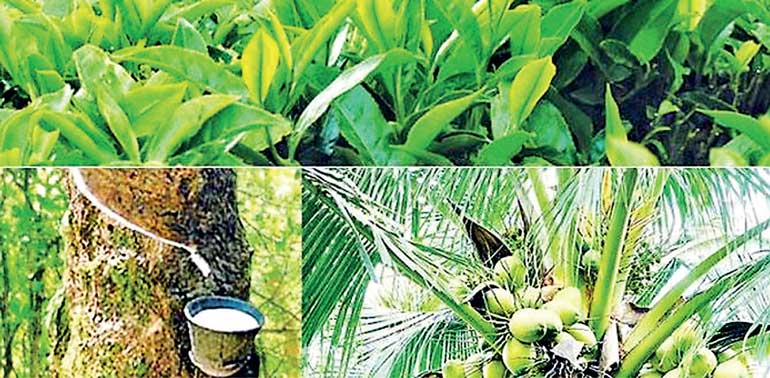

A tea bush planted today may take five years to produce a crop, a decade to generate meaningful returns and more than 20 years to repay the investment. Yet Sri Lanka’s regional plantation companies have only 19 years remaining on their leases. This is the contradiction at the heart of the country’s plantation economy: an industry whose future depends on long-term investment is operating within a policy framework that makes such investment increasingly difficult to justify.
The stakes extend well beyond the estates. According to the World Bank, Sri Lanka’s wider agrifood system accounts for roughly one-sixth of national output, supports over 40% of employment and contributes nearly 30% of goods exports. Within plantations, however, the pressures are mounting. Tea production during the first seven months of 2026 declined by 3% to 152.5 million kilograms. Sheet rubber production fell by nearly 18%, while tea export earnings decreased from $ 743
million to $ 701 million.
Costs have moved in the opposite direction. Labour accounts for approximately 65% of production costs, while the Rs. 200 wage increase added an estimated Rs. 6 billion to industry expenditure. Disruption around the Strait of Hormuz has pushed fertiliser prices from approximately Rs. 100,000 to Rs. 220,000 per metric ton, alongside rising freight and energy costs. Irregular rainfall, prolonged drought and a shrinking workforce have further complicated production.
Yet these figures tell only part of the story. Across Sri Lanka’s plantations, companies are investing in automation, higher-value products and alternative crops. The industry’s capacity to adapt is evident. What it requires now is a policy environment equally prepared for change.
Investment cannot flourish without certainty
Regional Plantation Companies (RPCs), which manage approximately a quarter of Sri Lanka’s tea acreage, have already demonstrated what productivity-led transformation can achieve.
Automation and factory consolidation has improved productivity in processing centers enabling to optimise production capacities. Such improvements illustrate how investment can strengthen competitiveness even amid rising costs.
But modernisation cannot be sustained through operational efficiency alone.
Plantation leases, originally granted for 99 years in 1992, were subsequently reduced to 53 years. With only 19 remaining, the commercial case for replanting becomes increasingly difficult. Banks cannot reasonably be expected to finance projects whose investment recovery extends beyond the lease period.
Restoring the outstanding 46 years would provide the certainty needed to unlock replanting, diversification and new investment, including opportunities in leisure and other estate enterprises. Government engagement on this matter is welcome, but a timely resolution would send a far stronger signal to investors than continued discussion.
The same long-term thinking must guide diversification. In parts of Uva, annual rainfall falls below 500 millimeters, making conventional tea cultivation increasingly challenging. Where conditions no longer support viable tea production, alternative crops offer opportunities to generate greater value from existing land.
Coffee, avocado and cinnamon are already demonstrating this potential. At Malwatte, avocado planting density has increased from 150 to 800 plants per hectare since 2015, while approximately 60% of cinnamon processing has been automated.
Yet high-density coffee cultivation can result in the loss of subsidies, while restrictions on oil palm have limited cultivation to approximately 10,400 hectares against a planned 20,000. Agricultural policy should encourage commercially sound, environmentally responsible adaptation rather than constrain it.
Competitiveness must be built on value, not volume alone
Sri Lanka’s opportunity lies not simply in producing more, but in producing better.
Value-added teas now represent more than half of the country’s tea export volumes. Producers are investing 100’s of millions in specialised products, including matcha, green and artisanal teas.
This shift towards higher-value production is encouraging. However, the trading environment must recognise and reward such investment.
Approximately 30% of locally produced green and CTC tea remains unsold, while lower-cost imports enter duty-free for re-export blended with 30% of local teas. This 30% local-content requirement has remained in place for approximately three decades.
The Planters’ Association proposes increasing this requirement to 50% and applying equivalent testing standards to imported tea. The objective is not to retreat from international competition, but to ensure that domestic investment in quality and value addition can compete on equitable terms.
Scientific capability is equally fundamental to competitiveness. As international markets tighten maximum residue limits, commercially viable alternatives to several widely used herbicides remain limited, and domestic testing infrastructure requires strengthening.
The Tea, Rubber and Coconut Research Institutes too need strengthening to work more closely with plantation companies to develop practical crop-protection solutions, climate-resilient planting material and disease-resistant varieties etc.
The threat of Pesta disease to rubber reinforces the urgency. Sri Lanka’s agricultural future will depend increasingly on how effectively scientific research translates into productive fields.
Sustaining this capacity depends on retaining skilled personal. Sri Lanka must create an enabling environment that ensures the retention of its full cadre of scientists, addresses the anomalies affecting them and placing the cadre structures of research institutes in line with those of university academia.
The opportunity for a modern plantation economy
Modernisation also demands a more practical approach to regulation.
Drip irrigation offers considerable potential for improving water efficiency, supporting high-density cultivation and strengthening resilience against drought. Yet existing tube-well approval procedures can delay investment even where responsible groundwater management can be demonstrated.
Environmental protection and agricultural productivity need not be competing priorities. Transparent, science-based regulation can safeguard water resources while enabling responsible investment.
Similarly, effective estate-land management is essential. Encroachment on productive land, staff quarters and stream reservations creates operational uncertainty and environmental risks. Delays in enforcing lawful orders compound these difficulties.
Predictable enforcement, with appropriate legal safeguards, would strengthen investor confidence while protecting land and surrounding communities.
These challenges are interconnected, but so are their solutions. Secure tenure encourages replanting. Research supports productivity and quality. Diversification improves resilience. Fair trading arrangements reward innovation, while effective regulation protects long-term investment.
The plantation industry must continue doing its part through technological adoption, operational reform and responsible land management. Policymakers, in turn, have an opportunity to establish the conditions in which these investments can flourish.
Sri Lanka possesses internationally recognised agricultural products, established export markets, experienced producers and considerable scope for technological transformation. These are substantial competitive advantages.
The ambition should therefore extend beyond recovering historical production levels. It should be to build a more diversified, productive and resilient agribusiness economy capable of generating greater value from every hectare.
The foundations for that transformation already exist. What Sri Lanka needs now is the policy conviction to build upon them.
(The author is Chairman, Planters’ Association of Ceylon)



