Thursday Oct 15, 2026
Thursday Oct 15, 2026
Friday, 12 December 2025 00:28 - - {{hitsCtrl.values.hits}}
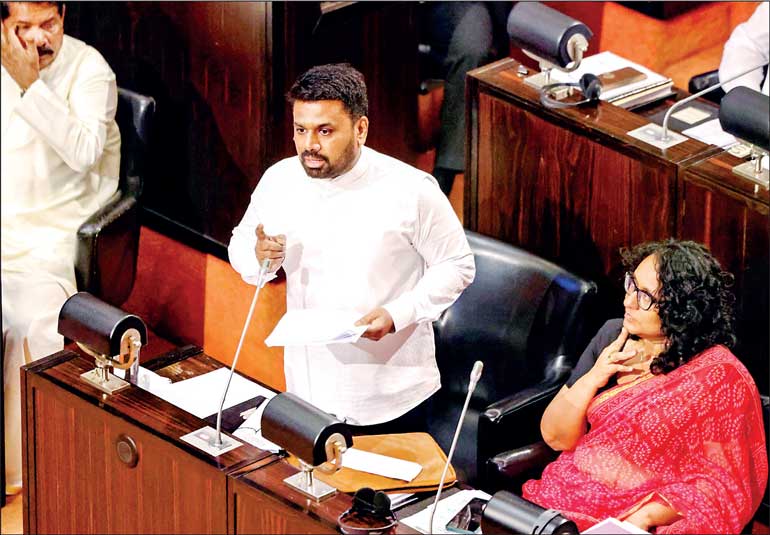
President and Finance Minister Anura Kumara Dissanayake presents the 2026 Budget in Parliament on 7 November
– File photo
 Towards a national reading of the Budget
 Sri Lanka is now facing one of its gravest natural disasters in recent memory, as Cyclone Ditwah and the associated weather system continue to bring relentless rain, flash floods, and landslides across the island. In view of the severe disaster situation, Speaker Jagath Wickramaratne has announced an amended schedule for the Committee Stage debates on the 2026 Budget in Parliament. It is important to note that President Anura Kumara Dissanayake presented the 2026 Budget to Parliament —prior to the onset of this national calamity—in his capacity as the Minister of Finance. Since its presentation, various interpretations have emerged from economists, the business community, academics, and civil society. Some analyses draw on economic expertise, others reflect social understanding, while certain groups read the Budget through political ideology. But with the country now grappling with a humanitarian and economic emergency, it is clear that fragmented interpretations will not suffice. This is a moment when Sri Lanka needs a unified, responsible, and collective “national reading” of the Budget—one that rises above personal or political positions and focuses on safeguarding citizens, restoring stability, and guiding the nation toward recovery.
This Budget is unique for several reasons. To understand it properly, we must “read” it through the lens of Sri Lanka’s current economic realities as well as the fiscal consolidation pathway outlined under the International Monetary Fund (IMF) program. Some argue that this Budget reflects a liberal policy orientation, citing several key allocations that support this view: strong investment in human capital, an infrastructure-led growth strategy, targeted support for private enterprise and MSMEs, and an emphasis on fiscal discipline and transparency.
Anyway, it can be argued that it is still too early to categorise the 2026 Budget as a fully liberal Budget approach, especially when considering the structural realities that continue to shape Sri Lanka’s economy. Still the some sectors in Sri Lanka restricted private-sector space, with state dominance. And also, we can witness a weak performance-based management system with no strong KPI-linked monitoring or institutional performance cells. Moreover, the country still maintains a broad subsidy orientation, where extensive welfare transfers may constrain productivity unless they shift toward targeted and time-bound mechanisms. Even though we can see improved tax administration in the recent past, there is a need to have proper tax rationalisation, requiring significant simplification to become broad-based and globally competitive. These factors collectively indicate that, despite certain reform signals, it may be premature to label the 2026 Budget as fully liberal in nature.
Overall, Sri Lanka needs to have proper monitoring mechanisms for the Budget. Even if it is a liberal type, development, or any type of Budget, we need to see how we can have a Budget monitoring system.
Establish a National Budget Performance and Evaluation Office
 Whatever the Budgets presented last seven decades, the implementation of Budget proposals can always be mostly considered as around 30-50 %. Sri Lanka needs to have proper Budget monitoring mechanisms. This is not only important for the Budget but also for all other activities in Sri Lanka. Most of the countries in the world have this, and we can learn many best practices from them.
Establishing a National Budget Performance and Evaluation Office is essential for strengthening Sri Lanka’s fiscal governance and ensuring that public spending delivers measurable value. Such an office would provide an independent, data-driven mechanism to track Budget implementation, monitor program outcomes, and evaluate whether ministries achieve their intended results. Drawing from global best practices—including India’s PFMS-enabled monitoring and OECD program-based Budgeting frameworks—the office would develop clear KPIs, performance scorecards, and annual evaluation reports linked to national priorities. By integrating financial data, output metrics, and policy outcomes, this institution would enable evidence-based decision-making, improve Budget credibility, reduce wastage, and foster greater transparency and accountability across the public sector. Ultimately, this would help shift Sri Lanka’s Budgeting process from input-focused allocations toward performance-oriented results.
Conclusion
There is an urgent need for a paradigm shift in Sri Lanka’s economy, where export diversification, strengthened governance, and institutional efficiency become essential pillars of reform. Establishing a National Budget Performance and Evaluation Office is a critical step that can help the country address many long-standing challenges related to governance, fiscal discipline, and evidence-based decision-making. Such an institution would create the mechanisms required for transparency, accountability, and performance-focused Budgeting. Ultimately, for Sri Lanka to gain greater global recognition and move toward a more stable, credible economic future, every stakeholder must be equipped with the right knowledge, tools, and systems that support disciplined financial management and a respected national identity.
(The author is a Professor in Management Studies, Open University of Sri Lanka, and can be reached at [email protected].)




