Monday Sep 21, 2026
Monday Sep 21, 2026
Tuesday, 3 February 2026 02:30 - - {{hitsCtrl.values.hits}}
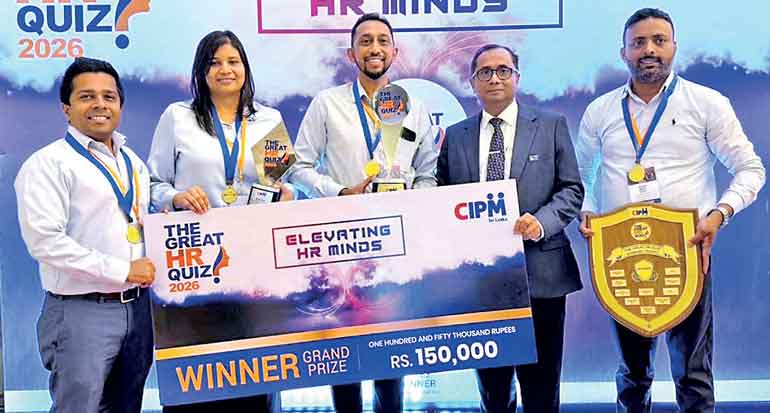
The Great HR Quiz 2026, conducted by CIPM Sri Lanka on 28 January at Monarch Imperial, Sri Jayewardenepura Kotte, was more than a competition. It was a statement of intent. A signal that professional assessment in Sri Lanka is beginning to catch up with the realities of a world where information is abundant, but judgment, context, and application are scarce.
For over a decade, the Great HR Quiz has been a much-anticipated fixture in the HR calendar, celebrating technical knowledge and conceptual clarity. In 2026, however, CIPM made a deliberate and bold shift — from testing what participants know, to how they think, decide, and act. The result was a future-ready quiz that assessed experience, insight, and strategic judgment rather than rote recall.
 This year’s quiz was structured around the 16 HR Dimensions of the Great HR Awards, ensuring full alignment with CIPM’s broader framework of HR excellence. Participants were challenged through scenario-based multiple-choice questions spanning the entire employee life cycle — from strategic workforce planning and talent development to employee wellbeing, industrial relations, digital HR, ESG, and the future of work. An additional round on sports and current affairs tested agility, awareness, and breadth of thinking — capabilities increasingly essential for modern leaders.
Why this shift? Quite simply, because the world has changed.
Knowledge today is freely available. Textbooks, search engines, professional networks, and now artificial intelligence have democratised access to information. In such a context, the value of memorisation as a primary assessment tool is rapidly diminishing. What truly differentiates professionals is not what they know, but what they do with what they know.
This thinking is not unique to Sri Lanka. Globally, education and professional assessment systems are moving decisively away from memory-based testing. Finland, consistently ranked among the world’s best education systems, places minimal emphasis on standardised exams, instead prioritising problem-solving, collaboration, and real-world application. Singapore’s SkillsFuture initiative similarly focuses on applied competencies and continuous learning rather than academic recall.
Professional institutes have led this transition even more decisively. The Chartered Institute of Personnel and Development (CIPD) in the UK has redesigned its qualifications to emphasise applied assignments, workplace evidence, and reflective practice. The Society for Human Resource Management (SHRM) in the United States assesses candidates through situational judgment questions that test decision-making in complex, ambiguous scenarios. The Project Management Institute (PMI) revamped its PMP examination to focus heavily on real-life project situations rather than theoretical definitions.
The message is clear. The future belongs not to those who know the most, but to those who can apply knowledge with wisdom, courage, and impact. It is time our education systems caught up
Against this global backdrop, CIPM Sri Lanka’s evolution of the Great HR Quiz stands out as both timely and courageous. Every question was carefully designed and reviewed by a distinguished Technical Committee to ensure relevance, rigour, and fairness. The emphasis was on assessing applied competence — evaluating how HR professionals balance people, performance, ethics, and business impact in real organisational contexts.
The enthusiastic participation and high level of engagement witnessed at the event confirmed the success of this approach. Teams grappled with nuanced scenarios, debated trade-offs, and demonstrated the kind of strategic thinking expected of contemporary HR leaders. The winners, proudly captured in the event’s celebratory photographs, exemplified not just knowledge, but clarity of thought, confidence of judgment, and professional maturity.
Beyond celebrating excellence, the Great HR Quiz 2026 carries a much larger message — particularly for educators, academics, and education policymakers in Sri Lanka.
If professional bodies are moving decisively towards experience-based and judgment-driven assessment, can our education system afford to remain anchored in memorisation-heavy examinations? Knowledge will always matter. Foundational understanding is essential. But in an era where information can be retrieved in seconds, education must prioritise sense-making over storage, application over accumulation, and thinking over ticking the right box.
Knowledge will always matter. Foundational understanding is essential. But in an era where information can be retrieved in seconds, education must prioritise sense-making over storage, application over accumulation, and thinking over ticking the right box
Sri Lanka’s aspiration to be a knowledge-driven economy will not be realised by producing graduates who can reproduce content, but by developing professionals who can analyse, decide, and lead in uncertain environments. This requires a fundamental rethinking of assessment philosophies across universities, professional programmes, and national examinations.
CIPM Sri Lanka, through the Great HR Quiz 2026, has demonstrated what such a shift can look like in practice. By aligning assessment with real-world capability frameworks and global best practices, CIPM continues to strengthen its position as the custodian of HR professionalism in the country.
The message is clear. The future belongs not to those who know the most, but to those who can apply knowledge with wisdom, courage, and impact. It is time our education systems caught up.
As Sri Lanka’s HR fraternity celebrates the success of the Great HR Quiz 2026, one hopes that its ripple effects will extend far beyond the ballroom — into classrooms, lecture halls, and policy chambers across the nation.




