Saturday Oct 10, 2026
Saturday Oct 10, 2026
Saturday, 10 October 2026 00:00 - - {{hitsCtrl.values.hits}}
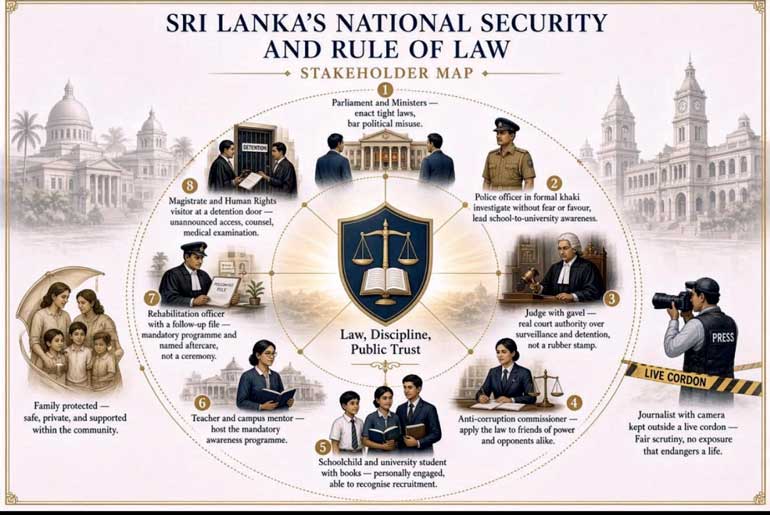
 The statute in the middle will not police itself. I am the son and the grandson of two police officers who rose from the lowest rank, and I was brought up inside a police training school. What I watched, from the first parade to the last entry in the book, was a duty with a name on it. It was a grand family environment, and it is the reason I could render whatever service I have rendered. The Prevention of Organised Crimes Bill, gazetted on 6 October, the Protection of the State from Terrorism Bill tabled to replace the Act of 1979, and the Anti-Corruption Act as tightened this year, will stand or fall the same way. Not in the preamble. On whether every stakeholder in the circle does the one job that is his, and refuses the job that is not.
The test is whether a judge can say no?
Three statutes are now before the country, and the argument around them has been conducted almost entirely in slogans. The Prevention of Organised Crimes Bill, gazetted on 6 October, is called a police blank cheque. The Protection of the State from Terrorism Bill, sent to Parliament the same day to replace the Prevention of Terrorism Act of 1979, is called the old law under a new name. The Anti-Corruption Act No. 9 of 2023, tightened this year, is treated as a side show. None of these readings is an analysis. Severity is not the test. The test is judicial independence: whether a court can refuse the power, and whether the executive can proceed without that refusal mattering.
The missing statute
The organised-crime bill is the most necessary of the three, and the easiest to defend if the court authority in it is real. For years, suspects in drug trafficking and syndicate crime were held under the PTA because ordinary procedure could not carry the case. The Cabinet cleared a dedicated bill on 8 September to end that practice. Minister Vijitha Herath’s distinction was the correct one. These men are not terrorists, and a terrorism file crowded with them is a professional failure. The bill gives effect to the United Nations Convention against Transnational Organised Crime. Membership of an organised criminal group for the purpose of a serious crime carries five to twenty years and a fine of up to Rs. 1 million. Detention runs two months at a time, to a ceiling of one year. Digital surveillance, interception, undercover deployment and extraction of data from devices sit under court authority. Victim identity is protected. There is no retrospective reach
The street has already made the operational case. Police recorded 114 shootings and 60 deaths in 2025. By late September this year organised-crime shootings stood at 38, with 25 dead, leaders directing from overseas, red-notice repatriations under way and asset action running into billions. The shooter is the expendable end of the chain. The network is the facilitator, the boat owner and the man who moves the money. Ordinary procedure was written for a man caught in the lane. It was not written for a group that replaces him before the inquest is closed. A law that criminalises the group, and puts covert access under a judge who can say no, is an investigation. A law that merely lengthens custody is a round-up.
Judicial independence safeguards
Independence is not a visit to a cell and it is not a preamble. It has four conditions, and each of these statutes should be read against them.
The first is the power to refuse. A judge who records an application he cannot reject is not independent. He is a witness to an executive act. Authorisation of interception, device extraction and extended detention must be written so that refusal is an ordinary outcome: reasons, a record, and a short appeal. Silence must not be treated as consent. On the organised-crime bill this is the feature that separates an investigation from a habit. Parliament should say so in the text, not leave it to practice.
The second is the power to see the material. Review without the underlying grounds is theatre. A court asked to extend detention, to confirm a freeze, or to authorise covert access has to be shown why, under a procedure that protects sources without emptying the hearing. Ex parte applications are sometimes unavoidable. They are not a permanent state. The affected person, or counsel cleared to see the gist, must have a route back before the same judge.
The third is a reviewer whose tenure does not depend on the minister whose order is under challenge. A sitting judge, or a panel nominated by the Judicial Service Commission, with reasons published, meets that test. A committee appointed by the authority it advises does not. Advice is not a decision. A recommendation that can be ignored is not a safeguard.
The fourth is a clock that cannot be reset. Detention, remand and a fresh order must not be stacked so that the statutory ceiling is a fiction. One aggregate period, one court, one record. Unannounced access, counsel and a Judicial Medical Officer are necessary protections against torture. They are not a substitute for a judge who can order release.
Where the terrorism bill still fails
The Protection of the State from Terrorism Bill improves on the Act of 1979 in ways that should be kept. A suspect is to be produced before a magistrate within 48 hours. Counsel, notice to the Human Rights Commission, medical examination and a restriction on custodial confessions are in the text. Detention is capped at one year in aggregate. Extension beyond two months requires High Court approval. A review committee is to examine necessity, legality and proportionality. These are the difference between a detention and an abduction.
They are not yet judicial independence. Human Rights Watch and the World Organisation Against Torture have marked, this week, the residuum that should not survive committee. Detention orders are obtained by the Inspector General or a Deputy Inspector General from the Defence Secretary. A magistrate cannot set them aside. Using separate provisions, a person can be held without charge for up to two years. Search and arrest on reasonable suspicion are extended to the armed forces and the Coast Guard, outside a police chain of command. The review committee is appointed by the minister whose orders it reviews, and it recommends. It does not decide.
That structure fails the four conditions. The magistrate cannot refuse. The reviewer depends on the minister. The clock can be walked from detention to remand. Armed forces given police powers without a short handover and a police chain of command sit outside judicial sight for the hours in which abuse is easiest. Pass the law. The threat has not retired: Dalada Maligawa, political assassination, a thirty-year campaign, Easter Sunday 2019, residual facilitation and regional spillover. Cut the residuum until a judge can quash the order, see the grounds, and release. A statute where a hostile minister can aim at a rival destroys the intelligence product, because sources go silent when they believe the file is political.
The stronger model
The anti-corruption statute is already in force, and on this test it is the better draft. Act No. 9 of 2023 constituted the Commission as a body corporate that acted without direction other than from a court, and reached private-sector bribery and trading in influence. A freeze of property must be confirmed by the High Court within a fixed period. This year’s amendment adds a mandatory penalty of not less than three times the value of corrupt property, recovery of the full loss to the State, and bail only from the High Court, in exceptional circumstances, where the bribe is at least Rs. 100,000 or the loss is at least Rs. 500,000. The judicial lock on bail and on frozen assets is the point. Independence fails if the Commission is brave only against the unconnected, and it fails if a lower court can unwind a major case that Parliament has reserved to the High Court.
Every durable syndicate, and every facilitation chain that has fed a terrorist act, has rented an official somewhere: a port, a registry, a prison, a police station. Corruption is the logistics of the other two threats. A security law that cannot reach that official is half a law. The organised-crime bill should copy this discipline. Court authority that is not confirmed, recorded and open to refusal will become the rubber stamp the terrorism bill already risks.
The officer, the child, and the follow-up
The remaining duties sit around that judicial core. None of them replace it. The officer on the ground needs welfare enough to do the right thing without fear or favour: a predictable chain of command, cover for action taken in good faith inside the statute, insurance, and protection for his family when a syndicate has the address. That welfare is not a shield for fabrication, for a beating in a cell, or for a file opened to please a politician. The lines of a training school protected the man who kept the procedure. They did not protect the man who broke it. This writer was raised inside one, the son and the grandson of two officers who rose from the lowest rank. The formation was procedure from start to finish. It is the standard, not a memoir.
The same service should own a mandatory awareness programme from the classroom to the university, with the student personally engaged rather than seated for a speech. The gang recruits where the State is absent: the school gate, the tuition class, the hostel, the phone. A child who can recognise a runner, and who has met a serving officer as a carrier of procedure, is harder to enlist. The lesson dies if the child then watches the officer taking from the gang the class warned him against. Crime prevention of this kind is cheaper than the shooting now being counted, and it is the only way the new statute does not spend the next decade processing children the last decade failed to reach.
Rehabilitation, where diversion from a terrorism prosecution is justified, or where a sentence is served and the risk remains, should be mandatory, and the follow-up as mandatory as the order. A named officer, a family contact, a placement, and a review that can return a man who drifts. Prosecution remains for the organiser and the man with blood on his hands. A certificate without a follow-up is a ceremony. An order used to silence a critic would wreck the programme in the same stroke.
Fair scrutiny of a completed case stays.
Malicious publication of a home address, a child’s school or a live cordon, done to intimidate or to obstruct, should be a separate offence, distinct from reporting an allegation of abuse. A ten-second clip is not a judgment. Officers who learn that initiative is punished twice, once by the gang and once by the fragment, stop making the lawful stop. Training in that environment is as necessary as the narrow rule against exposure. Diplomatic in manner, strategic in timing. Not media performance.
The standard
Judicial independence is the hinge. Without a judge who can refuse, the organised-crime power becomes a habit, the terrorism detention becomes executive custody with a visit attached, and the anti-corruption freeze becomes a headline. With that judge, the three statutes can do the work they were written for. The gang comes out of the terrorism file. The cell is met with a law tight enough to survive a hostile minister. The rented official is reached without favour. The child is formed before the network reaches him. The man who leaves a rehabilitation centre is owned after the certificate.
National security
National security is the first duty of the State. It is not a permit for prejudice, vengeance or communal selection. A law that cannot be used is a failure. A law no court can stop is a failure of a worse kind. Welcome the organised-crime bill. Pass the terrorism bill only with the residuum cut. Apply the anti-corruption law to the friend of power at the same speed as to the opponent. Give the officer the confidence to do the right thing, and withdraw it the moment he does the wrong one. Parliament’s job this month is to tell those duties apart. Anything less will be paid for in funerals, or in a service the public no longer trusts.
(This analysis is offered in the interest of national security, institutional reform, and public safety)
(The author is a retired Senior Superintendent of Police, former head of the counter terrorism desk at the state intelligence service, a former member of the Sri Lanka Wakfs Board, and the author of Security Beyond Enforcement: Practical Approaches for a Safer Nation (2026). [email protected])




