Saturday Oct 03, 2026
Saturday Oct 03, 2026
Thursday, 21 May 2026 04:17 - - {{hitsCtrl.values.hits}}
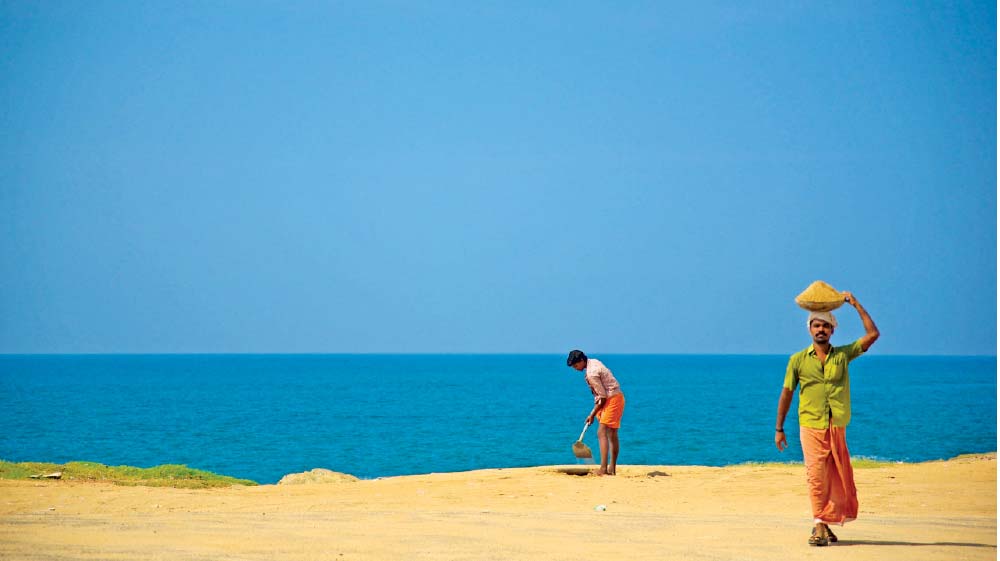
 Welfare was not the failure; the failure was the absence of a productive economy strong enough to sustain welfare
To a traveller crossing the waters between South India and Sri Lanka, Kerala and Sri Lanka may appear less like strangers than reflections of each other. Both share tropical landscapes, strong traditions of education and public health, extensive overseas migration, and human development indicators that have long stood out in South Asia.
For decades, both fascinated students of development. They achieved social outcomes unusually advanced for their income levels: high literacy, broad healthcare access, long life expectancy, social mobility, and extensive public welfare. They proved that human development need not wait until a country or region becomes rich.
These achievements were not accidental. They reflected deliberate public investment in education, health, welfare, and social inclusion.
Yet the comparison has become more difficult today. Sri Lanka suffered a sovereign default in 2022, followed by shortages, inflation, debt restructuring, and social hardship. Kerala, too, has faced fiscal pressure, debt concerns, salary and pension burdens, and borrowing constraints. But Kerala did not collapse in the way Sri Lanka did.
This contrast raises the central question: if both invested heavily in welfare and human development, why did both come under fiscal pressure, and why did Sri Lanka break while Kerala only bend?
The answer is not that welfare failed. Welfare was not the failure; the failure was the absence of a productive economy strong enough to sustain welfare. The issue is not whether welfare is good or detrimental, but whether a society has built the productive capacity to finance it over time.
Social progress without economic depth
Sri Lanka and Kerala succeeded in building societies with high social expectations. But success itself created new obligations. A literate and healthier population expects decent employment, reliable public services, pensions, healthcare, infrastructure, and dignity in old age.
Such expectations require a strong economic base: productivity, exports, investment, tax revenue, and efficient public administration.
This situation is where both Sri Lanka and Kerala faced a common weakness. Social progress advanced faster than economic transformation. Public services expanded, public-sector employment grew, pension obligations increased, and recurrent expenditure absorbed a larger share of public resources. But the productive engine beneath the welfare model remained too weak.
Neither Sri Lanka nor Kerala built a sufficiently deep industrial and export base capable of generating sustained high-productivity employment and strong fiscal revenue. In Sri Lanka, the weakness was visible in the narrowness of the export base: even by 2024, exports of goods and services were only around one-fifth of GDP, while the economy remained heavily dependent on apparel, tourism, remittances, and imported essentials. Kerala’s structure shows a comparable limitation in a different form: its economy is dominated by services, remittances, and public consumption, while manufacturing and export-oriented industry have not played the same transformative role seen in Tamil Nadu.
Remittances helped both societies, especially through Gulf migration. But they are a safety valve, not a development strategy.
This is the underlying development dilemma: a society may achieve impressive human development, but unless that achievement is matched by economic transformation, the commitments that made it admirable become fiscally vulnerable.
Sovereign exposure and the federal cushion
The symptoms were similar, but the anatomy was different. The comparison between Sri Lanka and Kerala is not a like-for-like statistical comparison: Sri Lanka is a sovereign state, and Kerala is a sub-national unit within India. The useful comparison lies in how welfare commitments are supported — or exposed — by different economic and institutional structures.
Sri Lanka’s crisis exposed this vulnerability in its most severe form. As a sovereign state, it had to finance its own welfare commitments, imports, debt service, public-sector costs, and development expenditure.
When foreign exchange reserves collapsed, Sri Lanka reached a critical limit. It could not create US dollars, continue normal imports, or service external debt. Fiscal stress became a balance-of-payments crisis, and the balance-of-payments crisis became a national economic emergency. The economy contracted by 7.8% in 2022, while post-crisis poverty remained around twice the pre-crisis level.
Kerala’s fiscal stress is real. It faces high committed expenditure, debt pressure, salary and pension obligations, borrowing restrictions, and recurring concern over fiscal sustainability. But Kerala operates under the monetary stability of the Reserve Bank of India and within the wider fiscal and institutional framework of the Indian Union. It may face liquidity stress and fiscal compression but not sovereign external default of the Sri Lankan type.
In simple terms, Sri Lanka was a solitary ship in rough seas. Kerala was a cabin inside a much larger vessel. Similar social models can produce different outcomes depending on institutional architecture. Sovereignty brings autonomy but also exposure to external debt, currency risk, reserves, and global markets.
Governance and resilience
The comparison also shows that economic resilience is not only about money. It is also about the quality of governance: how decisions are made, how risks are tested, and how quickly institutions can correct policy mistakes.
Sri Lanka’s crisis was worsened by policy inconsistency, weak institutional checks, poor fiscal discipline, inefficient State-Owned Enterprises, and major decisions taken without adequate technical scrutiny. The sudden fertiliser policy shift in 2021 remains a powerful example of how a single central decision can create economy-wide consequences when safeguards are weak.
Kerala’s governance is not free from weaknesses. It faces fiscal rigidity, administrative constraints, political pressures, and concerns over expenditure sustainability. Yet its decentralised local government system, competitive politics, civic activism, and federal setting provide more channels through which pressure can be expressed, negotiated, and absorbed.
This does not make Kerala immune to fiscal stress, but it provides the system more shock absorbers. Resilience is not the absence of crisis; it is the capacity to absorb pressure, correct mistakes, and prevent fiscal stress from becoming systemic collapse.
The Tamil Nadu contrast
Tamil Nadu offers a useful contrast. Like Kerala, it invested in education and social development. But it also built a stronger productive base through industrialisation, infrastructure, export-oriented manufacturing, and private-sector investment.
Chennai, Coimbatore, Hosur, and Tiruppur became centres of automobiles, engineering, textiles, electronics, logistics, and manufacturing exports. Tamil Nadu’s merchandise exports nearly doubled from about US$26 billion in 2020–21 to over US$52 billion in 2024–25.
Tamil Nadu did not reject welfare. It combined welfare with productive transformation. That is the critical lesson. Social development becomes more sustainable when supported by industry, exports, investment, technology, employment, and a broad tax base.
Sri Lanka and Kerala achieved impressive human development. But their productive engines remained weaker than their social ambitions required.
The lesson for Sri Lanka
The wrong lesson from Sri Lanka and Kerala would be that welfare is economically damaging. That would be too simple. Several advanced economies have combined strong welfare systems with industrial competitiveness, innovation, exports, productivity, and disciplined taxation.
The correct lesson is that welfare must rest on production. Welfare without productivity becomes fragile. Growth without social protection becomes unjust. A successful development model requires both.
For Sri Lanka, this lesson is urgent. Macroeconomic stabilisation should not be mistaken for development. Inflation may fall, reserves may improve, debt restructuring may progress, and fiscal balances may strengthen. However, if the country fails to establish exports, productive investment, skilled employment, technology, efficient public services, and sustainable revenue, it may only delay the next crisis.
Sri Lanka need not retreat from welfare. It must build the productive economy that can protect it: earning foreign exchange, widening the tax base, reforming State-Owned Enterprises, and creating productive employment.
Sri Lanka and Kerala reveal a powerful truth. Human development can be achieved before high income, but it cannot be sustained indefinitely without economic transformation. The choice is not between welfare and growth. The real challenge is to make social progress and economic transformation reinforce each other.
That is the only way to avoid welfare outrunning growth.
(The author is a former Chairman of the Finance Commission of Sri Lanka and a financial management professional with experience across public, private, and international institutions. He has served as a Financial Management Specialist at the Commonwealth Secretariat (CFTC) and writes on governance, fiscal policy, and institutional reform in a comparative context)



