Saturday Oct 03, 2026
Saturday Oct 03, 2026
Tuesday, 26 May 2026 07:04 - - {{hitsCtrl.values.hits}}
 Recovery at risk
After years of economic turmoil, Sri Lanka’s construction industry was finally showing signs of stability. The CIOB Construction Cost Report 2024/2025 indicated that construction costs had largely stabilised, giving contractors, developers, financiers, and homeowners renewed confidence.
That confidence is now being tested.
When the numbers don’t add up
No one disputes that a stronger US dollar increases construction costs. Sri Lanka remains dependent on imported materials and inputs, making exchange rate movements an unavoidable factor.
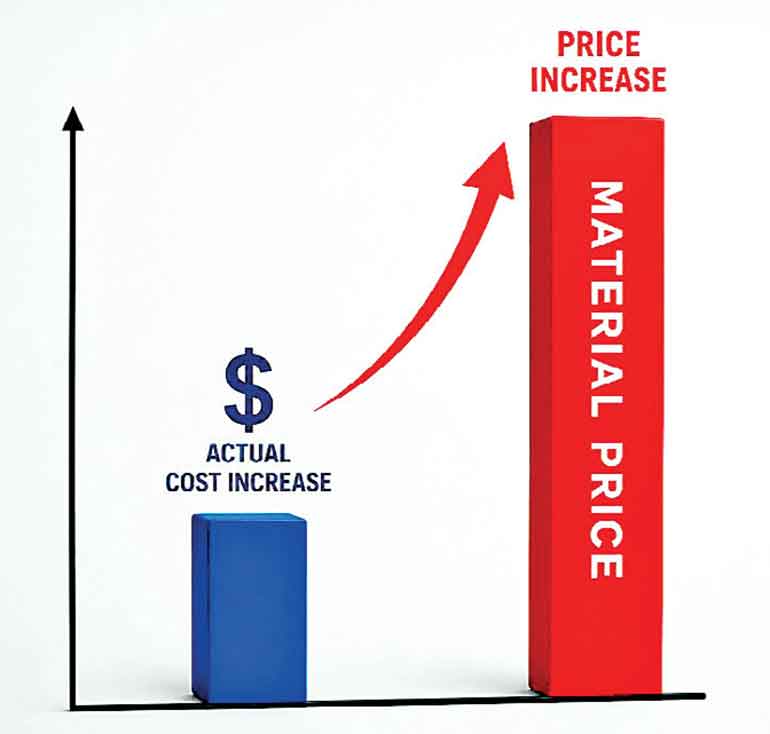
However, during a recent discussion with a senior representative of one of Sri Lanka’s leading cement manufacturers, I was informed that even if the exchange rate were to reach Rs. 360 per US dollar, the resulting increase in cement prices would be approximately 10%.
Yet some suppliers are reportedly increasing prices by 20% to 25%, citing the same exchange rate movement. If costs are rising by one amount and prices by another, the industry is entitled to ask why.
Contractors caught in the middle
The biggest victims are contractors. Most ongoing projects operate under CIDA price fluctuation formulas, which are designed to accommodate genuine market movements. They do not adequately cover sudden and disproportionate price hikes.
As a result, contractors are often forced to absorb these costs themselves, turning viable projects into loss-making ones overnight.
A national issue, not just a construction industry issue
This goes far beyond contractor margins. Higher material prices mean more expensive housing, delayed developments, postponed investments, and costlier infrastructure. When construction slows, jobs are affected, economic activity declines, and national development suffers.
At a time when Sri Lanka is striving to rebuild investor confidence and accelerate growth, the construction sector should be helping drive the economy forward—not being burdened by avoidable cost escalation.
Transparency is the answer
The solution is not price controls, it is transparency. Suppliers should be able to demonstrate whether increases are driven by exchange rates, freight, customs duties, financing costs, or genuine replacement costs. The industry must distinguish between legitimate cost recovery and opportunistic pricing.
This is not about blaming every supplier. Many face genuine cost pressures. But when the same dollar movement is used to justify vastly different price increases across the market, questions must be asked.
A responsibility to the industry and a preventable loss for suppliers
The dollar may rise. Prices may rise too. But prices should reflect actual costs—not market opportunity.
Excessive and unjustified price increases may generate short-term profits, but they ultimately damage the very market on which suppliers depend. When projects are delayed, cancelled, or scaled back due to escalating costs, demand for materials falls, investment slows, and suppliers themselves face reduced sales and a loss of trust that can take years to rebuild.
The stability that returned to the industry over the past year has given Sri Lanka a chance to rebuild one of its most important economic sectors. Allowing unjustified price increases to erode that progress would be a costly mistake.
The dollar should influence prices. It should not become an excuse for them.
(The author is the President of Ceylon Institute of Builders)



