Saturday Oct 03, 2026
Saturday Oct 03, 2026
Thursday, 5 March 2026 00:16 - - {{hitsCtrl.values.hits}}
 For Sri Lanka, maritime security is not only a defence concern it is an economic and national resilience issue. Strengthening maritime surveillance must become a priority. Strengthening maritime surveillance must become a priority
 The destruction of a naval vessel in the southern seas off Sri Lanka is not merely an isolated maritime incident. It represents a strategic signal that uncertainty may be spreading into one of the most important maritime corridors in the world. For Sri Lanka and the broader Indian Ocean region, such developments demand careful assessment and a coordinated response.
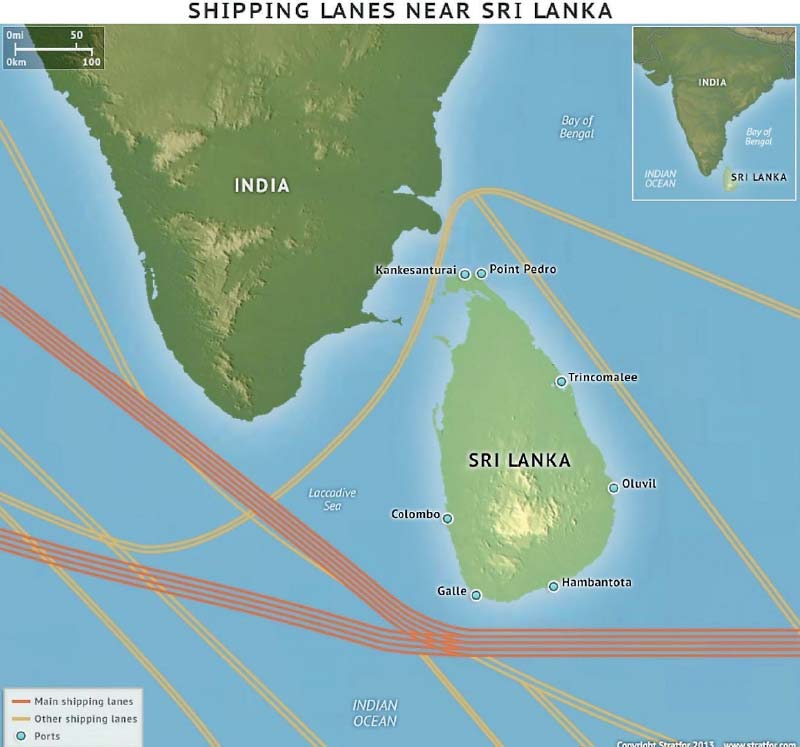
The waters south of Sri Lanka form a critical segment of the Indian Ocean’s global sea lanes of communication. A large proportion of global trade, energy shipments, and container traffic moves along routes that pass just a few nautical miles from Sri Lanka’s southern coastline. These sea lanes connect the oil-producing regions of the Middle East with the manufacturing hubs of East Asia and the consumer markets of Europe.
When an incident occurs in this maritime space, especially one involving naval assets and possible undersea capabilities, it immediately raises concerns among shipping companies, naval forces, and regional governments.
Even the perception of insecurity at sea can have far-reaching consequences.
Shipping companies operate on risk calculations. If the region begins to appear unstable, vessels may be rerouted, insurance premiums may rise, and shipping schedules could be altered. For a country such as Sri Lanka, whose economy is deeply connected to maritime trade and port activity, these developments would have direct economic implications.
The Port of Colombo is one of the busiest transshipment hubs in South Asia. A large share of its business comes from handling cargo that moves along the east–west maritime highway across the Indian Ocean. Any disruption or perception of risk along these routes could affect shipping volumes, logistics operations, and investor confidence in the maritime sector.
The challenge extends beyond trade. The Indian Ocean surrounding Sri Lanka and the Maldives is also a thriving tourism zone. Cruise ships, diving vessels, recreational yachts, and small tourist craft regularly navigate these waters. The introduction of new maritime risks especially those associated with stealthy underwater threats could create anxiety within the tourism industry.
Small vessels are particularly vulnerable in such environments. Unlike large commercial ships or naval vessels, they have limited defensive capabilities and often lack advanced monitoring systems. Even rumors of underwater hazards or hostile activity can lead to cancellations and operational restrictions, affecting tourism-dependent economies in the region.
More broadly, the incident highlights an evolving strategic reality: the maritime domain is becoming increasingly complex and contested.
Modern naval warfare and maritime security challenges are no longer confined to visible surface fleets. Advances in submarine technology, underwater drones, mines, and covert maritime operations have introduced a new layer of uncertainty beneath the sea surface. These developments complicate surveillance and raise the stakes for countries responsible for safeguarding busy maritime corridors.
Sri Lanka’s geographic position makes this challenge particularly significant. Situated at the midpoint of the main east–west shipping route, the island sits at a strategic crossroads between the Arabian Sea, the Bay of Bengal, and the broader Indo-Pacific maritime system.
For Sri Lanka, therefore, maritime security is not only a defence concern it is an economic and national resilience issue.
Strengthening maritime surveillance must become a priority. Enhanced radar coverage, maritime patrol aircraft operations, and coordinated naval monitoring are essential to maintaining situational awareness across the southern approaches to the island. The ability to detect unusual maritime or underwater activity early is critical in preventing incidents from escalating into broader security threats.
Equally important is the protection of key port infrastructure. Colombo, Hambantota, and Trincomalee represent strategic national assets that underpin Sri Lanka’s role in global trade networks. Harbor security measures must incorporate underwater monitoring, vessel screening protocols, and rapid-response capabilities to address emerging risks.
However, maritime security cannot rely solely on naval forces.
Sri Lanka possesses a unique and often underutilised strategic advantage: its coastal fishing communities. Thousands of fishermen operate daily along the country’s maritime boundaries, making them the first observers of unusual activity at sea. With appropriate communication mechanisms and trust-building initiatives, fishing communities can become an invaluable source of early warning information for maritime authorities.
A structured partnership between the coast guard, the navy, and the fisheries sector could significantly enhance maritime awareness. Fishermen reporting unidentified vessels, suspicious floating equipment, or unusual underwater disturbances could provide critical early signals that help authorities respond quickly.
(The author is a Senior Security Analyst and former Head of Counter-Terrorism, SIS Sri Lanka)



