Friday Oct 02, 2026
Friday Oct 02, 2026
Friday, 14 August 2026 04:32 - - {{hitsCtrl.values.hits}}
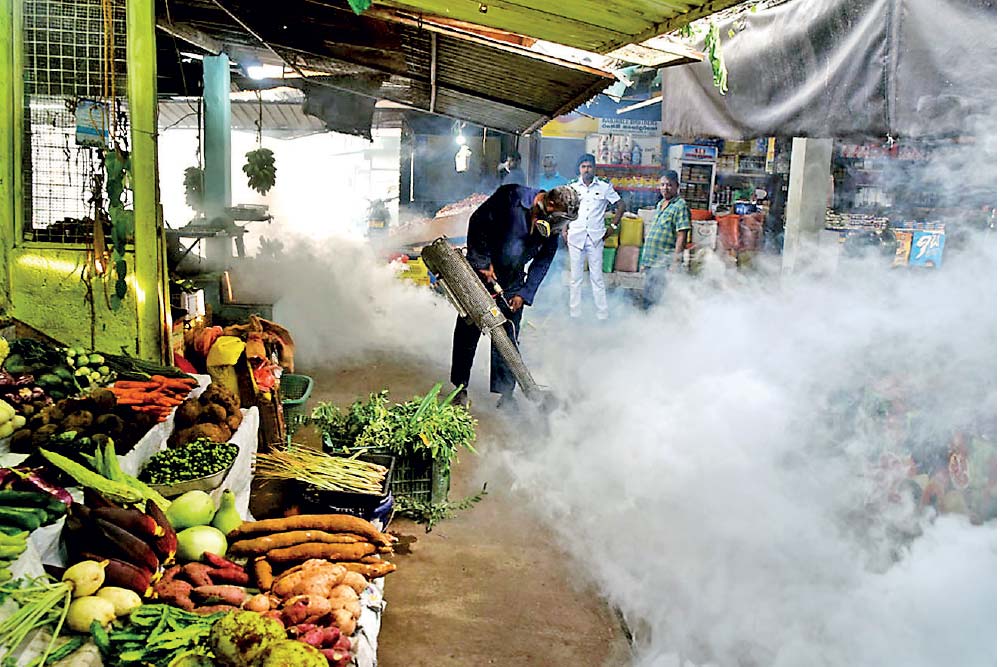
Health sector workers carry out fumigating operations at the Narahenpita pola recently - Pic by Pradeep Pathirana
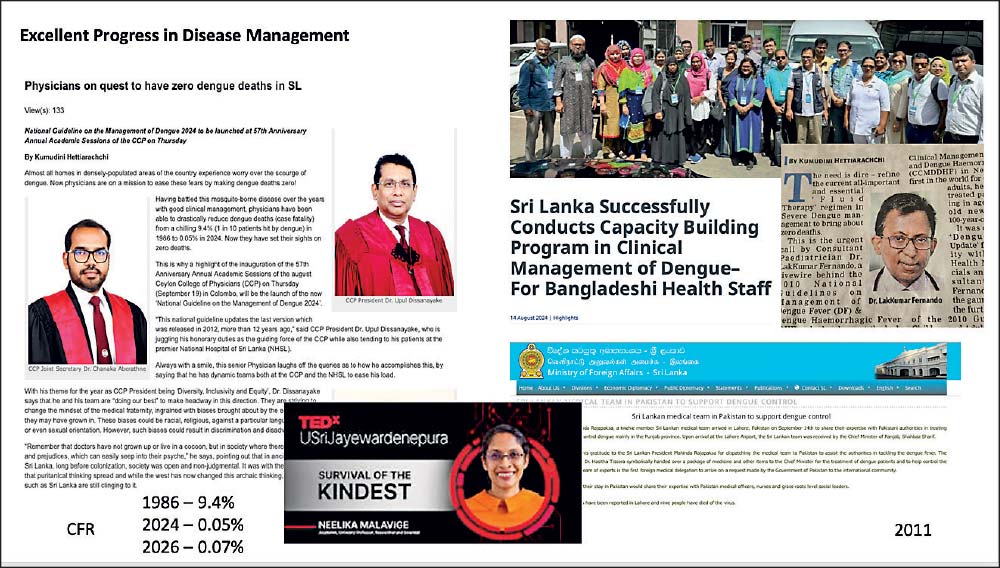
 In dengue care, Sri Lanka has shown excellent results. The CFR (case fatality rate) is significantly low, though the current episode is pushing the number a bit higher due to the sheer number of infections. The medical community cannot solve the root cause, which is a community waste management issue, accentuated by climate instabilities. However, science can intervene and check dengue spread, irrespective of the waste management issue as well
 Dengue infections are reaching record heights in Sri Lanka, and the response appears to be the usual as well. Weather changes appear to be slowing down the daily infection rate now. The Government has just appointed Mosquito Eradication Health Service Assistants – 1500 in number! Hospitals are overflowing with patients, and patients are even advised to stay at home and follow protocols. The surge is reminiscent of the COVID-19 days. In dengue care, Sri Lanka has shown excellent results. The CFR (case fatality rate) is significantly low, though the current episode is pushing the number a bit higher due to the sheer number of infections. The medical community cannot solve the root cause, which is a community waste management issue, accentuated by climate instabilities. However, science can intervene and check dengue spread, irrespective of the waste management issue as well.
The Breteau index
There is no excuse for our poor waste management and even poorer community participation. The absence of a structured waste management system means the community is left to its own devices to address the issue. It must be stated, however, that waste management in all local councils usually carries the highest expenditure proportion. The result, however, has been that mosquitoes are finding the environment quite conducive to proliferation. The Breteau index is evidence – it is a standard measure used by public health teams to track the density of Aedes mosquito larvae. It counts the number of positive water-holding containers found per 100 houses inspected. Counting and stating values may be fine and support the evidence base, but the issue must be resolved by addressing the root cause. There are a few advanced techniques as well, and they come from scientific approaches. There was a Government communique stating that the Wolbachia bacteria would be introduced in September this year. It is good to hear that, as a scientific approach is being mooted. However, there was not the slightest hint that the launch was coming, with lessons learned from the past. The healthcare system has advanced with an excellent near-0.0 % CFR, and clinical protocols with benchmark SOPs have been developed. A Dengue Management Centre of Excellence is present – the world’s first. The Sri Lankan medical community has ventured out in advising patient management at scale in other countries.
The preventive measures that aggressively address the issue at the root have not gained ground despite the presence of a Prevention of Mosquito Breeding Act. Scientific research has been either ignored or not factored well into decision-making. We have excellent world-class researchers in this area. As an observer of science, research, and innovation, I only see decision-making running on a different rail. Most certainly, bringing in other advances in technology to serve the problem is not happening. How many mobile apps came and went? Mosquitoes continue to bite us while the Apps bite the dust!
An attempt to position advanced Bt. Bacteria went from basic research to industrial-scale production to tackle Dengue. The production facility – established by a private investor - is now defunct after the production received a lukewarm response, or was it because it was a local solution?
An attempt to position advanced Bt. Bacteria went from basic research to industrial-scale production to tackle Dengue. The production facility – established by a private investor - is now defunct after the production received a lukewarm response, or was it because it was a local solution? The technology originated from work by the Industrial Technology Institute (ITI) and the Medical Research Institute (MRI). ITI developed the indigenous Bti technology, and the technology was transferred to Bio Power Lanka Ltd., for commercialisation. ITI reported that the technology was patented and commercialised around 2009. Bio Power Lanka had a five-year licence to produce the local Bti, and the product was intended to enter the Sri Lankan market in 100-ml and 200-ml spray bottles. I believe that during the period, overseas supply was also being considered from the USA and Cuba.
While research specifically on dengue prevention has been ignored, the same is true of the broader area of waste management
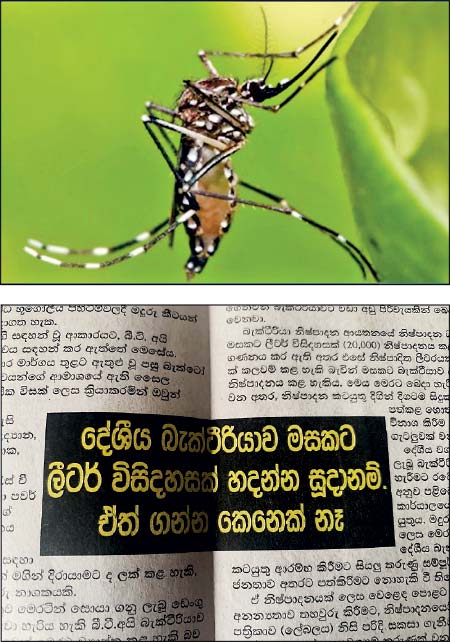 Work on Wolbachia
Wolbachia also received research funding and applications, and at one point even release dates were announced and releases carried out with community participation. When I listened to the current announcement, a sense of Déjà vu prevailed. Wolbachia intervention as a solution to dengue was principally introduced through an international research partnership, with Sri Lanka serving as a field-testing and implementation partner. The National Research Council of Sri Lanka supported it with funding. In 2017, Sri Lanka’s Health Ministry, through the National Dengue Control Unit, entered a research partnership with the World Mosquito Program (WMP)/Monash University. The Australian Government supported the project, which was specifically designed to test the Wolbachia method under Sri Lankan conditions.
Sri Lanka completed a pilot, demonstrated the establishment of Wolbachia in the release areas, but did not proceed to the anticipated large-scale expansion. The answer to the question “Why?” remains. Was it because the way research is traditionally funded in the country means that once the grant period ends, no one is there to support continuity? Financial communications are completed, and the report gets shelved or saved as it is at present. The Audit is happy if that process has taken place correctly. There is no mission integrated, and the funders do not have a purpose either.
With the Audit happy, nothing else matters.
After a cycle of research, the results have not influenced the decision-makers, and research also does not get continuous support, with each step having to start from the beginning. It was interesting to note a current US response to dengue. Google (mind you, this is Google!) is seeking federal approval to release 32 million Wolbachia-infected male mosquitoes in California as part of its Debug Project, aimed at reducing disease-carrying pest populations. In California, it is not about the dengue mosquito, but the lesson should not be lost on us. Again, consider Singapore. Singapore’s National Environment Agency (NEA) is operating Project Wolbachia–Singapore, releasing male Aedes aegypti mosquitoes carrying Wolbachia. They have rolled out the research nationally, integrating the results of research taking place with policy and decision-making. Singapore has a mosquito production facility as well.
Lessons taken after the Meethotamulla dump failure disaster have been ignored or, again, conveniently forgotten! The number of dumps is only rising, and that is not reaching the news, as that is a chronic issue. All these situations point to unscientific governance and ignoring evidence
Orderly Science House
We need to understand how research should be done, results integrated, siloes dismantled, private-public partnerships developed, all with one mission in mind. We should not forget that accelerating climate change is going to test us severely, and the sooner we place our ‘Science House’ in order, the better for us. Why, after investing in Bti and Wolbachia research and field demonstrations, has Sri Lanka not converted either technology into a sustained national biological dengue-control program? If an orderly Science House were present in Sri Lanka, these would not happen.
Much more prominent as a way of communicating on the management of the issue is the issuing of court orders and circulars. The spectacle handed to the audience in evening TV broadcasts showcases mosquito larvae in water-collecting points ad nauseam; confidence in a strong management technique is demonstrated. The additional burden of the court system is a punitive answer, and that, as the sole threat of realising compliance, is not going to take us to the right positioning. While research specifically on dengue prevention has been ignored, the same is true of the broader area of waste management. Lessons taken after the Meethotamulla dump failure disaster have been ignored or, again, conveniently forgotten! The number of dumps is only rising, and that is not reaching the news, as that is a chronic issue. All these situations point to unscientific governance and ignoring evidence. As deaths accumulate and some lives are snuffed out at very early stages, I hope sense will prevail. Decisions will be taken scientifically and without bias, arresting the next round of the disease cycle and showcasing that Sri Lanka is solid, evidence–based, and scientifically sound in managing the issue.