Friday Sep 18, 2026
Friday Sep 18, 2026
Friday, 18 September 2026 00:25 - - {{hitsCtrl.values.hits}}
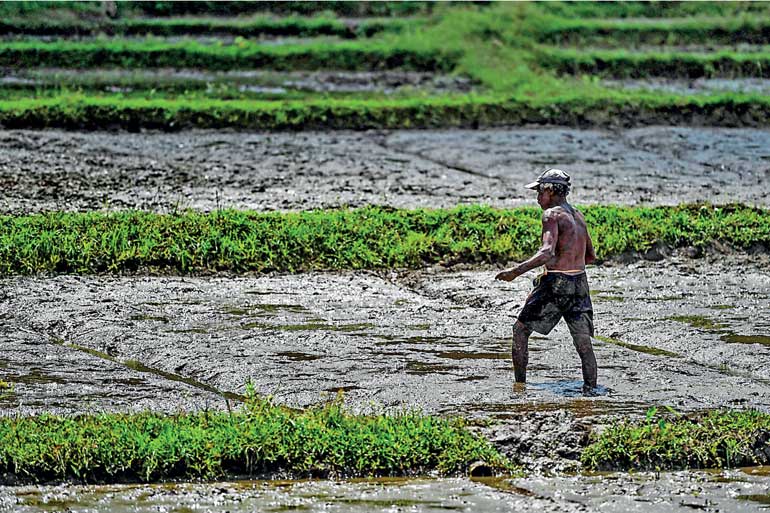
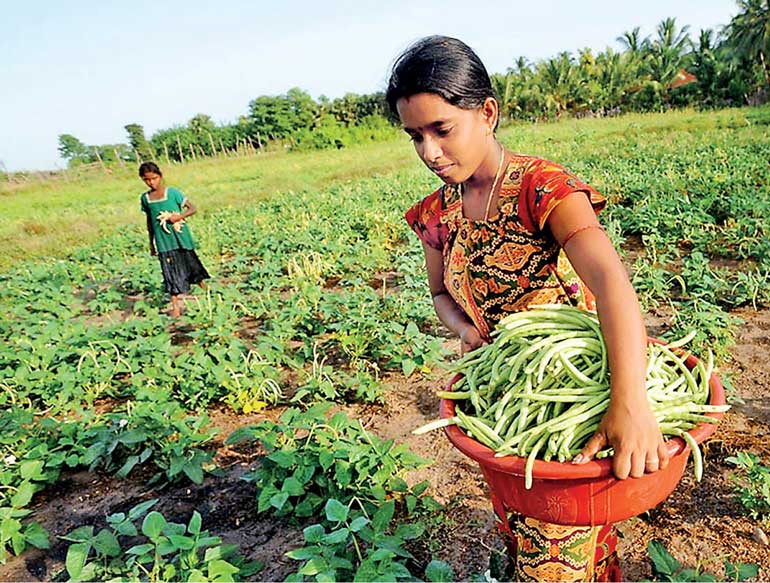
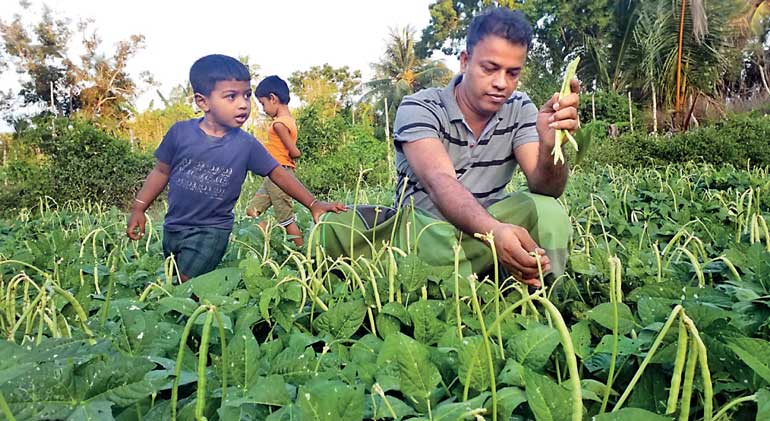
 There are two very different situations within the rural agricultural society in Sri Lanka. The first is a capable farmer becoming poor because farming no longer provides an adequate net income. The second is a household experiencing poverty turning to farming because few alternative livelihood options are available. Both groups require public support, but not through the same policy instruments. If Sri Lanka treats poverty alleviation and agricultural development as if they belong on the same platform, it risks achieving neither objective properly. That is a lesson we have already learned.
A vulnerable household cultivating a small plot for food and having supplementary income may strengthen its resilience and partly improve its food security. However, national food security requires something more from farmers who consistently supply food of sufficient quantity and quality to the market. For example, the rice consumed by millions of people who are not engaged in agriculture depends on such producers. Policy must therefore not only protect vulnerable farmers but also provide greater attention to, and further strengthen the efficient and commercially-oriented producers.
Let us use paddy cultivation as an example to examine this issue further. Official statistics demonstrate the scale of the national paddy production process. According to the Department of Census and Statistics, approximately 769,700 ha were cultivated in the 2025/26 Maha season, of which 691,690 ha were harvested. Paddy production in that Maha season reached 3.134 million metric tons (MT), with an average yield of 4,531 kg/ha. Final official harvest data for the 2026 Yala season have not yet been released to enable an assessment of the total paddy harvest for 2026. However, in the 2025 Yala season, the net harvested extent was 485,002 ha, production reached 2.308 million MT, and the average yield was 4,760 kg/ha.
Paddy productivity also varies considerably according to irrigation conditions. In the 2025 Yala season, the average yield under major irrigation was 5,175 kg/ha, compared with 4,300 kg/ha under minor irrigation and 3,471 kg/ha under rainfed conditions. In the 2025/26 Maha season, the corresponding figures were 5,324, 4,188 and 3,526 kg/ha, respectively. Treating every hectare and every farmer identically may be politically convenient, but from a scientific perspective it is a weak approach to increasing agricultural productivity considering the practical reality of paddy growing environments.
Poverty is a real problem — reducing it requires the right instrument
Close attention must be paid to the economic vulnerability and living conditions of Sri Lankan households in achieving economic development. The World Bank estimated that 24.5% of the population in Sri Lanka lived below the poverty line of $3.65 per person per day (2021 PPP) in 2024, nearly twice the proportion recorded in 2019. Food prices in Sri Lanka had also more than doubled between 2021 and 2024. Poverty reduction is therefore unquestionably an essential priority. However, the policy instrument used to reduce poverty should not necessarily be the same as that used to increase national rice production or to measure progress in national agricultural development.
Government intervention can help a household experiencing poverty obtain food, employment and supplementary income. Public policy should support such households through social protection, livelihood diversification and related assistance. However, merely changing a person’s occupation to ‘farmer’ does not create a sustainable livelihood. If the landholding is too small, irrigation is inadequate, capital is scarce, scientific agricultural knowledge is limited and market linkages are absent, agriculture can become a setting in which poverty is sustained rather than a pathway out of poverty.
Do not undermine the successful farmer
The most dangerous situation on the path to food security is a successful farmer becoming poor. A paddy farmer must finance land preparation, seed-paddy production or purchase, nutrient supply, crop protection, machinery, fuel, labour, harvesting and transport, while also bearing climatic, biological and market risks. For example, a farmer who efficiently produces six MT or more of paddy per hectare and supplies a substantial share of that production to the market is precisely the producer Sri Lanka should make a special effort to protect. Reasonable profitability preserves agricultural production capacity and helps attract technology, investment and the next generation to the sector.
Paddy at Rs. 120/kg — rice at Rs. 230/kg
For both the Maha and Yala harvests in 2026, the Paddy Marketing Board has maintained a minimum purchasing price of Rs. 120/kg for Nadu paddy that met the prescribed standard, with Samba at Rs. 130/kg and Keeri Samba at Rs. 140/kg. The Government has determined the maximum retail prices prevailing in the market for locally produced rice as Rs. 230/kg for Nadu, Rs. 240/kg for Samba and Rs. 260/kg for Keeri Samba, while locally produced raw rice is priced at Rs. 220/kg.
The price difference between paddy and rice is not simply the profit of millers. When paddy is converted into rice, technical assessments of the rice-milling industry in Sri Lanka indicate that the practically achievable milling outturn is approximately 62.5%. In other words, about 1.6 kg of paddy is required to produce 1 kg of rice. The actual average milling outturn may vary according to grain type and quality and the milling technology used. Accordingly, if Nadu paddy is purchased at Rs. 120/kg, the cost of paddy alone to produce 1 kg of rice is approximately Rs. 192. This is even before recognising the commercial value of bran, husk and other by-products, and adding the costs of drying, storage, milling, finance, transport, packaging, loading and unloading, and distribution. Sri Lanka therefore needs a transparent, independently updated paddy-to-rice accounting system for the value-chain that shows how value is shared among the farmer, collector, miller, transporter, wholesaler and retailer.
Subsidies should protect production capacity
For the 2026 Yala season, the fertiliser cash subsidy for paddy was Rs. 30,000 per hectare, up to two hectares per farmer. The maximum payment is therefore Rs. 60,000. This is an important partial support provided by the Government to paddy farmers. However, this ceiling raises a legitimate policy question. If a successful farmer cultivates more than two hectares and supplies a larger marketable surplus, should support for the additional cultivated extent be restricted?
This does not mean that large landholders should receive unlimited subsidies. The requirement is a distinction between social assistance and production incentives. Vulnerable farmers may need more strongly targeted support. Commercial producers require a different support package, potentially comprising reliable availability of quality inputs, access to credit, guidance and facilities for mechanisation, technologies that improve irrigation-water use efficiency, effective extension services, storage facilities, predictable markets and guidance on risk management. Support should be designed to deliver sustained rewards for productivity growth, resource-use efficiency, climate resilience and the volume of produce supplied to the market.
Insurance: Prevent disasters from turning a successful farmer into a poor farmer
Agricultural insurance should be an essential component of professional farming. A successful farmer may invest a substantial sum and manage the crop well, yet still lose most of that investment because of a flood, drought or another insured disaster. The adequacy of insurance coverage may determine the difference between a temporary production loss and being driven into debt.
Under the Government-supported crop-insurance scheme in Sri Lanka, paddy cultivation has been covered up to Rs. 40,000 per acre (approximately Rs. 100,000 per hectare) for a maximum of five acres, with the Government paying the premium under this free insurance arrangement. This basic level of protection is valuable, particularly for vulnerable farmers. However, being ‘insured’ is not the same as being ‘adequately insured’. As production costs and economic exposure change, the insured value should be reviewed accordingly.
A stronger system would retain a Government-supported basic level of insurance while encouraging farmers to purchase higher-value supplementary cover. For example, under specialised commercial insurance programs introduced by the Agricultural and Agrarian Insurance Board, high-value seed-paddy production farms may obtain enhanced compensation of Rs. 180,000 per acre by paying a premium of Rs. 13,600 per acre. Higher insurance coverage necessarily requires a higher premium. Commercially-oriented farmers should be prepared to pay a reasonable additional premium for greater benefits. The Government could also consider a targeted premium support based on production capacity. The sum insured should progressively be set to reflect the actual investment in production and a realistic economic exposure.
Insurance can also serve as an incentive for risk reduction. Sound water management, the use of climate-resilient varieties and the adoption of other good agricultural practices could progressively be considered when determining insurance coverage and premiums. Insurance should not merely compensate for yesterday’s loss. It should also provide sufficient financial protection for a successful farmer to cultivate again tomorrow. That is how a successful farmer can be prevented from turning into a poor farmer after a disastrous season.
Two policy pathways — one national objective
The way forward requires two complementary policy pathways. The first should focus on poverty eradication and livelihood improvement, protecting vulnerable rural households and helping them move towards having sustainable income levels. The second should focus on food production and competitiveness, strengthening farmers who are capable of maintaining dependable commercial production.
Farmer organisations, farmer companies and production aggregation can build a bridge between these two policy pathways. Small farmers need not remain as subsistence-level producers simply because their individual landholdings are small. Coordinated production, machinery services, collective input purchase, irrigation management, storage and organised marketing can create a commercial-scale production environment without requiring every farmer to own a commercially-oriented large farm. Wherever feasible, the objective should be to help small farmers become productive commercial farmers.
Food security requires prosperous farmers
It may be politically attractive to promise affordable rice prices to consumers, remunerative paddy prices that support livelihoods of farmers, adequate profits for processors and low fiscal costs to the Government. Economics, however, does not allow all these outcomes to be sustained simultaneously over the long term. Sustainable policy must increase agricultural productivity, minimise unit production costs and losses, and improve competitiveness. At the same time, households unable to purchase adequate food should be supported through social protection programs.
Sri Lanka must certainly provide public support to people experiencing poverty who are engaged in farming. However, it must be equally determined to prevent capable and successful farmers from becoming poor. Success should be measured by whether vulnerable farmers are moving out of poverty, productive farmers are becoming more competitive and resilient, and consumers receive a stable and affordable food supply. A principal objective of the agriculture sector should be to make farming a profession in which successful farmers can prosper while feeding the nation.
(The author is attached to the Faculty of Agriculture, University of Peradeniya)



