Saturday Oct 03, 2026
Saturday Oct 03, 2026
Tuesday, 12 May 2026 00:34 - - {{hitsCtrl.values.hits}}
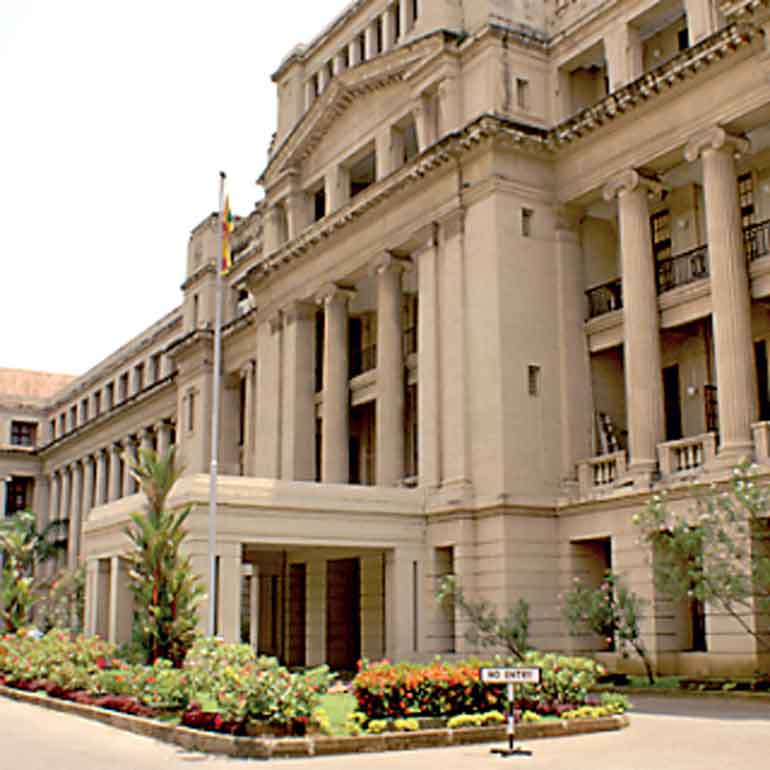
Finance Ministry
 When Sri Lanka was staring the 2021-22 economic crisis in the face, several informed groups proposed remedial measures. Based on seven such documents, I and two young economists drafted a Common Minimum Program (CMP). Our draft was changed based on comments from economists and from business leaders (listed in the document). It was handed over to the then Prime Minister on 4 June 2022, and to multiple other decision makers subsequently. Its elements made their way into many documents such as the “Blueprint” developed by the principal opposition party.
The CMP included as part of the first of its proposals, the following:
Attention is also focused on ensuring that data on public debt are accurate at all times and that a professional approach is adopted for the management of different forms of debt and guarantees. The proposed Public Debt Office should be an elite organisation staffed by highly qualified and experienced professionals. It was felt that providing adequate compensation packages for such professionals would be a challenge unless the Office was located within the Central Bank. However, concerns were expressed about whether the placement of the Public Debt Office within the Central Bank would detract from the central objectives of the Bank.
The problem was seen as the lack of reliable data for effective debt management. There were multiple agencies involved in managing the debt and supplying data for the Quarterly Debt Bulletin. Sovereign guarantees were a particular problem. Details on critical parameters such as the cost of funds raised through different means were needed.
The enactment of a law may have been included in the IMF program. But it was a home-grown solution.
The solution, ideal versus actual
The solution was seen as an elite organisation staffed by highly competent professionals. Taking into account the pervasive problem of paying enough to attract competent professionals into state service, there was a discussion of whether it should be located within Central Bank, which is one place that has managed to attract and hold on to competent professionals.
The outcome was the Public Debt Management Act, No. 33 of 2024. Section 6(6)(h) assigns to the Public Debt Management Office (PDMO) the function of “servicing of the debt of the Government on a timely basis in accordance with this Act,” among others specified in section 6. The choice was made within Government to locate the PDMO within Treasury. Section 5 explicitly states that the terms and conditions of those employed by the Office are to be governed by the existing Government regulations. So, what was created is not an elite organisation staffed by CFAs and PhDs, but one that was merely a reshuffle of existing Government officials.
We knew reliable and comprehensive data was a problem. Section 24 assigns that task to the PDMO. The Quarterly Debt Bulletin (QDB) has been coming out regularly, but the publication lag (the latest is for 2025 Q4) and the lack of analytically useful data (not that all of that should be disclosed) suggest improvements are possible. We believed the state needed competent professionals to perform treasury-management functions, as understood in the corporate world. That is yet to be seen. It is reported that they are planning to recruit one CFA, which is not adequate. We did not address special expertise in information systems, though one could argue that such a requirement would be implicit in the call for an elite organisation.
There are two possible explanations for the loss of $2.5 million. One is that responsibility for debt repayments being in the process of being transferred to the PDMO led to some failures in following the stated procedures and thereby to the deactivation of some of the safeguards. The other is that the incomplete state of the information systems was responsible, or that they contributed to the failures. The reported acceptance of a change to the beneficiary account stated in the original contract communicated via email suggests that both factors were at play
Theoretically, it is possible to develop a system solely dedicated to debt management. Alternatively, it’s possible to envisage a module within a larger integrated Government resource management (GRM) system. From the available information, it appears that the authorities have taken the latter option. The problem is that various components are functioning in parallel, but do not qualify as a fully-fledged Government Resource Management (GRM) system yet, which may explain the lag in publishing the QDB. More than most within the state, Treasury has experience with information systems and its own in-house Department of Information Technology Management. One hopes the frictions will be overcome soon.
Causes of the loss
The misdirection of ten payments constituting a loan repayment to Export Finance Australia over period from October 2025 to January 2026 is what has focused attention on the PDMO. It is possible that the transition from the old arrangements where the Central Bank and the Department of External Resources within Treasury is not yet complete. For example, section 32 of the Act requires the Minister of Finance to delegate various functions to the Secretary and others. No such gazette notification appears to exist. The only one is regarding regulations on primary dealers under Section 35 of the Act (Gazette 5459/52). This may come as good news to the PDMO and Treasury officials, in that they would not be responsible for actions under any of the non-delegated powers.
There are two possible explanations for the loss of $ 2.5 million. One is that responsibility for debt repayments being in the process of being transferred to the PDMO led to some failures in following the stated procedures and thereby to the deactivation of some of the safeguards. The other is that the incomplete state of the information systems was responsible, or that they contributed to the failures. The reported acceptance of a change to the beneficiary account stated in the original contract communicated via email suggests that both factors were at play.
Given the seriousness of the failure, it is important to get to the root of the problem based on information that is expected to be unearthed by Parliament through the relevant committees and by other means. If the organisational and information system failures laid bare by the current loss are not correctly diagnosed and remedied, the overall losses to the country will be far greater than $ 2.5 million. This is not to exclude the possibility of criminality on the part of one or more officials. The whole point of good financial procedures is to prevent bad actors from causing losses.