Sunday Oct 04, 2026
Sunday Oct 04, 2026
Saturday, 9 May 2026 00:01 - - {{hitsCtrl.values.hits}}
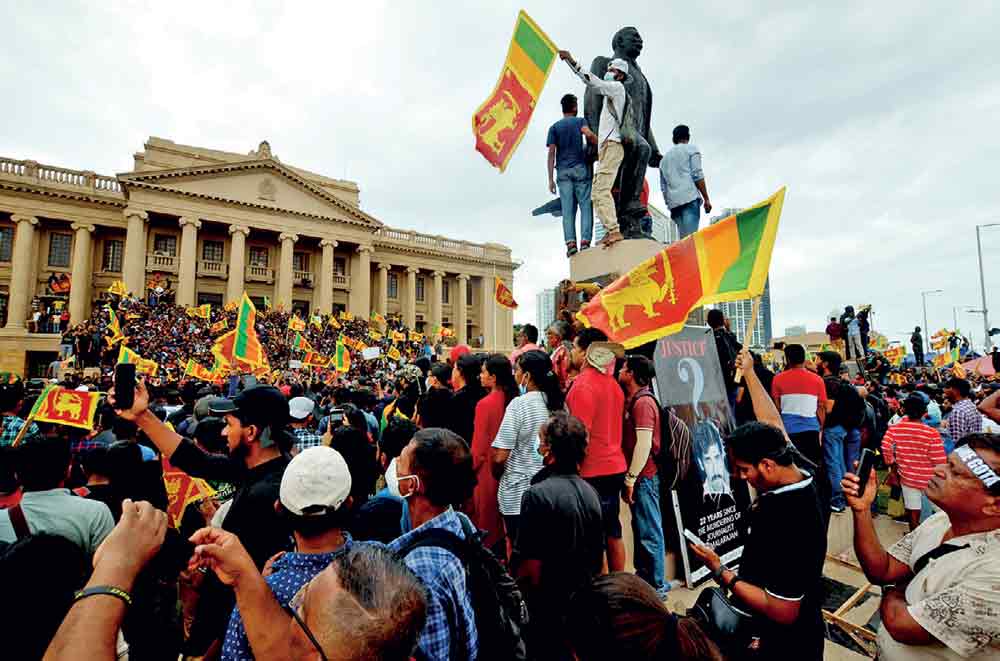
 On 9 May 2022, the political establishment ruling the roost at the time made a catastrophic miscalculation. It obviously believed that brute force would succeed where patronage, propaganda and intimidation had failed. And let loose its dogs of war.
Those loyalists of the ancien régime descended on peaceful protestors at the Galle Face Green. Like the Assyrian came down like a wolf on the fold, these minions of the regime assailed the camps of the righteous and the indignant with makeshift clubs, clenched fists and hired fury.
It was an assault on the Aragalaya in broad daylight, which by nightfall of the same day would spell the beginning of the end for a political dynasty that once thought itself invincible.
Four years later, the blood of that dark day has dried but the memory still bleeds raw in those who were set upon by State terror. The tents along the green are gone, the revolutionary artwork at the artists’ village is faded, and only the faint echo of the once fervent slogans remain.
Yet the issues that animated the unprecedented people’s movement remain – perhaps as urgent as ever... Even though the tyrant fled and the establishment crumbled, only to be retrenched behind another mask...
And maybe the most uncomfortable question to be asked in a splinter of my mind’s eye over a thousand sunrises and sunsets later is: Did people’s sovereignty in Sri Lanka on that halcyon day mistake the catharsis of a moral victory with the ambiguous certainty of a transformation that never came into full effect?
Truth to power
Certainly, the struggle of a people suffering deprivation then as never before achieved something extraordinary. It punctured the myth of invincibility surrounding entrenched power.
In tearing off the cloak of inevitability that a militarised securocracy had cast over the polity like a body shroud, it succeeded in much more than would eventuate in the fateful week of 9-13 July, then only a brace of tense months away...in a future few could foresee on 9 May.
It united classes, creeds and communities in ways our cynical (and don’t forget corrupt) politicos had long thought – and declared – impossible. It restored – I remember it as doing so briefly, if luminously at the time – the idea that our precious citizenship mattered far more than corrupt patronage or pernicious connections.
Revolution not romantic
But sadly for the people’s sovereignty, revolutions of sentiment are not quite the same as revolutions of structure. The Rajapaksa regime left the building – literally. Yet to be seen if the much vaunted system change to which end the intrepid protestors of 9 May sustained injury to self and dignity came in to take its right and dutiful place?
Indeed, what Sri Lanka has since then discovered is a harder and less romantic truth: dismantling the apparatus of corruption is easier than designing competence.
Protest movements – even if they are arguably driven by bodily hunger and lack of essential commodities initially, rather than hifalutin principles from the outset – are adept at identifying moral rot.
However, governing with due diligence after Gota goes home demands the altogether less glamorous arts of administration, negotiation, institutional discipline and economic realism.
That was the challenge facing the National People’s Power when it first swept into power on the back of the broken Aragalaya of 2022 way back in September and November of 2024.
Today it is struggling to do more than pay lip service to the spirit of 9 May 2022. And may the force be with it – and you, and all of us – as we all struggle together to deconstruct a better calibre of nationhood.
Arrogance to amateurishness
To date, no compelling case has emerged to place the present dispensation in the same moral or ethical category as the old order that it replaced. That distinction matters muchly. And it should be acknowledged openly, honestly and fairly.
As well as admitted – even in the ranks of Tuscany who lament that a glory has passed, or hanker for the putative return of Ranil perhaps – that the JVP-led NPP is cut from another cloth other than the tattered rags of the regime that was unceremoniously ousted.
But a safe moral distance from past corruption does not, regrettably, automatically translate into administrative excellence. And a government may be ethically earnest and still strategically uncertain, as well as dull as ditchwater in the diplomatic and developmental spheres.
That the NPP’s stalwarts as much as its standard-bearers are personally austere and yet policy-wise amateurish is a cause for much lament among the right-minded and a little laughter among the less righteous.
Of class and culture
And herein lies the paradox of post-Aragalaya Sri Lanka.
The people demanded – and voted with their feet first, and then the ballot – for a new political culture. What they may have received instead is a new political class that is still learning – sometimes, painfully, in public – the difference between oppositional (and truth be told opportunistic) idealism and the burdens of statecraft.
Recent controversies, political imbroglios, procurement questions, hesitant foreign policy, mixed economic messaging and periodic displays of ideological rigidity strongly suggest that even reformist governments can inherit (and inadvertently perpetuate) the dysfunctionality of a hollowed-out State.
Not because they are uniquely villainous. But because Sri Lanka’s once – and maybe future – crisis was never solely about tyrannical personalities or perverse temperaments. And once again (the truth be told) it was about institutions degraded over decades by nepotism, short-termism, corruption, politicisation and intellectual mediocrity.
Republican experiments
The tragedy is that electorates emerging from captivity to generational trauma often expect cultural, social and political renewal to produce technocratic competence – and even excellence – where only moral turpitude flouted all the rules before. But history rarely works so neatly, nicely or naturally well. And we are taking a tad too long to start learning that rather than run about defensively like a headless chicken in denial.
France after the revolution descended into a reign of terror before even aspiring to scale the heights of empire. America – well, let’s draw a blank there, shall we? Even the Arab Spring, which is closer to the spirit of our Aragalaya, yielded painful fragmentation as often as it offered us perfect freedom from previous tyranny. And in similar vein have Sri Lanka’s own republican experiments frequently conflated – or dare I say confused – symbolic rupture with substantive reform.
Victory vs. reality
The Aragalaya’s greatest victory, therefore, may have been psychological rather than political. It taught citizens that their governors could be challenged, and it made elected representatives of the people learn that they are as traumatically replaceable as they are readily voted into power.
And it also brought to light another sobering reality. That once the barricades come down, someone still has to control the power grid – both electrical and electoral – and someone still has to adroitly renegotiate debt restructuring, manage ports and airports, stabilise the currency, bring inflation under control, procure suitable trade deals and navigate tricky territorial straits... all while resisting the ancient temptations of power to corrupt and avoiding the heresy that the office sanctifies its holder.
This does not diminish the movement’s importance. Far from it. So gentle reader, yes, 9 May should still be remembered aright – and rightly celebrated – as the day that ordinary Sri Lankans refused to retreat before orchestrated violence or bow down before State terror. In the end it was that rarest of moments when fear left the breasts of the oppressed and came home to roost in the oppressor, soggy with the stink of muddy waters after their baptism in the Beira.
No time for nostalgia
But anniversaries should also invite studied reflection, not simply sentimental nostalgia. If the people’s struggle of four years ago is to mean anything more than a temporary interruption in the long decline of the late once great republic, Sri Lanka must move beyond the seductive theatre of permanent protest.
Democracies cannot survive indefinitely on ethical outrage or thrive on moral indignation forever. They require capable institutions, ethical leadership, informed citizens and a political culture mature enough to distinguish between political theatre and true-life governance.
The Aragalaya opened a wide-enough door, as perhaps never before. Whether the nation at large walked convincingly through it, or merely stood at the threshold applauding itself in the mirror, remains the unresolved question on my mind and yours today, the ninth day of May.
(The author is the Editor-at-large of LMD and is a senior journalist with a Post-graduate Diploma in Politics and Governance)



