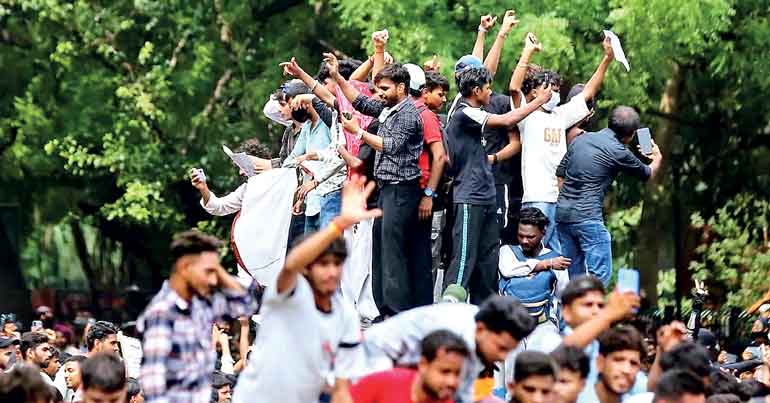
Protesters participate in a demonstration demanding educational reforms as part of the Cockroach Janta Party’s ongoing protest movement in New Delhi, India, 25 July 2026
- Why education reform must become a national priority

A movement that speaks beyond India’s borders
India’s recent youth-led protest movement should not be viewed merely as a political episode confined to one country. It is a powerful reminder that when education systems fail to meet the aspirations of young people, the consequences extend far beyond classrooms and universities. Examination integrity, graduate employability, equal opportunity, institutional credibility and public accountability eventually become matters of national importance.
The movement, popularly identified with the self-styled Cockroach Janta Party, began as an online expression of frustration but developed into a nationwide youth campaign following allegations of leaks and irregularities surrounding a major medical entrance examination. The controversy affected approximately two million candidates and drew attention to wider concerns about unemployment, fairness and accountability within India’s education system. After weeks of demonstrations, India’s Education Minister resigned on 25 July 2026, and the protest organisers subsequently agreed to end their demonstrations following discussions with the government.
This outcome illustrates an important democratic principle: when large numbers of young people raise legitimate concerns through organised civic engagement, governments and public institutions must listen, respond and reform.
India is home to more than 371 million young people—the largest youth population in the world. This demographic strength can become one of the country’s greatest assets or one of its most serious challenges, depending on how successfully the nation educates, empowers and employs its young citizens.
Sri Lanka has a much smaller population, but its youth are no less important to its future. UNFPA has estimated that more than 4.4 million Sri Lankans are between 15 and 29 years of age. Their education, capabilities, values and employment opportunities will largely determine the country’s future prosperity and stability.
The questions raised by India’s young people are therefore equally relevant to Sri Lanka. They challenge us to ask a fundamental question:
Are we preparing our young people for yesterday’s economy—or tomorrow’s world?
Education is national security
Every nation invests heavily in roads, ports, airports, energy systems and physical infrastructure. These investments are necessary. Yet no investment generates more enduring national returns than investment in people.
Education is not merely a social service. It is the foundation of economic growth, technological advancement, social cohesion, democratic stability and national competitiveness. Countries that lead the twenty-first century will not necessarily be those possessing the greatest natural resources, but those capable of developing the most educated, innovative, ethical and adaptable people.
Sri Lanka has every reason to be proud of its free education system. According to the 2024 Census, 97.4 per cent of the population aged ten years and above is literate. This is a major national achievement.
However, literacy and educational access alone are no longer sufficient measures of success. The challenge today is not simply getting children into classrooms. It is ensuring that they leave those classrooms with the knowledge, practical skills, confidence, creativity, values and adaptability required by a rapidly changing world.
The national challenge is therefore no longer simply to educate more students. It is to develop better learners, better professionals, better entrepreneurs, better innovators and better citizens.
The urgent need for comprehensive education reform
The world of work is changing faster than many education systems. Artificial intelligence, robotics, automation, digital technologies, climate change and the transition towards greener economies are transforming occupations and altering the skills expected by employers.
Across South Asia, the working-age population has increased by approximately 16 million people annually since 2010, while the region has created only about ten million jobs each year. This means that millions of new labour-market entrants risk being excluded unless job creation, productivity and workforce preparation improve substantially.
Sri Lanka faces a particularly serious employment challenge. The World Bank estimates that nearly one million young Sri Lankans will enter the labour market during the coming decade. Without stronger economic growth and greater private investment, only about 300,000 new formal jobs may be created—leaving a substantial majority of new entrants without access to quality formal employment.
Available World Bank data also indicate that nearly one in five Sri Lankans aged 15–24 was not in employment, education or training in 2023. This is not simply an education statistic. It represents lost productivity, weakened confidence and unrealised human potential.
Sri Lanka therefore requires a comprehensive national education transformation focusing on:
n
Strengthening early childhood education and foundational literacy and numeracy.
n
Modernising school, university and vocational curricula.
n
Strengthening science, technology, engineering and mathematics education.
n
Introducing age-appropriate and ethically grounded learning in artificial intelligence, coding and digital literacy.
n
Promoting entrepreneurship, innovation, research and practical problem-solving.
n
Strengthening English-language proficiency while preserving excellence in Sinhala and Tamil.
n
Expanding technical, vocational and apprenticeship-based education.
n
Building stronger partnerships among schools, universities, industries and employers.
n
Developing critical thinking, creativity, communication, teamwork and leadership.
n
Reforming assessment systems to measure understanding and competence rather than memorisation.
- n Creating pathways for lifelong learning, reskilling and continuous professional development.
- n Strengthening civic education, ethics, constitutional understanding and responsible citizenship.
- n Education reform must become a national mission rather than a collection of disconnected policy initiatives.
Reform must begin with foundational learning
Discussions about education reform frequently begin with universities, technology and graduate employment. However, national transformation must begin much earlier.
A child who does not acquire strong literacy, numeracy, communication and reasoning skills during the primary years will find it increasingly difficult to benefit from advanced science, technology or vocational education later.
Sri Lanka must therefore invest more consistently in:
- n quality early childhood education;
- n primary-level literacy and numeracy;
- n hild nutrition and school attendance;
- n teacher availability and classroom quality;
- n early identification of learning difficulties;
- n special education and learning support; and
- n recovery programs for students who have fallen behind.
Artificial intelligence and digital education cannot compensate for weak foundations. Technology becomes transformative only when learners possess the basic knowledge, discipline and reasoning skills required to use it wisely.
Equity must remain at the centre of reform
A national education system cannot be considered successful when opportunity depends upon a student’s district, income, language, disability, school category or access to private tuition.
Sri Lanka’s reform agenda must therefore address the circumstances of rural, estate-sector and low-income students; children with disabilities; students in underserved provinces; and those without reliable access to teachers, laboratories, libraries, devices and internet connectivity.
A National Education Equity Guarantee should establish minimum standards for every school. These should include access to qualified teachers, safe classrooms, sanitation, libraries, science facilities, digital connectivity, counselling and learning support.
Educational excellence and educational equity should not be treated as competing objectives. A truly excellent education system is one that enables talent to emerge from every part of the country.
Young people are asking for opportunity
The Indian experience reminds us that young people are not demanding charity. They are demanding fairness.
They seek credible examinations, quality education, meaningful employment, transparent institutions and equal opportunities to realise their potential.
Sri Lankan youth share these aspirations. Their greatest expectation is not permanent dependence on government assistance. It is the opportunity to compete fairly, develop their talents, innovate confidently and succeed on merit.
Governments that listen before frustration becomes disillusionment strengthen democracy. Governments that ignore young people risk losing the confidence of an entire generation.
Education reform must be connected to job creation
Education reform alone cannot solve unemployment. Even well-qualified graduates will struggle if the economy does not generate sufficient productive employment.
Education policy must therefore be connected directly to economic, investment, industrial and regional-development policy.
Sri Lanka must address both sides of the employment challenge:
The supply side: developing skills, qualifications, competencies and employability.
The demand side: encouraging investment, enterprise growth, exports, innovation and the creation of quality jobs.
This requires:
- n a stronger environment for private investment and entrepreneurship;
- n support for small and medium-sized enterprises;
- n export-oriented industries and services;
- n technology-enabled employment;
- n regional enterprise and employment zones;
- n structured internships and apprenticeships;
- n work-integrated university and vocational education;
- n reliable labour-market information; and
- n closer coordination among education, industry, labour and economic-development institutions.
The objective should not be merely to produce jobseekers. It should be to develop job creators, innovators and productive professionals capable of competing internationally.
What Sri Lanka can learn from India
1. Education reform cannot wait
Education should become one of Sri Lanka’s foremost national priorities.
The competitiveness of nations increasingly depends upon the quality of their human capital rather than the abundance of their natural resources. Countries that continuously modernise their education systems produce innovators, entrepreneurs, scientists, skilled professionals and responsible leaders.
Those that postpone reform risk producing graduates whose qualifications no longer correspond with economic and social needs.
Education policy must therefore become a long-term national commitment rather than a victim of frequently changing political priorities.
2. Protect the integrity of public examinations
Public confidence in examinations is fundamental to social justice.
For many young people, a national examination determines access to university, professional education or employment. Any failure involving question papers, marking, admissions or the release of results can affect years of effort and permanently weaken trust in public institutions.
Sri Lanka should strengthen examination integrity through:
- n independent audits of national examinations;
- n secure and professionally managed question-setting systems;
- n transparent investigations of alleged irregularities;
- n conflict-of-interest safeguards;
- n clear student appeal procedures;
- n timely public communication;
- n contingency plans when an examination is compromised; and
- n firm accountability for misconduct without collectively punishing innocent candidates.
Examination integrity is not merely an administrative matter. It is a national trust.
3. Youth must be partners in policymaking
Young people should not merely receive policies. They should help shape them.
Sri Lanka should institutionalise youth participation through a National Youth Education Advisory Council, representation on education-reform bodies, district-level consultations, graduate surveys, digital submission platforms and regular dialogue among students, educators, employers and policymakers.
Participation must be genuinely inclusive. It should extend beyond urban university students to include rural youth, vocational trainees, school leavers, young entrepreneurs, young people with disabilities and those from economically disadvantaged communities.
Consultation becomes meaningful only when public institutions explain how youth proposals have been considered and acted upon.
4. Accountability strengthens public trust
Educational institutions, examination authorities and policymakers must be accountable for maintaining fairness, transparency and professional standards.
Accountability should never be regarded merely as political punishment. It is the cornerstone of institutional credibility.
When mistakes occur, the public expects acknowledgement, investigation, corrective action and measures to prevent recurrence. Attempting to conceal institutional failures usually causes greater damage than admitting and correcting them.
5. Constitutional rights must always be respected
Peaceful civic participation, freedom of expression and constructive dialogue are essential pillars of a healthy democracy.
Young people should express their concerns peacefully, responsibly and within the framework of the Constitution and the rule of law.
At the same time, democratic responsibility is reciprocal. Governments and public authorities must facilitate peaceful assembly, protect freedom of expression, respond to legitimate grievances, communicate transparently and avoid disproportionate restrictions.
Democracy is strengthened when citizens act responsibly and institutions respond respectfully.
6. Reform before crisis
Successful governments identify emerging problems early and undertake reforms before public dissatisfaction develops into national crisis.
This requires institutions that collect evidence, listen to citizens, evaluate performance and correct failures before they become deeply rooted.
Prevention is always less costly than reaction. Reform undertaken through consultation is also more sustainable than reform introduced under pressure.
7. Build human capital, not simply academic qualifications
Economic success will increasingly belong to countries that develop innovators, entrepreneurs, skilled professionals and ethical leaders—not merely graduates holding certificates.
Education must prepare students for life, work and leadership.
Every qualification should therefore develop a combination of subject knowledge, practical competence, digital capability, communication skills, teamwork, ethical judgement and the capacity to continue learning.
A degree without competence helps neither the graduate nor the country.
8. Nation-building begins in the classroom
Every classroom shapes the future productivity, character and resilience of the nation.
Teachers are therefore not merely employees delivering a syllabus. They are nation-builders.
Sri Lanka cannot achieve meaningful reform without investing in teacher education, professional development, modern teaching resources, appropriate recognition and accountable professional standards.
Curriculum reform without teacher preparation will remain reform on paper.
Student wellbeing must become a national concern
High-stakes examinations and intense academic competition place significant pressure on students and families. Examination uncertainty, repeated delays and institutional failures can deepen anxiety and weaken confidence.
A humane education system should therefore include:
- n properly trained school and university counsellors;
- n effective career guidance;
- n healthier and more diverse assessment methods;
- n reduced dependence on a single examination;
- n multiple routes into higher education and employment;
- n timely assistance for students affected by administrative failures; and
- n stronger cooperation among schools, families and health professionals.
Educational achievement should not be pursued at the cost of student wellbeing.
A national call for education transformation
Sri Lanka should seize this moment to launch its most ambitious education transformation since the introduction of free education.
Such a national programme should include:
- n Establishing an independent National Education Reform Commission supported by legislation and broad political consensus.
- nDeveloping a ten-year National Education Transformation Strategy, supported by three-year implementation plans.
- n Strengthening early childhood and primary education, with national targets for foundational literacy and numeracy.
- n Integrating artificial intelligence, coding, digital literacy and technology ethics into age-appropriate school education.
- n Strengthening English-language competency while preserving excellence in Sinhala and Tamil.
- n Reviewing the national curriculum every five years, supported by continuous annual adjustments where economic and technological conditions require them.
- n Building stronger partnerships among schools, universities, vocational institutions, industries and employers.
- n Expanding technical, vocational, apprenticeship and work-integrated learning pathways in line with labour-market demand.
- n Modernising public examinations through greater transparency, professional security and competency-based assessment.
- n Investing substantially in teacher education, continuous professional development and digital teaching resources.
- n Embedding entrepreneurship, financial literacy, research and innovation across educational disciplines.
- n Establishing a National Graduate Employability and Job-Creation Strategy linking education directly to investment, enterprise development and economic growth.
- n Creating a National Education Equity Guarantee to establish minimum facilities and learning opportunities in every school.
- n Expanding counselling, career guidance and student-wellbeing services.
Institutionalising meaningful youth participation in education and employment policymaking.
From policy announcement to measurable results
Sri Lanka does not suffer from a shortage of policy documents. Its greater weakness has often been incomplete implementation.
The proposed National Education Reform Commission must therefore have:
a clearly defined legal mandate;
- n political independence;
- n representation from educators, students, employers, provincial authorities and professional bodies;
- n responsibility for coordinating institutions;
- n guaranteed and transparent financing;
- n measurable annual targets;
- n public progress reports; and
- n independent evaluation.
A national education-performance scorecard should report annually on learning outcomes, teacher availability, school infrastructure, vocational participation, digital access, graduate employment, regional inequality and progress in implementing reforms.
Every major reform should identify what must be done, who is responsible, how it will be financed, when it must be completed and how success will be measured.
Without such accountability, education reform will remain an aspiration rather than a transformation.
Beyond education: A culture of responsible
democracy
The Indian experience also reminds us that democracy is strengthened when governments remain responsive, institutions remain independent and citizens exercise both their rights and responsibilities with maturity.
Constructive criticism should not be feared. It should be welcomed as an opportunity to improve governance, restore public confidence and renew institutions.
Citizens must recognise that lasting national progress depends upon peaceful civic engagement, respect for constitutional processes and commitment to the rule of law.
Governments must equally recognise that authority carries a duty to listen, explain, correct failures and remain accountable.
Democracy flourishes when governments listen, institutions act with integrity and citizens participate responsibly.
Reform today for tomorrow’s nation
Sri Lanka stands at an important moment in its national journey. The country’s future will not be determined solely by economic policies, political debates or infrastructure projects. It will depend substantially upon how successfully we educate, inspire, employ and empower the next generation.
India’s recent youth movement demonstrates that young people cannot be ignored. What began as frustration over examination integrity expanded into a broader demand for accountability and reform. The government’s eventual response and the peaceful conclusion of the demonstrations demonstrate both the power of youth participation and the importance of institutional responsiveness.
The lesson extends beyond politics. It concerns governance, fairness, opportunity, human dignity and national vision.
Countries that invest in young people invest in their own future. Countries that fail to modernise education, create employment and protect institutional trust ultimately mortgage that future.
Sri Lanka must therefore pursue education reform and job creation as two parts of the same national mission. Young people must be given not only qualifications, but capabilities; not only expectations, but opportunities; and not only promises, but credible pathways towards productive and meaningful lives.
If Sri Lanka genuinely aspires to become a knowledge-driven, innovation-led and globally competitive nation, education transformation must become one of its highest national priorities.
Investing in young minds is not merely an educational policy. It is the most important nation-building strategy any country can pursue.
The classroom is where the future of every nation is written. The decisions we make today will determine whether Sri Lanka merely participates in the twenty-first century—or helps to lead it.




