Thursday Oct 22, 2026
Thursday Oct 22, 2026
Wednesday, 17 December 2025 00:21 - - {{hitsCtrl.values.hits}}
 Introduction
When the Ceylon Chamber of Commerce led a Sri Lankan business delegation to India’s 30th CII Partnership Summit (organised jointly by Confederation of Indian Industries and Govt of Andra Pradesh, under theme of Technology, Trust, and Trade: Navigating the New Geoeconomic Order) in Visakhapatnam, the goal was simple: understand where India is heading and identify how Sri Lanka can benefit by integrating into the growth rather than be swept aside by it. What the delegation witnessed in Andhra Pradesh was instructive, timely, and relevant to Sri Lanka’s own development challenges. (You can access CII Partnership summit details here: THE CII PARTNERSHIP SUMMIT 2025)
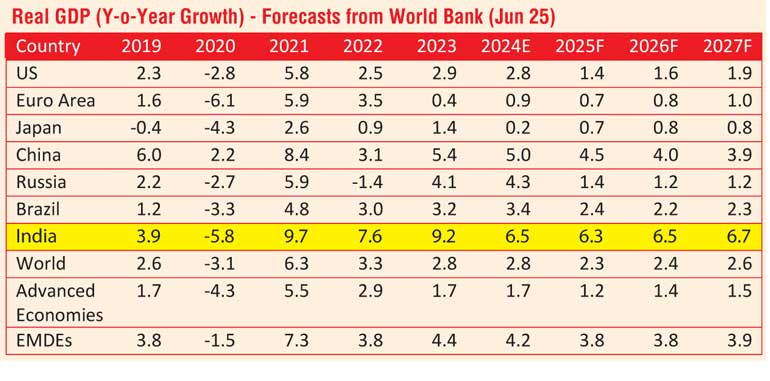
India is becoming a major force in global economic growth. The IMF projects India to remain one of the world’s fastest-growing large economies through the next decade. If Sri Lanka wants to secure its place in the new regional order, it must understand how key Indian states are shaping their economic futures. Andhra Pradesh offered one of the clearest examples at the Summit.
This is not about politics. It is about policy, execution, and how a state can transform itself by thinking long-term and acting with discipline.
Andhra Pradesh’s coastal advantage: Strategy, not luck
Andra Pradesh Government has selected Visakhapatnam as the host city for the Summit. Andhra Pradesh has India’s second longest coastline at 974 km and is already the country’s number two maritime cargo-handling state, moving close to 104 MMT annually, which is almost 15% of all cargo handled in India. As the State Government presented, the model was clear. Ports are not isolated assets. They are part of integrated economic corridors linking logistics, industrial clusters, technology parks, and export zones.
Sri Lanka, with Colombo, Trincomalee, and Hambantota, should be even better positioned. But we lack the same level of integration and forward thinking. The lesson from Andhra Pradesh is straightforward: a port becomes economically powerful when it is embedded in a larger strategy, not when it stands alone.
Governance built for investors
One of the repeated themes at the CII Summit, from top at the level of Chief Minister to bottom, was Andhra Pradesh’s focus on ease of doing business. Investors highlighted faster approvals, predictable processes, and clear lines of accountability. Whether one calls it a +1 model or by another name, the core idea is that every department has a partner in charge of ensuring speed and coordination. They want to go beyond the concept of ease of doing business to concept of speed of doing business.
This kind of administrative clarity is something Sri Lanka desperately needs. Our investors face long wait times, opaque processes, lack of inter-Governmental agency coordination and shifting regulations. In a competitive region, delays are costly. The message from Visakhapatnam was unmistakable: investors go where Governments move with speed, consistency, and discipline.
Betting on the future: Quantum, AI, and Deep Tech
Another eye-opening takeaway from the Summit was Andhra Pradesh’s commitment to emerging technologies. Quantum Valley, a planned cluster for quantum computing research and advanced materials, signals that the state wants to compete in frontier science, not just traditional industry. While India becoming a competitor for quantum computing is a longer journey, Andra is making the playing field for global giants to look at as a competitive venue.
Similarly, new AI and technology parks across the state aim to create ecosystems for automation, robotics, logistics tech, and data-driven services.
Sri Lanka, with its strong ICT base, can learn from this approach. Our ICT exports (Computer & IT/BPO related services) hover around USD 850 million. We have the talent. What we need now is targeted policy framework and timely execution of such policy in AI engineering, marine tech, logistics automation, and renewable energy systems. When Andhra Pradesh is planning for the industries of 2050, then Sri Lanka cannot remain tied to the industries of 2000.
Swarna Andhra 2047: A vision that outlives elections
What impressed many delegates was the clarity of Andhra Pradesh’s long-term development vision. The 2047 roadmap is not just a document. It shapes everything from infrastructure planning to human capital programs.
Sri Lanka has never had long-term development continuity. Economic plans shift with every administration, making it hard to sustain momentum or attract multi-decade investments. The Andhra Pradesh model shows that stability and predictability can be more valuable than generous incentives.
A Sri Lanka 2050 strategy, anchored in consensus and insulated from political shifts, is long overdue.
Human Capital: The quiet engine behind Andhra Pradesh’s rise
The sessions in Visakhapatnam repeatedly highlighted the focus on education and skills. From digital classrooms to university–industry collaboration to specialised skill clusters near industrial hubs, the state is building a workforce ready for advanced manufacturing, AI, logistics, and scientific research.
Sri Lanka’s youth unemployment** remains above 20% despite high literacy and strong institutional persuasion for education. This signals a continuing and clear mismatch between the skills the system teach and the jobs the region is creating. If Sri Lanka wants to benefit from India’s rise and integrate will with global markets, we must critically reform our education system and anchor it to future industries.
How Sri Lanka can position itself
The CII Partnership Summit made one thing clear: India’s growth is opening doors. Decision is ours, walking through them or not is up to us.
In summary, Sri Lanka can consider several areas to focus on:
A moment Sri Lanka cannot miss
The CII Partnership Summit in Visakhapatnam was more than a conference. It was a window into a future taking shape next door—a future where states like Andhra Pradesh are not waiting for growth but building it.
Sri Lanka has the geographical advantage and huge talent pool, best in class education and healthcare in South Asia. What we need is the discipline and clarity to act with long-term vision.
The rise of India is the biggest regional opportunity of our generation. Quite similar to UAE as the gateway to Middle Esat, Singapore to East Asia, Sri Lanka should position to benefit from the rise of India. Andhra Pradesh is showing us how to convert opportunity into progress. Sri Lanka can choose to learn from it, partner with it, and grow alongside it—or risk being left out of the next chapter of regional development. The choice is ours.
Sources:
This has reference to previous article on
Daily FT , titled Economic integration and cooperation with India is vital for economic resurgence of Sri Lanka (https://www.ft.lk/columns/Economic-integration-and-cooperation-with-India-is-vital-for-economic-resurgence-of-Sri-Lanka/4-742953)
(The author is a CFA charterholder; capital market specialist and Certified FRM. The views and opinions expressed in this article are those of the writer and do not necessarily reflect the official policy or position of any institution.)




