What Budget 2027 means for Sri Lanka’s international trade

Monday, 30 November 2026 00:53 -     - {{hitsCtrl.values.hits}}


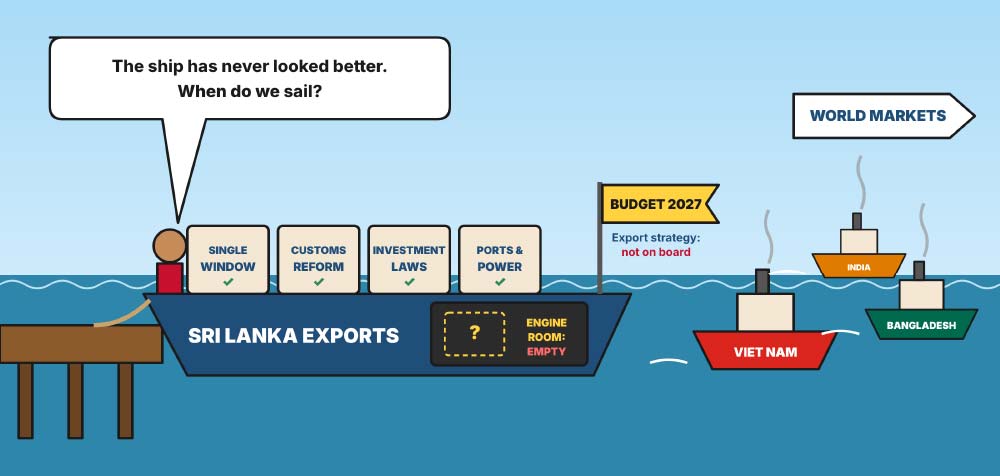
Budget 2027 polishes the ship, but leaves the engine room empty.


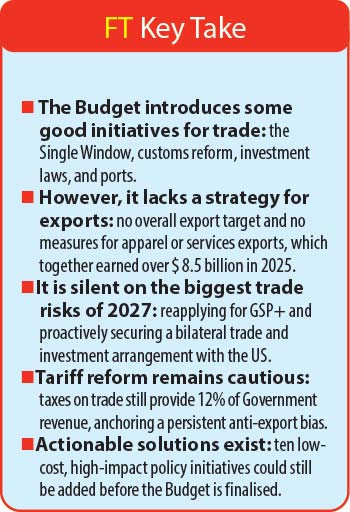
Budget 2027 improves Customs, investment laws, ports and power, and keeps the trade agreement agenda alive. But a budget whose second objective is export-led growth should have put trade at its centre, with targets, a strategy for our largest industries and markets, and new instruments for financing, digital trade and services


On 12 November, the Government presented its third Budget for 2027. Its stated aim is to move “from economic stability towards transformation”, and its second strategic objective is growth “driven by investment, production and exports”. This paper asks what the Budget means for Sri Lanka's trade, and what it could have done better.


Why trade should have been prioritised in the Budget

The Budget itself identifies the problem: the external sector has not yet been strengthened as required. The current account moved from a surplus of $ 1,853 million in the first nine months of 2025 to a deficit of $ 420 million in the same period of 2026, as the fuel import bill rose with the Middle East conflict.

Exports reached a record $ 17.25 billion in 2025 but missed their $ 18.2 billion target, and the 2026 target of $ 20 billion looks out of reach. The Asian Development Bank estimates that Sri Lanka leaves about $ 6 billion of export potential unrealised (Daily FT, 2026a). Meanwhile, the IMF program ends in March 2027, foreign debt service rises again to $ 3.6 billion in 2028, and remittances, now around $ 8 billion a year, cannot carry the balance of payments forever. Exports are the only sustainable source of the dollars we need.


What the Budget offers trade

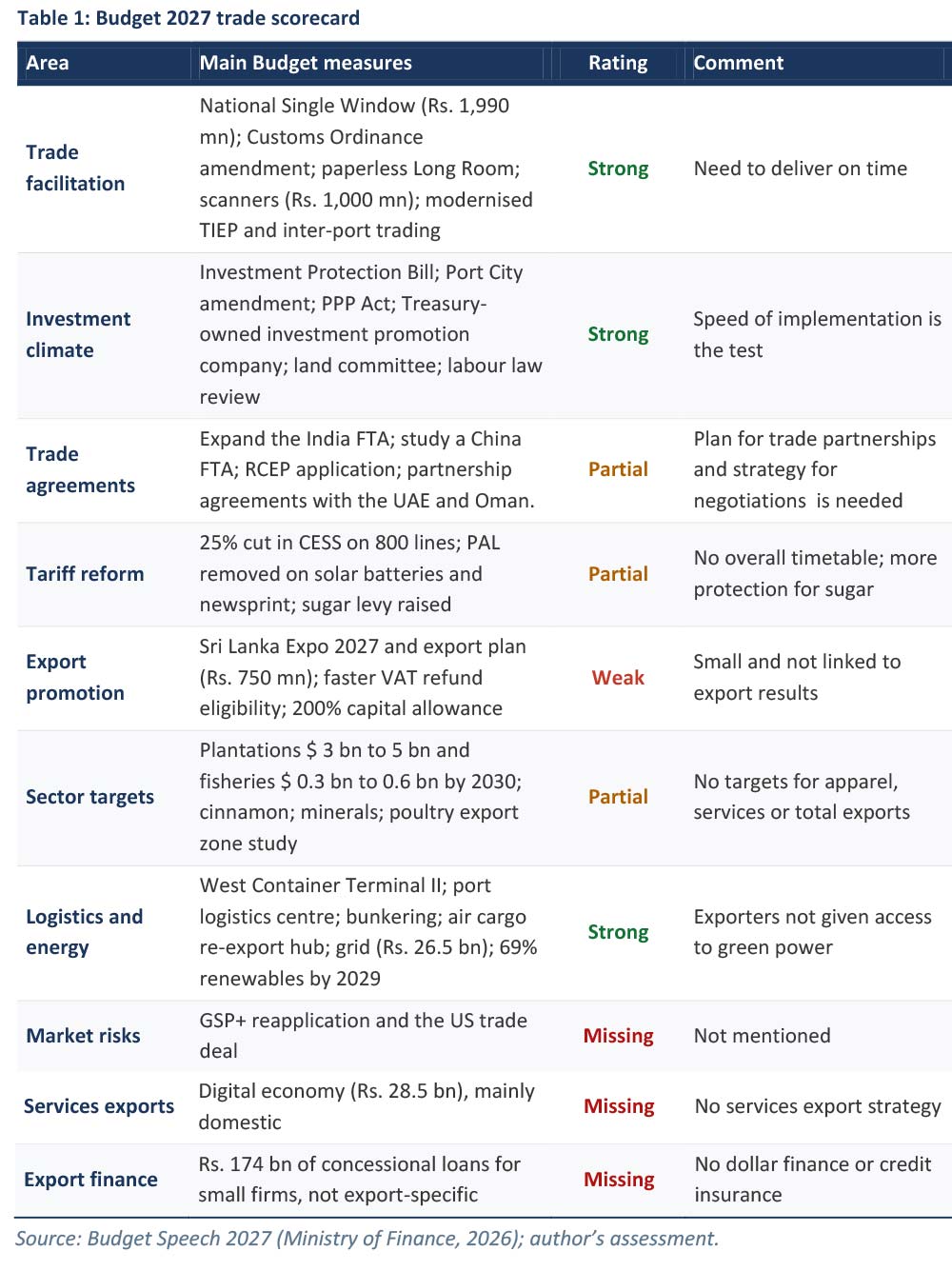
Four areas deserve credit. On trade facilitation, the National Single Window will connect exporters in the first half of 2027 and importers in the second; a new Customs Ordinance is due, and the scheme for importing inputs for export processing will be modernised to draw small firms into exports. On investment, the Investment Protection Bill, a Public-Private Partnership Act, a professionally staffed investment promotion company and a review of labor laws signal a serious effort. On trade agreements, the Budget commits to expanding the agreement with India, exploring one with China, joining the Regional Comprehensive Economic Partnership (RCEP), and concluding agreements with the UAE and Oman. On logistics and energy, port expansion, an air cargo re-export hub, and Rs. 26.5 billion for the electricity grid all matter to exporters.

There are also useful tax changes: a 200% capital allowance for BOI-approved export manufacturers investing at least $ 3 million, faster VAT refund eligibility for new exporters, and a 25% cut in the CESS on 800 tariff lines.


What could have been included: 10 new ideas
Earlier articles in this series made the case for a national trade policy, faster removal of para-tariffs, and strategies for the EU and US markets. Here are ten further ideas. Most are cheap, and several cost nothing but a law or a signature.

1. A dollar revolving fund for exporters' inputs. Exporters often borrow abroad because local interest rates are high. A fund that lends dollars for up to six months to import raw materials, repaid from export proceeds, would ease this. Bangladesh has used such a fund to support its garment industry. Since the money revolves, the cost to the Budget is small.

2. Performance-based export market grants. Instead of untargeted interest subsidies, reimburse part of the cost when a small firm enters a new market or launches a new product, but pay only after the exports are made. Part of the Rs. 67.7 billion allocated to interest subsidies and refinancing could be redirected this way.

3. An export test for every concession. Every year, governments give away revenue through tax holidays, duty waivers and allowances, but rarely ask what they get back. The Treasury should publish an annual statement showing how much each trade-related concession costs and how many exports, jobs and investments it produced, and withdraw those that do not deliver. It should also apply an export test before any new levy is imposed. For example, a levy on imported yarn raises costs for every garment exporter. Before such a levy is introduced, the Treasury should estimate how much it adds to exporters' costs and set this against the revenue it brings in. The Budget already promises to assess "every tax concession granted". This would put that promise into practice.

4. A digital trade law package. Three steps would make the Single Window far more powerful. First, a law recognising electronic bills of lading and other trade documents, based on the UN model law. Second, joining the UN ESCAP agreement on cross-border paperless trade, so that our systems can exchange data with partners. Third, seeking to join the Digital Economy Partnership Agreement, which Korea and Costa Rica have joined.

5. A services export strategy. India hosts over 2,000 global capability centres, the in-house service and technology hubs of multinational companies. Sri Lanka, with its skilled workforce and time zone, could attract firms seeking a second location in South Asia. A target of $ 5 billion in ICT and business services exports by 2030, with incentives for capability centres in the Port City, would complement the digital economy budget.

6. E-commerce exports for small firms. Sri Lanka Post and Customs could offer a simplified electronic export declaration for low-value parcels, linked to the Single Window, so that small firms in rural areas can sell online abroad. India has opened over 1,000 postal export centres for this purpose.

7. Artificial intelligence for trade intelligence. The World Trade Organization estimates that AI could raise global trade by nearly 40% by 2040 (WTO, 2025). The National AI Centre funded in this Budget could build a service that alerts small exporters to new standards, tariff changes, and buyer demand in Sinhala, Tamil, and English.

8. Green electricity as an export advantage. About 62% of our installed power capacity is already renewable, and global brands are pressing their suppliers to use renewable power. The Budget offers electricity concessions to data centres, but not to exporters. Allowing exporters to buy renewable power directly from producers, with internationally recognised certificates, would make our energy mix a selling point.

9. Critical minerals as a bargaining chip. The Budget plans to seek investors for graphite, mineral sands, silica and quartz, which the EU, the US and Japan treat as strategic. Sri Lanka should negotiate partnership agreements that secure in-country processing and better market access in return for reliable supply.

10. A free-port law, starting with tea. The re-export hubs proposed at the port, the airport, and for gems need a single modern law for free ports and bonded logistics. A tea hub (originally proposed by a former Chairman of EDB) that allows imported teas to be blended and re-exported under a separate label, while protecting the "Pure Ceylon Tea" brand, could capture blending and packaging profits now earned abroad.


During the committee stage, Parliament could add an export target and a quarterly export scorecard, redirect part of the interest subsidies to performance-based export grants, adopt the digital trade law package, and commission a services export strategy. The plumbing is being fixed. It is time to install the engine


Conclusion

Budget 2027 improves customs, investment laws, ports and power, and keeps the trade agreement agenda alive. But a budget whose second objective is export-led growth should have put trade at its centre, with targets, a strategy for our largest industries and markets, and new instruments for financing, digital trade and services.

During the committee stage, Parliament could add an export target and a quarterly export scorecard, redirect part of the interest subsidies to performance-based export grants, adopt the digital trade law package, and commission a services export strategy. The plumbing is being fixed. It is time to install the engine.


(The author is an international trade specialist, a former United Nations Director of Trade and Investment, and former Chief Economist for the Asia-Pacific region at ESCAP)


References

Daily FT (2026a). $6 b export gap and weak performance strains external stability: ADB. 25 April. https://www.ft.lk/front-page/6-b-export-gap-and-weak-performance-strains-external-stability-ADB/44-791101

Daily FT (2026b). Para-tariff phase-out to boost manufacturing and lift incomes: World Bank. 21 April. https://www.ft.lk/front-page/Para-tariff-phase-out-to-boost-manufacturing-and-lift-incomes-World-Bank/44-790889

Ministry of Finance (2026). Budget Speech 2027 (81st Budget Speech). Presented to Parliament on 12 November 2026. Colombo: Ministry of Finance, Planning and Economic Development.

WTO (2025). World Trade Report 2025: Making trade and AI work together to the benefit of all. World Trade Organization, Geneva.


Recent columns