Thursday Nov 12, 2026
Thursday Nov 12, 2026
Thursday, 12 November 2026 00:22 - - {{hitsCtrl.values.hits}}
 Trade as an engine of growth for Sri Lanka: Part 1
In 1977, Sri Lanka was among the developing world’s pioneers in open trade and outward orientation. Viet Nam and Bangladesh followed much later, yet both have since moved far ahead. Understanding why matters if Sri Lanka is to recover the promise of those early reforms
In 1977, Sri Lanka took a bold step. At a time when most developing Asia remained suspicious of international markets, Sri Lanka dismantled import controls, unified the exchange rate, welcomed foreign investors and established the Greater Colombo Economic Commission, including the country’s first export processing zone at Katunayake.
The response was immediate. Exports, which had contracted during the closed-economy years of the early 1970s, rose to around 30% of GDP by the early 1980s. Sri Lanka briefly became an example to the developing world: a small island prepared to earn its place in the global economy.
Almost half a century later, an uncomfortable question remains. If Sri Lanka opened its economy first, how did it fall so far behind?
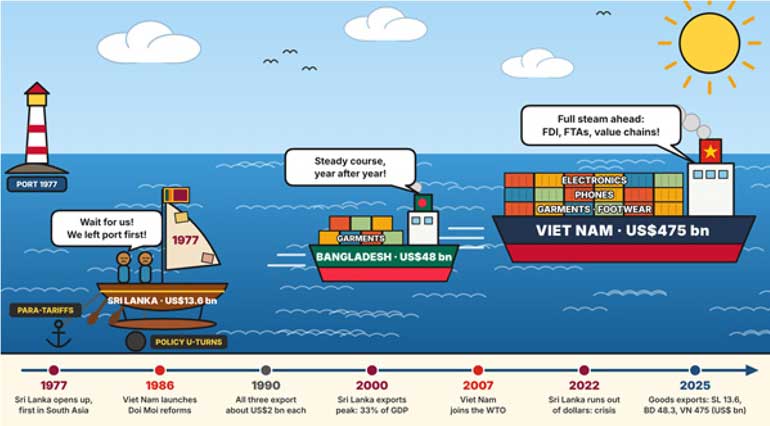
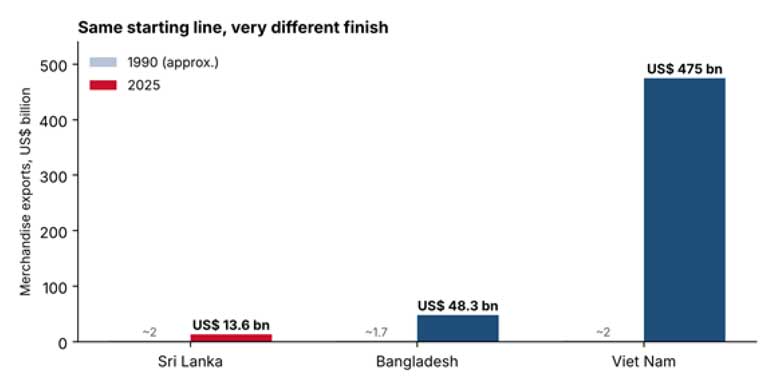
The contrast is shocking. In 1990, Sri Lanka, Viet Nam and Bangladesh each exported roughly $2 billion in goods annually. Viet Nam was a war-scarred, centrally planned economy only four years into its Doi Moi reforms. Bangladesh was among the poorest countries in the world. Sri Lanka, by comparison, had a thirteen-year head start, a highly literate workforce and a position beside one of the world’s busiest shipping lanes.
By 2025, Sri Lanka’s merchandise exports had reached about $13.6 billion. Including services, total export earnings stood at a record $17.3 billion. That is an achievement, but the comparison with our competitors is disheartening. Bangladesh shipped goods worth $48.3 billion in its latest fiscal year, about three and a half times Sri Lanka’s total. Viet Nam exported $473 billion, roughly 35 times our figure. Its electronics exports alone, worth $106 billion, were nearly eight times the value of all Sri Lankan merchandise exports.
Merchandise exports, 1990 and 2025 ($ billion).
The more troubling comparison is not with Viet Nam or Bangladesh, but with Sri Lanka’s own past. In 2000, exports amounted to one-third of GDP. By 2021, goods exports had fallen below 15%, approaching the levels seen during the inward-looking early 1970s that the 1977 reforms were intended to leave behind.
The economy continued to expand, but growth increasingly relied on borrowing, construction, and domestic consumption rather than income earned abroad. The consequences were painfully clear in 2022, when Sri Lanka ran out of foreign currency to pay for fuel, medicine, and food.
How did this happen?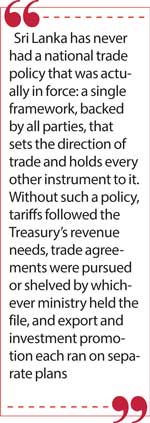
The problem was not openness or outward-orientation itself. Every economy that has moved from poverty to prosperity without relying on oil or mineral wealth, including Korea, Taiwan, Singapore, Malaysia and, more recently, Viet Nam, has done so through exports. A country of 22 million people cannot become prosperous by selling mainly to its own consumers.
The new policy was good. What failed was Sri Lanka’s ability to sustain it.
Sri Lanka stopped reforming. Vietnam and Bangladesh began later, but they continued. Sri Lanka’s liberalisation lost momentum and eventually reversed. Successive Governments introduced para-tariffs such as CESS and the Ports and Airports Development Levy. These measures raised revenue and protected favored industries while creating an anti-export bias.
According to the World Bank, Sri Lanka’s simple average import duty is about 19%, including para-tariffs that account for 11%age points. Import taxes also act as taxes on exports. They increase the cost of machinery, fabric and components used by exporters, while making the protected domestic market more attractive than the far more demanding international one.
Sri Lanka also remained largely outside global value chains. Modern trade rarely involves producing an entire product within one country. It is built around specialised tasks performed across networks of factories, suppliers and markets in several countries.
Viet Nam understood this shift. It actively attracted multinational manufacturers, entered trade agreements with Europe, its Pacific partners and neighboring Asian economies, and made itself one of the region’s most attractive locations for electronics assembly. Foreign-invested companies now account for about 77% of Viet Nam’s exports.
Sri Lanka attracted too little foreign investment directed towards exports. It entered relatively few trade agreements outside South Asia and continued to depend heavily on garments, tea and rubber, much as it had a generation earlier.
Sri Lanka’s export base remained narrow. For decades after independence, tea, rubber and coconut supplied much of the country’s export income. Their prices were volatile and tended to decline relative to the cost of the goods Sri Lanka needed to import.
Garments eventually widened the export base, but much of the subsequent growth came from selling larger quantities of familiar products rather than developing successful new ones. Exporters experimented with hundreds of products, but few achieved lasting commercial success. At the same time, factories imported much of the fabric, machinery, and other components they used. A significant portion of each export dollar therefore flowed back out of the country, limiting the value retained at home.
Foreign investors were often kept at a distance by a complicated tax system, unpredictable regulation, and expensive logistics. Although successive Governments periodically promoted FDI, creating an investment-friendly environment or investment facilitation was not on the agenda. Governments forgot that export-oriented foreign investment brings technology, management expertise, production knowledge, and access to international markets. By failing to attract enough FDI and retain foreign companies, Sri Lanka missed several benefits at once.
Trade relationships were also limited. Competitors entered deep, reciprocal agreements across Asia and with Europe. Sri Lanka concluded only one agreement outside South Asia (Thailand). Most of them, if not all, were ineffective. Even the free trade agreement with India remained underused and unbalanced. Most Governments feared opening to such relationships. Even if Governments were in favor of free trade agreements, such initiatives were strongly opposed by self-interested political parties. Instead, exporters relied heavily on one-way preferences such as the European Union’s GSP+. These arrangements are useful, but they are conditional and can be withdrawn, as Sri Lanka discovered between 2010 and 2017.
Most importantly, Sri Lanka never developed a durable national trade agenda. In Viet Nam and Bangladesh, export growth became a national undertaking that survived changes in political leadership. In Sri Lanka, trade was often portrayed as a threat to employment, farmers, and national sovereignty, rather than as a means of creating more productive and better-paid jobs. Without broad public support, reform remained politically vulnerable. For Governments, introducing another levy was easier than making the case for competition and an open market.
True that Sri Lanka did face exceptional shocks: three decades of war, a tsunami, a pandemic and a sovereign default. These events undoubtedly held the country back. But war alone cannot explain why the decline continued after 2009, when peace created the best economic opportunity Sri Lanka had seen in a generation.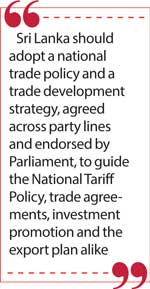
Behind all these failures lies a deeper reason. Sri Lanka has never had a national trade policy that was actually in force: a single framework, backed by all parties, that sets the direction of trade and holds every other instrument to it. Without such a policy, tariffs followed the Treasury’s revenue needs, trade agreements were pursued or shelved by whichever ministry held the file, and export and investment promotion each ran on separate plans.
However, the Government attempted to formulate and implement a National Trade Policy in 2017. Although a policy was formulated and approved by the Cabinet, it was never turned into a time-bound action plan; the ministry responsible for it was restructured, and it quietly disappeared. It rested on three pillars: competitiveness through domestic reform, wider market access through a strategic program of trade agreements with both Asian and Western markets, and trade facilitation. Its first principle was predictability, consistency, and transparency. This framework can be revived, taking into account new developments at both national and global levels. Global value chains are being redrawn as firms spread production beyond China and closer to trusted markets. Services and digital trade account for a growing share of value, even inside manufactured goods. Sustainability standards increasingly decide who gets access to rich-country markets. A modern trade policy must treat these shifts as opportunities: positioning Sri Lanka as a reliable link in Asian value chains, letting producers import inputs freely, and turning standards and certification from a barrier into a source of competitiveness.
The gap matters even more today. The National Tariff Policy is a welcome step, but a tariff policy is an instrument, not a strategy. It cannot decide which trade agreements Sri Lanka should pursue, how to secure membership of the Regional Comprehensive Economic Partnership (RCEP), how to respond when the United States changes its tariffs on our goods, or how exporters will meet Europe’s new carbon and deforestation rules. After all, trade policy goes beyond tariffs and encompasses a spectrum of instruments: WTO agreements, regional and bilateral agreements, trade facilitation, GVCs, the trade-FDI nexus, trade-related legal and regulatory measures, and coherence with macroeconomic policies, which are interconnected. Unfortunately, many, including those who advise Governments, think trade policy is just revisions to the import tariff structure.
The National Tariff Policy proposes a simpler four-band structure of 0, 10, 20 and 30%. The Government has committed to eliminating CESS and the Ports and Airports Development Levy, with the phased removal of CESS due to begin in 2028. The World Bank estimates that removing para-tariffs could increase household consumption by an average of 3.1%, with the poorest households receiving the greatest gains. A National Export Development Plan for 2026 to 2030 has also been prepared, and exporters’ associations have supported the reforms. But without a national trade policy above them, these remain separate instruments, vulnerable to the next budget or the next change of Government.
This paper ends with a straightforward proposal. Sri Lanka should adopt a national trade policy and a trade development strategy, agreed across party lines and endorsed by Parliament, to guide the National Tariff Policy, trade agreements, investment promotion and the export plan alike. It should have an owner: a properly staffed trade agency working through an inter-ministerial council, with the policy reviewed every three years.
(The author is an international trade specialist, a former United Nations Director of Trade and Investment, and former Chief Economist for the Asia-Pacific region at ESCAP)