Saturday Oct 17, 2026
Saturday Oct 17, 2026
Saturday, 16 May 2026 00:50 - - {{hitsCtrl.values.hits}}
 “Man is the measure of all things.” — Protagoras (490–420 BCE ca)
‘Vitruvian Man’ (34.3 × 24.5 cm) is one of the most celebrated drawings by Leonardo da Vinci, created around 1490. Executed in pen and brown ink with wash over metalpoint on paper, the work is preserved in the collection of the Gallerie dell ‘Accademia, Venice. As a fragile work on paper, it is rarely exhibited. However, in 2019, it was lent to the Louvre Museum for a major exhibition marking the 500th anniversary of Leonardo’s death.
The idea behind the drawing is derived from the writings of the ancient Roman architect and military engineer Vitruvius (c. 80 – c. 20 BC). In his treatise De architectura (On Architecture), Vitruvius described the ideal proportions of the human body, proposing that a perfectly formed man could be inscribed within both a circle and a square. He observed that when a man lies on his back with arms and legs outstretched, the navel becomes the center of a circle drawn around him, with the fingers and toes touching the circumference. He also noted that the height of the body equals the span of the outstretched arms, forming a perfect square.
|
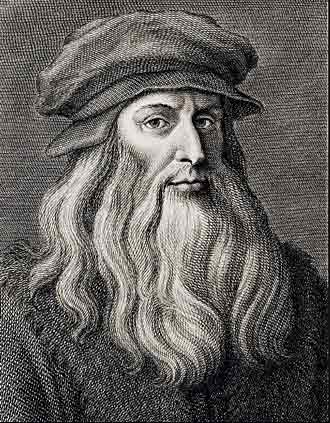
Leonardo Da Vinci: 1452-1519 |
Vitruvius did not include illustrations, and during the 15th and 16th centuries several artists and architects including Fra Giovanni Giocondo, Cesare Cesariano, and Francesco di Giorgio Martini attempted to visualise his description. Many of these attempts forced the figure to fit within the shapes by placing the circle inside the square or the square inside the circle, often resulting in distorted proportions.
Leonardo approached the problem differently. Studying the proportions of young men in Milan, he relied on careful observation and measurement. Although the notes accompanying the drawing refer to Vitruvius, they largely reflect Leonardo’s own anatomical investigations. Unlike earlier interpretations, Leonardo separated the centers of the circle and the square. In the circular pose, the navel forms the center, with the hands and feet touching the circumference, closely following Vitruvius’s description. In the square pose, the legs are together, the feet rest on the base of the square, and the arms extend horizontally so that the fingers meet the sides. Here, the center of the square lies slightly above the genitals—a refinement based on empirical observation. Through this adjustment, Leonardo achieved a more natural and convincing representation of the human form.
It is fascinating to consider that this iconic image was likely a private notebook page, not intended for public display. Leonardo wrote his notes in his characteristic mirror writing (from right to left), suggesting it was primarily for personal study—a record of his ongoing investigation into proportion and harmony.
The Vitruvian Man is fascinating because Leonardo created a detailed field guide to human proportions. The notes surrounding the figure are packed with specific measurements: The span of the outstretched arms is equal to the height of the man. From the hairline to the bottom of the chin measures one-tenth of the total height, and from below the chin to the top of the head one-eighth. The distance from the chest to the top of the head is one-quarter, with one-sixth from the upper chest to the crown and one-seventh to the hairline. The width of the shoulders is one-quarter of the total height. From the elbow to the tip of the hand is one-quarter, and from the elbow to the armpit one-eighth, while the length of the hand is one-tenth. The foot measures one-seventh of the height. From the sole of the foot to below the knee is one-quarter, and from the knee to the root of the genitals another quarter, placing the genitals at the midpoint of the body. Within the face, the distances from the chin to the nose, the eyebrows, and the hairline are equal, and the ear measures approximately one-third of the face.
The two geometric shapes carry symbolic weight, especially within Renaissance thought. The square, with its four equal sides and right angles, was associated with the earthly and the material—stability, rationality, and the finite world. The circle, with no beginning or end, symbolised perfection, the divine, and the cosmos. By placing the human figure within both, Leonardo expresses a central idea of Renaissance humanism: that the human being is a “microcosm” of the universe, capable of reflecting both earthly and cosmic order.
There may be a deeper mathematical relationship at play. Leonardo’s notes mention that when the legs are spread and arms raised, the space between the legs forms an equilateral triangle. Recent analysis suggests this triangle corresponds to a fundamental principle of human jaw function (Bonwill’s triangle), and the ratio between the circle and square in the drawing (about 1.64-1.65) approximates the tetrahedral ratio of 1.633—a number associated with optimal spatial organisation in nature.
It’s a beautiful reminder that for Leonardo, art, architecture, anatomy, and mathematics were never separate subjects—they were all lenses to understand the same magnificent design.
This drawing was largely unknown for centuries. It remained in private collections until it was acquired by the Gallerie dell’Accademia in Venice in 1822. Its rise to iconic status—becoming a universal symbol of humanity and even appearing in popular culture—occurred much later, particularly during the 20th century. This transformation reminds us that the meaning of great works of art is not fixed, but evolves with the cultures that rediscover them.
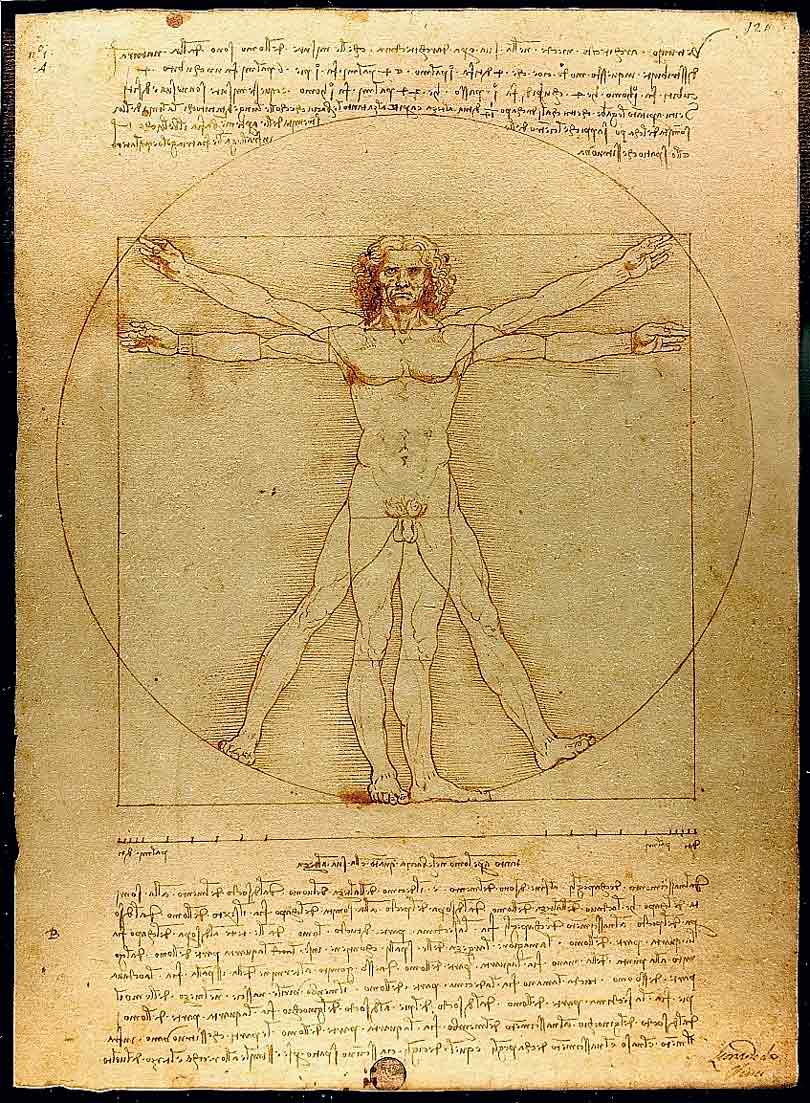
Vitruvian Man (1490) Gallerie dell ‘Accademia, Venice