Saturday Oct 03, 2026
Saturday Oct 03, 2026
Friday, 8 May 2026 02:54 - - {{hitsCtrl.values.hits}}
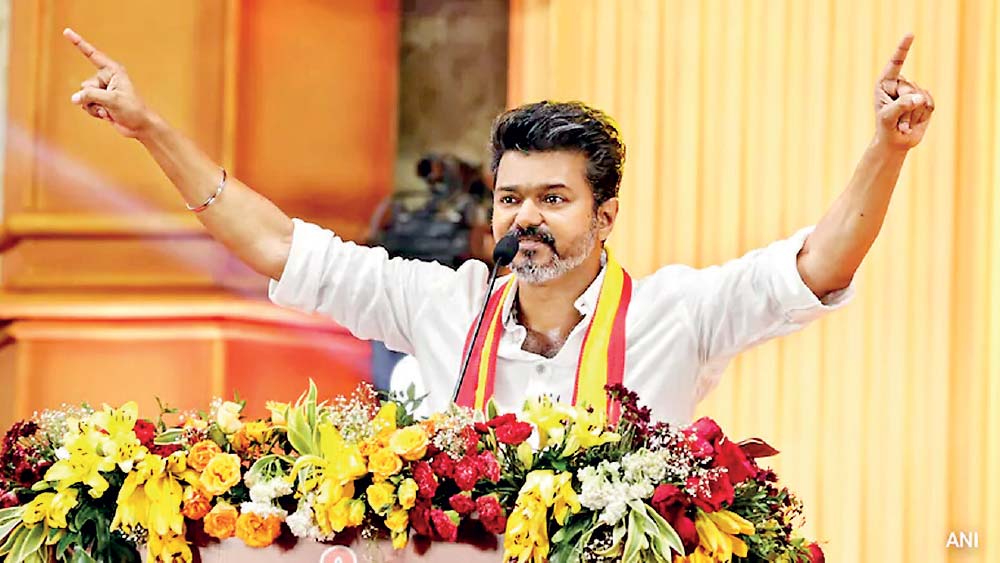
Actor-turned-politician Joseph Vijay celebrates his victory as the single largest party in the Tamil Nadu Assembly, winning 108 of 234 seats in the 23 April elections
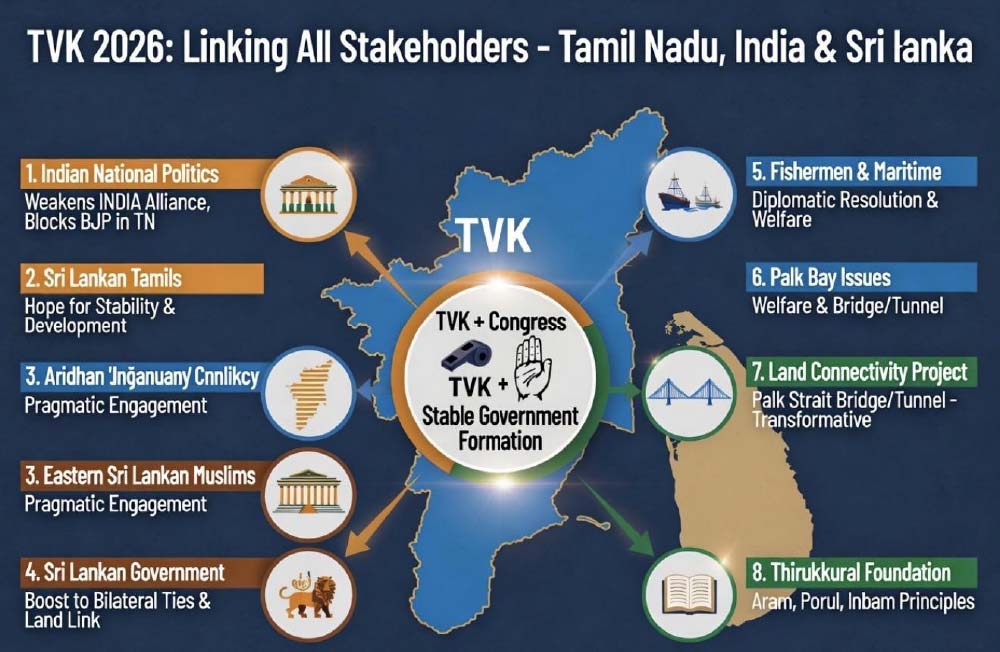
 Ascent marks the first time a non-Dravidian party has become Tamil Nadu’s single largest force. By grounding its politics in Thirukkural’s eternal principles of equality by birth, virtuous governance, shared prosperity, and collective well-being, Vijay has offered the state a chance to break free from old cycles. Whether the new leadership can translate its ambitious manifesto into effective governance while managing coalition dynamics will define the coming years
 In one of the most dramatic political upheavals in southern India in over half a century, actor-turned-politician Joseph Vijay’s Tamilaga Vettri Kazhagam (TVK) has emerged as the single largest party in the Tamil Nadu Assembly, winning 108 of 234 seats in the 23 April elections. The result has decisively ended the long-standing duopoly of the Dravida Munnetra Kazhagam (DMK) and All India Anna Dravida Munnetra Kazhagam (AIADMK), which had alternated power since the late 1960s. Incumbent Chief Minister M.K. Stalin lost his Kolathur seat and resigned, paving the way for a new political dawn.
This is far more than an electoral upset. It represents a generational and philosophical shift in Tamil politics. Powered by Vijay’s massive fan following, widespread anti-incumbency against the DMK, and deep voter fatigue with decades of revolving-door Dravidian governance, TVK’s victory is firmly rooted in the timeless principles of Thirukkural.
The party’s 95-page manifesto and its core ideology draw directly from Thiruvalluvar’s ancient Tamil ethical masterpiece, structuring its vision around the three fundamental pillars: Aram (virtue and righteousness), Porul (wealth, governance and prosperity), and Inbam (joy, well-being and happiness). The party motto “Pirappokkum Ella Uyirkkum” (All beings are equal by birth) is taken straight from Kural 972, emphasising radical equality and social justice.
The drivers of change
Vijay’s star power proved decisive, drawing lakhs to rallies that transcended caste, class and region. Yet the triumph went deeper than charisma. Five years of DMK rule had bred resentment over corruption allegations, rising crimes against women, dynastic politics (particularly the elevation of Udhayanidhi Stalin), unmet job promises, and a perceived overemphasis on Centre-state confrontation at the expense of local governance. The AIADMK, weakened by internal splits and its alliance with the BJP, could not capitalise. Voters, exhausted by the predictable binary, embraced TVK as a fresh, secular, and principled alternative grounded in Tamil ethical tradition.
A bold agenda guided by Thirukkural
TVK’s manifesto is explicitly built on Thirukkural’s framework. Under Aram (virtue), it promises uncompromising anti-corruption measures, including a State Whistleblower Protection Act, transparent governance, a caste survey for equitable resource distribution, and a dedicated Women’s Safety Department with fast-track courts.
Under Porul (wealth and statecraft), the party focuses on economic upliftment: legally guaranteed Minimum Support Price for farmers (₹3,500 per quintal for paddy, ₹4,500 for sugarcane), full crop loan waivers for smallholders, 100% crop insurance, and a ₹15,000-crore MSME credit guarantee fund. Fishermen, a critical coastal constituency, are assured ₹27,000 during the annual ban period, subsidised diesel, ₹25 lakh accident insurance, and India’s first statutory fish MSP.
Under Inbam (joy and well-being), the agenda is people-centric: ₹2,500 monthly financial assistance for women heads of households, six free LPG cylinders annually, free travel on all government buses, 8 grams of gold plus a silk saree for brides from economically weaker sections, unemployment allowance for youth (₹4,000 for graduates), skill development stipends, collateral-free education loans up to ₹25 lakh, and a massive “CM People Service Associate” programme creating 500,000 village-level jobs at ₹18,000 per month. Healthcare insurance is expanded to ₹25 lakh per family.
This harmonious integration of ethical governance, economic prosperity, and human happiness gives TVK a distinctive cultural legitimacy that resonates deeply with Tamil voters.
National political realignment
The national implications are profound. Tamil Nadu’s 39 Lok Sabha seats have long been a cornerstone of southern politics. DMK’s defeat represents a major setback for the INDIA alliance. In a decisive development on May 6, the Congress Party formally accepted Vijay’s invitation to support the TVK government. With Congress’s five seats, TVK can now comfortably surpass the 118-seat majority mark and form a stable administration.
This pragmatic alliance weakens the INDIA bloc, blocks the BJP’s entry into Tamil Nadu, and signals Congress’s willingness to prioritise state-level relevance over rigid national alliance loyalty. TVK’s independent, centre-left stance critical of both dynastic corruption and divisive majoritarianism positions it as a potential kingmaker in future national coalitions, particularly ahead of the 2029 Lok Sabha polls.
Implications for Sri Lanka and the region
For Sri Lanka, the emergence of a stable TVK-Congress government in Tamil Nadu carries deep significance. Northern and Eastern Tamil communities have welcomed the change, hoping for continued advocacy on livelihood and development issues while expecting a more development-oriented approach. Eastern Muslim communities anticipate pragmatic engagement that could ease historical tensions.
The shift aligns closely with the renewed call by Indian High Commissioner Santosh Jha for a fixed land link across the Palk Strait. Speaking at the Global Innovation and Leadership Summit in Colombo, Jha emphasised that while Colombo and Chennai are roughly 300 km apart by sea, the closest points Rameswaram and Talaimannar are merely 30 km apart. He described the current lack of direct road, rail, ferry, energy grid or pipeline connectivity as “an anomaly” and declared, “the time for wavering is over.” A bridge or tunnel, he argued, would transform the economic geography of the region and help Sri Lanka realise its aspiration as a regional hub far more effectively than port or airport expansions alone.
With TVK’s strong emphasis on fishermen’s welfare and Congress’s traditional support for deeper bilateral economic ties, the new government is well-placed to pursue such transformative connectivity projects through mature diplomacy. This could lead to faster resolution of longstanding Palk Bay fishing disputes, expanded trade, tourism, and investment flows. India remains Sri Lanka’s largest trading partner, top source of tourists, and accounts for over 50% of foreign direct investment. A stable, development-focused Tamil Nadu Government strengthens this partnership while advancing broader Indian Ocean regional stability.
A historic transition
Ascent marks the first time a non-Dravidian party has become Tamil Nadu’s single largest force. By grounding its politics in Thirukkural’s eternal principles of equality by birth, virtuous governance, shared prosperity, and collective well-being, Vijay has offered the state a chance to break free from old cycles. Whether the new leadership can translate its ambitious manifesto into effective governance while managing coalition dynamics will define the coming years.
For India, this signals the rise of principled, personality-driven regional forces capable of reshaping national equations. For Sri Lanka, it opens fresh avenues for economic integration and constructive engagement on sensitive issues. For the wider region, it strengthens the prospects of a more connected and prosperous India-Sri Lanka relationship.
The whistle has been blown. Guided by the wisdom of Thirukkural, a new chapter has begun in Tamil Nadu and in the shared destiny of India and Sri Lanka.
(The author is the former Head of the Counter-Terrorism Division of the State Intelligence Service of Sri Lanka, and has served as Head of the Sri Lankan Delegation at three BIMSTEC Security Conferences. With over 40 years of experience in policing and intelligence, he writes on regional security, interfaith relations, and geopolitical strategy)



