Friday Oct 02, 2026
Friday Oct 02, 2026
Thursday, 18 June 2026 00:21 - - {{hitsCtrl.values.hits}}
The General Secretary of the Communist Party and President of Viet Nam concluded a historic State visit to Sri Lanka on 8 May 2026. This visit by Viet Nam’s top official comes at a particularly important moment for Sri Lanka. Beyond its diplomatic significance and implications for bilateral relations, the visit should encourage Sri Lanka to carefully examine one of the most remarkable economic transformations witnessed in Asia over the past 25 years.
Few countries in the developing world have moved as decisively and strategically as Viet Nam in transforming itself from a relatively poor agrarian economy into one of Asia’s largest export manufacturing bases.
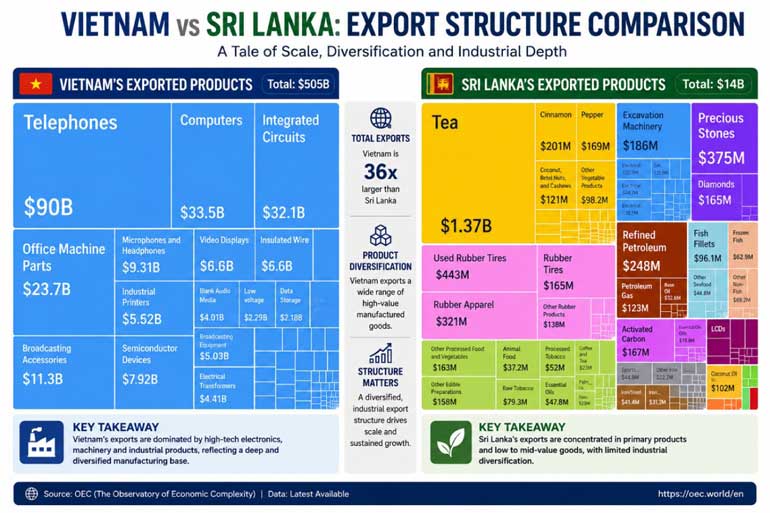
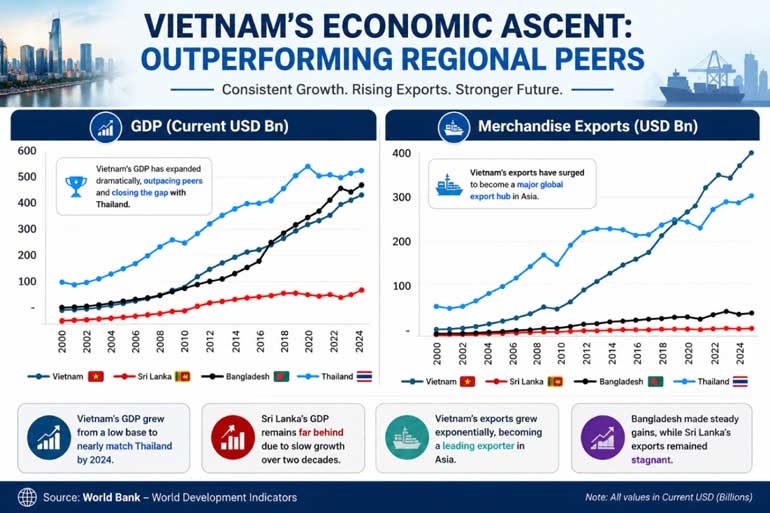
For Sri Lanka, the comparison is particularly relevant because, around the year 2000, the two countries were not vastly different economically. Sri Lanka possessed stronger social indicators, higher literacy levels, a more established private sector, a strategic location, and a higher per capita income. By 2025, however, Viet Nam had emerged as a global manufacturing powerhouse with exports exceeding $ 475 billion, while Sri Lanka continued to struggle with a comparatively small export base of $ 13.6 billion.
These figures tell a remarkable story. Sri Lanka’s nominal GDP in 2000 was $ 16.6 billion, while Viet Nam’s GDP was nearly double that amount at $ 31 billion, supported by a significantly larger population. Sri Lanka’s exports were approximately $ 5.4 billion, while Viet Nam exported roughly $ 14.5 billion. Sri Lanka’s GDP per capita at the time was significantly higher than Viet Nam’s. Sri Lanka was also regarded as one of South Asia’s more promising middle-income economies, with relatively strong human development indicators.
By 2025, the divergence between the two economies had become extraordinary. Viet Nam’s economy is now approaching $ 514 billion, while Sri Lanka’s economy stands at slightly above $ 108 billion. Viet Nam’s exports have reached a massive $ 475 billion, while Sri Lanka’s remain at $ 13.6 billion. Viet Nam has become deeply integrated into global supply chains for smartphones, electronics, machinery, industrial manufacturing, furniture, textiles, and technology products. Sri Lanka, despite its strategic location and educated workforce, remains dependent on a relatively narrow export basket led by apparel, tea, rubber, and coconut products, with little significant change from that of 2000.
The key lesson is that Viet Nam’s rise was not accidental. It was the result of a long-term national economic strategy centred on export-oriented industrialisation, manufacturing competitiveness, infrastructure development, policy continuity, and the attraction of foreign direct investment. Viet Nam understood very early that sustainable economic transformation requires integration into global production systems. Unlike Sri Lanka, Viet Nam also recognised that a country cannot achieve economic prosperity simply by consuming more or borrowing more; it becomes stronger by producing, exporting, and moving up industrial value chains.
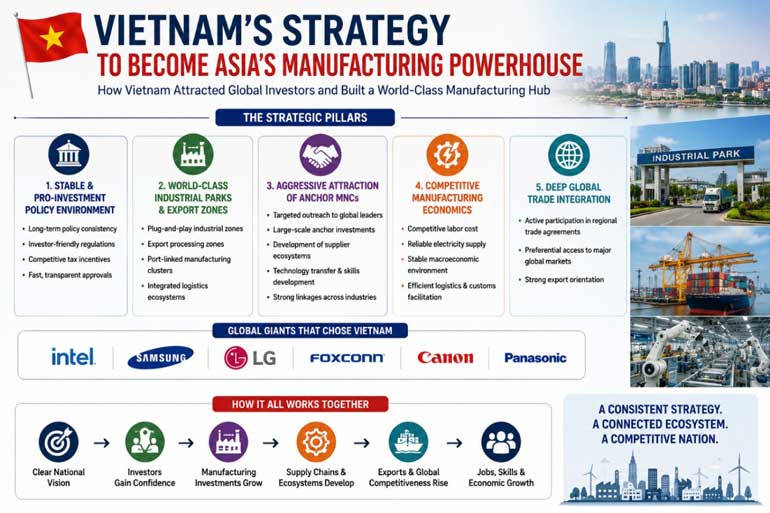
A key strategic decision Viet Nam made was to position itself as a reliable and cost-competitive manufacturing destination for multinational corporations (MNCs). This approach fundamentally changed the trajectory of the Vietnamese economy. Viet Nam did not attempt to build every industry domestically from the beginning. Instead, it invited the world’s leading MNCs to establish manufacturing bases within the country, thereby creating industrial ecosystems, supplier networks, technical capabilities, employment opportunities, and export growth simultaneously.
Among the earliest and most significant MNCs to establish large-scale operations in Viet Nam was the US technology giant Intel Corporation. Intel’s investment in semiconductor assembly and testing operations in Ho Chi Minh City was a strategic breakthrough because it signalled to global markets that Viet Nam was capable of supporting sophisticated technological manufacturing. This was not merely an investment in a factory; it was a vote of confidence in Viet Nam’s long-term industrial capability. It also provides real-world evidence of the transformative impact that a single investment by a major MNC can have on a country.
The real game changer was the entry of Samsung Electronics into Viet Nam in 2008 with a smartphone manufacturing facility. Samsung transformed Viet Nam into one of the world’s largest smartphone manufacturing hubs. Today, a substantial share of Samsung’s global smartphone production originates from Viet Nam. Samsung’s operations alone contribute a significant share of the country’s exports annually and support a vast ecosystem of suppliers, logistics providers, industrial service companies, packaging manufacturers, warehousing operators, and engineering support firms.
Following Samsung’s success, other major global MNCs accelerated their investments in Viet Nam. LG Electronics, another South Korean technology giant, expanded its large-scale electronics production operations. Foxconn, one of the world’s largest electronics manufacturers and a major supplier to Apple, significantly expanded its operations in Viet Nam as global supply chains diversified beyond China. Large manufacturing ecosystems supporting brands such as Apple, Nike, Adidas, Canon, Panasonic, and numerous Japanese and South Korean industrial companies steadily migrated to Viet Nam.
Viet Nam’s attraction extended beyond low labour costs. Many countries can offer cheap labour. Viet Nam succeeded because it combined cost competitiveness with policy consistency, infrastructure availability, export facilitation, political stability, and industrial discipline. Investors committing large-scale investments in manufacturing facilities require confidence that policies will remain stable for decades, not merely years. Viet Nam provided that assurance.
The transformation also reflected the success of Viet Nam’s industrial zone strategy. The country aggressively developed export processing zones, industrial parks, logistics corridors, ports, highways, and power infrastructure directly linked to manufacturing expansion. These were equipped with reliable electricity, water, roads, customs facilitation, and investor support mechanisms. This allowed multinational corporations to commence operations quickly and scale production efficiently.
In contrast, Sri Lanka’s approach to industrial development has been fragmented and inconsistent. While Sri Lanka successfully developed certain industrial zones and export sectors, particularly apparel in the 1980s, the country never achieved the scale necessary to become deeply embedded in global manufacturing supply chains. Policy inconsistency, periodic
macroeconomic instability, high energy costs, infrastructure bottlenecks, import restrictions, currency volatility, and lengthy approval processes have repeatedly weakened investor confidence.
The 2022 economic crisis further exposed the vulnerabilities of an economy that relied heavily on tourism, remittances, imports, and external borrowing rather than large-scale export manufacturing. The crisis demonstrated that sustainable foreign exchange generation cannot depend primarily on services and debt inflows. Strong export manufacturing remains the foundation upon which most successful Asian economies have built long-term resilience.
Lessons for Lanka
Sri Lanka’s recent economic stabilisation and debt restructuring process have undoubtedly created a valuable window of opportunity. Real GDP growth has returned, inflation has moderated, and foreign exchange reserves have improved relative to the crisis period. Yet stabilisation alone is insufficient. The country now requires a long-term economic transformation strategy comparable in ambition and consistency to that pursued by Viet Nam over the past three decades. (Please refer to my previous article on what Sri Lanka should do after economic stabilisation and the completion of debt restructuring: [https://www.ft.lk/columns/Beyond-debt-restructuring-Sri-Lanka-s-narrow-window-to-execute-a-real-economic-reset/4-791830](https://www.ft.lk/columns/Beyond-debt-restructuring-Sri-Lanka-s-narrow-window-to-execute-a-real-economic-reset/4-791830).)
The first major lesson Sri Lanka must learn from Viet Nam is the importance of creating globally competitive export manufacturing ecosystems at scale. Sri Lanka cannot rely solely on relatively small industrial parks or fragmented investment initiatives. The country requires large, integrated manufacturing and logistics zones directly connected to ports, airports, and transport infrastructure. Areas surrounding the Port of Colombo, Hambantota, Trincomalee, and key transport corridors should be developed into globally competitive industrial platforms capable of hosting large-scale electronics assembly, renewable energy manufacturing, automotive component production, ship-related industries, industrial engineering operations, and export-oriented manufacturing ecosystems.
The second lesson is the strategic attraction of anchor multinational corporations. Viet Nam did not merely market itself as a generic investment destination. It strategically targeted large corporations capable of creating entire supplier ecosystems around them. Sri Lanka should similarly identify and pursue a carefully selected group of multinational corporations in sectors such as electronics, electric vehicles, renewable energy equipment, logistics technology, industrial engineering, and advanced manufacturing. The establishment of even one major multinational manufacturing ecosystem can fundamentally alter a country’s industrial trajectory.
The third lesson concerns energy competitiveness and infrastructure reliability. Manufacturing economies cannot function efficiently with unstable or expensive energy systems. Viet Nam invested heavily in ensuring industrial power availability and infrastructure expansion. Sri Lanka possesses significant renewable energy potential, particularly in wind and solar power, but the rapid expansion of industrial-scale energy infrastructure remains essential. Energy infrastructure and industrial expansion should proceed in parallel. Competitive energy pricing, grid modernisation, energy storage systems, LNG infrastructure, and long-term industrial power planning are critical if Sri Lanka wishes to compete as a manufacturing destination.
The fourth lesson is the integration of logistics and industrial development. Sri Lanka already possesses one of the most strategically positioned ports in the Indian Ocean. However, the country has not fully leveraged this advantage to create integrated manufacturing and export ecosystems. Viet Nam successfully integrated ports, logistics corridors, customs facilitation, industrial zones, and export manufacturing into a coherent economic strategy. Sri Lanka should similarly position itself not merely as a transshipment hub, but as a manufacturing, distribution, and value-addition centre serving South Asia, the Middle East, and emerging Indo-Pacific trade routes.
The fifth and most important lesson is policy continuity. Viet Nam remained committed to export-oriented industrialisation over several decades. Investors trusted that the country's broader economic direction would remain stable. Sri Lanka, unfortunately, has frequently altered taxes, import policies, tariffs, investment regulations, and incentive structures. Long-term industrial investors require confidence, predictability, and institutional consistency. Without consistent policies across different political administrations, attracting large-scale manufacturing investment becomes extremely difficult, regardless of geographical advantages.
Sri Lanka’s strategic location presents a major opportunity. Positioned along one of the world’s busiest maritime routes and located close to India, the country possesses advantages that many manufacturing economies would highly value. Sri Lanka also retains relatively strong human capital, a capable private sector, sophisticated logistics expertise, and growing renewable energy potential. These strengths remain significant foundations upon which a more ambitious industrial strategy can be built.
The changing global economic environment may also create opportunities favourable to Sri Lanka. Global supply chains are increasingly diversifying beyond China. The “China Plus One” strategy adopted by many multinational corporations is reshaping Asia’s manufacturing geography. South Asia is becoming increasingly important strategically. India’s industrial rise is accelerating and will undoubtedly present exceptional opportunities for Sri Lanka. New logistics corridors are emerging across the Indo-Pacific region. Renewable energy manufacturing and electric mobility industries are expanding rapidly. Countries that position themselves effectively within these shifts could experience significant long-term benefits.
However, this window of opportunity may not remain open indefinitely. Competition among emerging economies for manufacturing investment is intensifying. Countries across Southeast Asia, South Asia, and the Middle East are aggressively pursuing industrialisation and logistics-led growth strategies. Sri Lanka cannot afford complacency, ignorance, or slow policy execution.
Conclusion
The State visit by the President of Viet Nam should therefore be viewed not merely as a diplomatic milestone, but as an opportunity for strategic reflection. Viet Nam’s success demonstrates what can be achieved through disciplined long-term economic planning, export orientation, industrial competitiveness, and policy consistency. It also shows that transformation is possible even for countries emerging from difficult historical and geopolitical circumstances.
Sri Lanka faces a critical economic choice today. The country can listen to popular rhetoric and nationalism, adopt a trade union mindset towards national assets, and continue with a relatively small, consumption-oriented economy (in technical terms, relying on growth generated through public spending and the production of non-tradable goods), or it can pursue a more ambitious path centred on export manufacturing and global competitiveness.
The difference between these two paths will determine not merely the size of Sri Lanka’s economy over the coming decades, but also its resilience, capacity for employment generation, foreign exchange stability, industrial capability, and, most importantly, its long-term geopolitical relevance.
Viet Nam, despite being governed by a Communist Party, broke through the barriers that constrain many developing economies because it recognised that sustained prosperity requires productive capacity, export competitiveness, industrial depth, and strategic integration into the global economy. Sri Lanka still has the opportunity to pursue a similar transformation. However, success will depend not on aspirations alone, but on disciplined execution, long-term policy commitment, and the courage to think beyond short-term economic cycles.
The next chapter of Sri Lanka’s economic history will depend on whether the country is prepared to make that transition with urgency, clarity, and strategic determination.
(The writer is a CFA Charter-holder, capital market specialist and Certified Financial Risk Manager (FRM). The views and opinions expressed in this article are those of the writer and do not necessarily reflect the official policy or position of any institution)



