Monday Oct 26, 2026
Monday Oct 26, 2026
Monday, 26 October 2026 04:42 - - {{hitsCtrl.values.hits}}
 Such susceptibility to superstition is difficult to reconcile with Sri Lanka’s claim to have preserved the Theravada Buddhist tradition for more than two millennia. If the country’s Buddhists, who constitute roughly two-thirds of the population, genuinely followed the Buddha’s core teachings, they would be less vulnerable to the perceived menace of Vas Kavi. In the Kalama Sutta, the Buddha famously advised the Kalamas not to accept a claim merely because it came from a religious leader, priest, teacher, elder, or member of the social elite. Rather, they were urged to examine it rationally and embrace it only if they judged that it would promote genuine social well-being
 Vas Kavi culture
Sri Lanka has recently seen a surge in antagonistic poetry composed by anonymous individuals and crafted to appeal to a broad public audience. Known locally as Vas Kavi, these verses purport to summon malevolent forces against the country’s current rulers. They have spread rapidly across social media and are replayed by citizens constantly absorbed in smartphones, tablets, and computers. The phenomenon reflects the rise of the “screenager”—a term in contemporary British English for a generation engrossed in digital screens. Those who broadcast such provocative audio loudly in public, whether alone or in groups, have also attracted the disparaging British label “sodcasters.” In Sri Lanka, the trend suggests that people are using these viral verses both for emotional gratification and to give voice to fears buried deep within their minds.
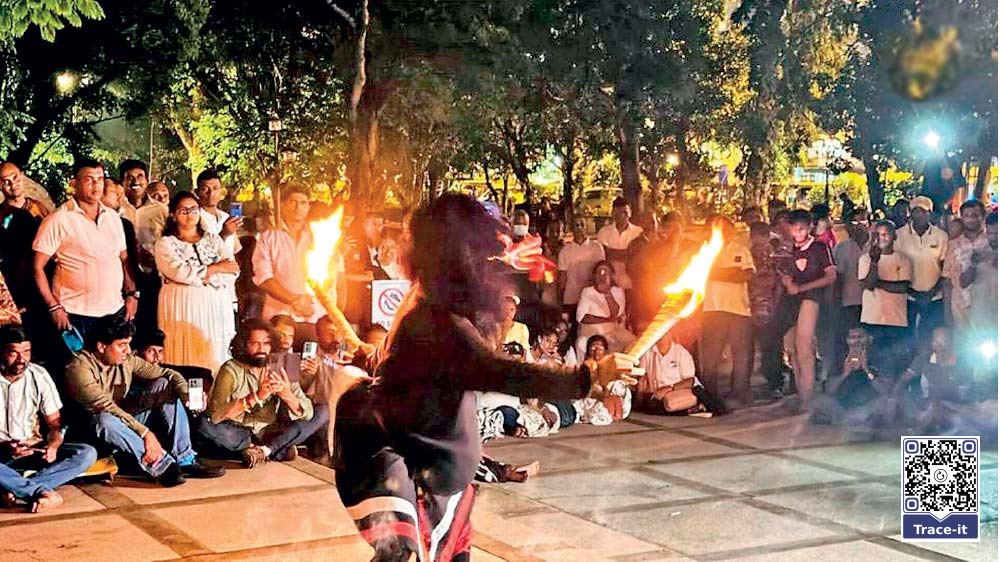
The Vas Kaviya emerged alongside a Satyagraha campaign launched by a group of Buddhist monks demanding the release of a fellow monk sentenced to six years’ rigorous imprisonment for contempt of court. To rally public support for their cause, the participating monks walked the 115-kilometre Kandy–Colombo Road. When the march failed to produce the desired response, they gathered at Viharamahadevi Park, a public space intended for recreation and repose. There, they reportedly performed a ritual invoking Maha Sona, one of the fiercest demons in Sinhala folklore, to punish the rulers who refused to release the imprisoned monk unconditionally. A clay effigy of the ruler concerned was fashioned, and wooden nails were driven into it in Maha Sona’s name. Such acts are not Buddhist practices, but forms of primitive witchcraft passed down among the Sinhala people over millennia.
Roots of superstition in a Buddhist society
Such susceptibility to superstition is difficult to reconcile with Sri Lanka’s claim to have preserved the Theravada Buddhist tradition for more than two millennia. If the country’s Buddhists, who constitute roughly two-thirds of the population, genuinely followed the Buddha’s core teachings, they would be less vulnerable to the perceived menace of Vas Kavi. In the Kalama Sutta, the Buddha famously advised the Kalamas not to accept a claim merely because it came from a religious leader, priest, teacher, elder, or member of the social elite. Rather, they were urged to examine it rationally and embrace it only if they judged that it would promote genuine social well-being.
Yet many contemporary Buddhists in Sri Lanka do not follow this rational standard. Professor Kotagama Vachissara Thero, who taught Buddhist civilisation in 1960s at the former Vidyodaya University—the predecessor of today’s University of Sri Jayewardenepura—offered an explanation for this divergence. He observed that when Arhat Mahinda introduced Buddhism to ancient Lanka, the indigenous population worshipped trees and rocks. Rather than confronting and uprooting these deeply embedded practices, Arhat Mahinda introduced the Dhamma without violently disrupting the community’s existing beliefs.
The influence of these inherited beliefs remains visible today. Many Sri Lankans, when passing a large, spreading roadside tree, instinctively make an offering known as a panduru; others believe that a shrine built on a massive rock can confer divine favour. It is therefore unsurprising that Vas Kavi continues to inspire considerable fear among many Sri Lankans. I have seen older screenagers transfixed by their devices as they listen to these viral curses, uneasy smiles revealing a mixture of fear and fascination. Such reactions suggest how deeply this psychological vulnerability remains embedded in the nation’s cultural consciousness.
Mythological warfare in the digital age
The current Vas Kavi invokes a formidable demon king named Vajrapani to strike down a ruler accused of gaining power through falsehoods, although the intended target is deliberately left unnamed. Vajrapani is not a familiar figure in contemporary Sri Lankan folklore. The name combines vajra, the mythical diamond thunderbolt wielded by the deity Sakra, with pani, meaning the bearer or holder of that weapon. In Sri Lankan popular belief, whenever Buddhism faces an existential threat, Sakra is said to abandon his benevolent form and assume a terrifying demonic guise to destroy those who seek to undermine the faith.
In the viral composition, this fearsome manifestation of Sakra is invoked to destroy rulers whom the composer accuses of plotting against Buddhism. Educated observers may dismiss the verse as mythology or superstition. Yet its influence should not be underestimated in a society where such esoteric narratives continue to shape the collective imagination.
Epidemic of surface learning
Why do Sri Lankans so readily turn to such destructive invocations? One explanation is the modern retreat from the rational inquiry encouraged by the Kalama Sutta, which has weakened the public’s capacity for critical thought. Increasingly, people acquire information through shortcuts—glancing at social-media posts or listening to brief, catchy songs designed to capture attention and lodge in the mind. This is surface learning, the opposite of the deep learning society should cultivate. Because surface learning is effortless and undemanding, it encourages people to skim headlines and absorb impressions rather than investigate the underlying truth.
This intellectual complacency makes it easy for skilful manipulators to manufacture provocative headlines and circulate them widely. Nor is the drift towards surface learning confined to Sri Lanka; it has become a global concern. Educators in the Nordic countries and neighbouring Singapore have sought to counter it by renewing the emphasis on sustained reading and rigorous critical analysis—the foundations of deep learning. Sri Lanka is yet to announce the adoption of such a bold education reform. Instead, it worships AI and plans to introduce it as a facilitator of learning at schools. It is widely recognised that AI will stunt the development of human brain, though it can make it easy for teachers to assemble their teaching materials readily.
In Sri Lanka, however, intense competition for admission to State universities encourages students to rely on surface learning at the expense of genuine understanding. Parents, anxious for their children to earn distinctions, often fail to create an environment that rewards curiosity and deep comprehension, despite their importance to long-term success. In reality, parents as a routine hire tuition masters to provide additional learning support to their children. Such tuition masters will help students to memorise answers to a given question selected by tuition masters from the past papers and do not help them to deep-learn a subject. These habits then follow students into adulthood and the workplace.
Against this background, it is unsurprising that a myth-laden and superstitious Vas Kavi has gone viral: the public has been conditioned to embrace precisely such easily consumed material. When I asked several non-Buddhist friends whether they had listened to it, they said that although a notification had appeared on their smartphones, they had simply ignored it. Its circulation therefore appears to be concentrated mainly among Sri Lankan Buddhists—a troubling indication of the community’s future intellectual resilience.
 Once the current International Monetary Fund (IMF) program ends, Sri Lanka’s leaders will face the formidable task of moving the country beyond its present fragile stability, placing it on a sustainable growth path, and strengthening its resilience to external economic shocks. Mobilising the public behind this national effort will be exceedingly difficult if one faction cultivates superstition while another responds with equally regressive tactics. Unless this cultural decline is reversed, it could seriously endanger the country’s economic and political future
Ideological enslavement and technical manipulation
The struggle, therefore, is fundamentally between surface learning and deep learning. Because surface learning demands little intellectual effort, the information it conveys is often fleeting and quickly forgotten. Those seeking to bind others to an ideology understand this weakness and exploit it by repeating the same message in varied forms until an idea first absorbed through a digital shortcut becomes embedded in the public consciousness. The technique recalls the methods of relentless repetition associated with Joseph Goebbels and wartime propaganda.
By repeatedly exposing the public to this Vas Kavi, its creators appear to be trying to lodge it in the nation’s collective consciousness. Yet, consistent with modern patterns of media consumption, even this feared verse has largely been absorbed at a superficial level. I asked several frequent listeners what it actually meant—whether they knew who Vajrapani was or why Sakra was believed to assume a demonic form to defend Buddhism from its supposed enemies. They could not answer. Their responses suggest that even superstition is now being consumed through the same effortless and uncritical habits that define the screen age.
I recently tested this phenomenon on an acquaintance’s birthday. I created a digital poster featuring her photograph and paired it with a song carrying a deliberately unconventional message: she needed no birthday wishes because her familiar smile showed that happiness was already a constant in her life. The poster also celebrated the dedication that had enabled her to rise professionally, captured in the Latin phrase Per Aspera Ad Astra— “through hardships to the stars”. The core message was that one should stand on his own feet for success without depending on gods, spirits, demons, and lowly-born spirits to deliver the same.
Within half an hour of being posted on Facebook, the image had attracted hundreds of “likes”. Yet this apparent engagement did not mean that viewers had understood its central message. The comments exposed the superficiality of their response: although the poster explicitly said that conventional birthday wishes were unnecessary, many viewers—including supposedly well-educated ones—posted routine “happy birthday” greetings or merely praised her smile.
Few appeared to have read the message carefully. The episode offered a vivid demonstration of how screenagers consume content through surface learning. In a digital environment shaped by such uncritical habits, manipulators can readily fill the resulting intellectual vacuum and bind audiences to their preferred narratives.
Threat to national recovery
The immediate danger is that those targeted by the Vas Kavi may retaliate in kind, either by issuing a counter-curse or commissioning a Seth Kavi—a protective verse intended to shield them. Such rituals have no demonstrable physical effect: there is no evidence that a demon king named Vajrapani exists, that Sakra assumes a demonic form to defend the faith, or that supernatural forces can harm the unnamed ruler. The real danger lies instead in political factions answering superstition with superstition and drawing the country into an unproductive cycle of hostility. Such tribal confrontation could divert attention and energy from Sri Lanka’s fragile economic recovery.
No nation can progress while one part of its population is persistently pitted against another. Instead of strengthening the intellectual capacities needed for creativity, invention, and innovation, Sri Lankans risk becoming passive consumers of destructive, backward-looking content. For the country, this erosion of independent thought poses a profound threat to its future sovereignty and prosperity.
Once the current International Monetary Fund (IMF) program ends, Sri Lanka’s leaders will face the formidable task of moving the country beyond its present fragile stability, placing it on a sustainable growth path, and strengthening its resilience to external economic shocks. Mobilising the public behind this national effort will be exceedingly difficult if one faction cultivates superstition while another responds with equally regressive tactics. Unless this cultural decline is reversed, it could seriously endanger the country’s economic and political future.
 Yet the country’s intelligentsia remains conspicuously silent. Academics and professionals must speak plainly: a nation at this fragile stage of recovery cannot afford further self-inflicted damage. They should unequivocally condemn both those who originated the Vas Kavi and those responding with retaliatory verses
A call to the intelligentsia and religious leaders
The emerging situation carries disturbing echoes of Sri Lanka’s catastrophic economic crisis in 2022, when the country exhausted its foreign exchange reserves and could no longer import even basic necessities. The resulting queues forced citizens to sacrifice millions of productive hours—a classic deadweight loss in which individuals, the economy, and society all suffered without any corresponding gain.
Yet the country’s intelligentsia remains conspicuously silent. Academics and professionals must speak plainly: a nation at this fragile stage of recovery cannot afford further self-inflicted damage. They should unequivocally condemn both those who originated the Vas Kavi and those responding with retaliatory verses.
Moreover, calling upon Sri Lanka’s Head of State to grant an unconditional pardon to a person convicted of contempt of court is inconsistent with established principles of good governance. Creating such a precedent would weaken confidence in the rule of law and deter legitimate investors from entering the country. If laws appear susceptible to pressure, reputable businesses will stay away, while those seeking to exploit institutional weakness will be encouraged to invest. The result would resemble Gresham’s Law, under which bad money—debased coins—drives good money out of circulation. In the same way, investors with questionable motives could displace the credible, long-term investment Sri Lanka needs.
The mainstream media likewise bears a heavy responsibility to foster deep learning rather than pursue sensationalist clicks. It must resist partisan alignment and confront the issue directly. Senior Buddhist leaders have an equally important duty—to safeguard both the integrity of the Dhamma and the welfare of the nation. If these influential institutions remain passive, the greatest burden will fall not on the elite but on Sri Lanka’s poorest and most vulnerable citizens, who will ultimately pay the price for this digital descent into superstition and tribalism.
(The writer, a former Deputy Governor of the Central Bank of Sri Lanka, can be reached at [email protected] )




