Thursday Oct 22, 2026
Thursday Oct 22, 2026
Friday, 19 December 2025 00:18 - - {{hitsCtrl.values.hits}}
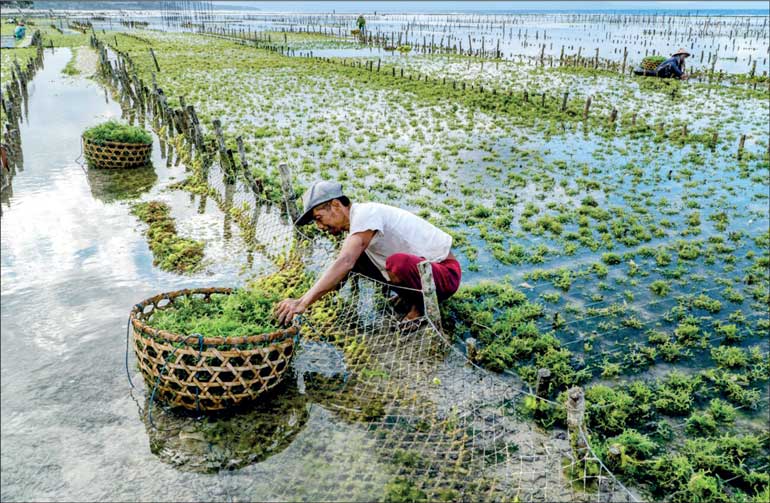
Seaweed farming is an eco-friendly and sustainable practice that offers numerous benefits for both the environment and local communities
 Sri Lanka’s coastline, with its pristine beauty and bountiful resources, has long been seen as an asset. Yet, hidden beneath the waves lies an agricultural opportunity with immense potential—seaweed farming. This growing sector has started to gain attention for its sustainability and profitability, and it’s creating new avenues for coastal communities.
Q: How did seaweed cultivation first start in Sri Lanka?
A: Seaweed farming in Sri Lanka was inspired by the successes seen in our neighbouring country, India. In India, starting as a community project after the Tsunami in 2004, seaweed farming has become a booming industry over the last two decades, driven by demand for seaweed in diverse sectors, including agriculture, food, and pharmaceuticals. After observing the positive impact in those regions, we saw a similar opportunity here, given Sri Lanka’s expansive coastline and favourable environmental conditions. Thereafter, we imported seaweed seed materials from the pioneer seaweed producer of the world, Indonesia and Malaysia. The real challenge, however, was sustaining a sufficient mass of viable seed materials with the time-consuming plant quarantine measures, particularly for seaweeds being really new to Sri Lanka those days back in 2010 – the startup location was areas around Kilinochchi. However, we succeeded in introducing this cultivation to our war victims including the women in fishing villages as a livelihood. We are of humble pride for receiving Asia’s most responsible entrepreneurship award for this project led by Hayleys Agriculture PLC.
Q: What are the benefits of seaweed farming?
A: Seaweed farming is an eco-friendly and sustainable practice that offers numerous benefits for both the environment and local communities. Firstly, seaweed farming requires no soil, no fertilisers, and no irrigation. From an environmental perspective, seaweeds help mitigate coastal erosion, provide a habitat for marine life, contribute to carbon sequestration by absorbing CO2, and create a positive impact on biological oxygen demand of the ocean which ultimately protects ocean environments from acidification.
Q: What are the key ecological requirements for successful seaweed farming, and do we really possess those?
 A: For seaweed to thrive, there are a few key ecological requirements, and of course there are locations in our coastline which are favourable for this cultivation:
Q: Can you explain the methods of seaweed cultivation practiced in Sri Lanka?
A: There are three primary methods for cultivating seaweed in Sri Lanka:
nRaft Cultivation: This is one of the most widely used methods, where seaweed is cultivated on rafts made using 5-6 feet long poles, particularly bamboo. PVC pipes are also used now, which is not a sustainable approach. In the bottom of the raft is a net laid to avoid fish entering the raft and fish grazing. The rope consists of holes along it where in one hole 25 g of seeds is placed. Raft method is not practiced much now a days in the North. The reason is bamboo is not abundantly found in the North; thus those have to be transported long distance from the areas like Ratnapura. Now people are also using multiple long line methods by using floats such as styrofoam or empty water bottles which float on water as well instead of bamboo/PVC rafts.
nFixed Bottom Monolines Cultivation: In this method, seaweed is anchored to the seabed using stakes and lines. This is mainly used to resist the effect of low tides. Unlike in Sri Lanka, in some countries, the sea water level is very low during low tide times in a day; thus the water level is not enough for seaweeds to be submerged. So, these fixed lines are used through which water flows into the seaweeds even though the water level is low in the sea. Indonesia and African countries are mostly practicing this method.
nMultiple Long Lines Cultivation: The longline method is similar to the raft or floating method in several ways. In fact, seaweed is hung to a rope which is suspended by floaters and anchored on the 4 corners. In this method, however, the main rope is thicker; about 10 to 15 millimetres in diameter.
Q: What do you have to say about seaweed harvesting?
A: Seaweeds are harvested either for replanting or drying for raw material purposes. If harvested for replanting, it occurs 30 days after planting, but for export as raw material, it is harvested 45 days after planting. In the last 15 days, carrageenan is deposited in the cell walls, thickening them and increasing the value of the seaweed. Carrageenan is a natural polysaccharide synthesised by a red seaweed called Kappaphycus alvarezii. Carrageenan acts as a stabiliser, thickening agent, and a gelatinising agent.
Sun drying is the only successful drying method, taking about three days, though it is labour-intensive due to the high biomass. Drying should be done on tarpaulin sheets to maintain quality; drying on grass causes impurities. The moisture content should be reduced to below 35%. There is no accurate moisture meter, so it is manually assessed by forming a soil ball: if it scatters, it is too dry; if water squeezes out, it has excess moisture; if it retains shape without water being squeezed out, it is optimum.
Salinity of the harvest can be tested by observing salt deposits on the surface. Seaweed with less than 3% impurities is considered good quality.
Q: It is said that the provision of seaweed seed materials is challenging in our country. Can you elaborate on this?
A: Yes, sourcing seed material is one of the most significant challenges. Currently, having seaweeds seed exports banned in India, we rely heavily on imported seaweed seeds from Indonesia, which is the leading producer of seaweed. However, the process of importing seeds can be time-consuming and unreliable. The lack of direct flight routes between Sri Lanka and Indonesia delays the process which causes loss of seed viability. In fact, seaweeds should be put-back in seawater within 24 hours after harvesting to secure its viability. It is great if we could have laboratories near coastal areas to do tissue cultured seed supply as practiced in other countries. Unfortunately, we still have to rely on mariculture programmes and seed imports only.
 Q: What are some of the challenges facing the seaweed farming industry in Sri Lanka today?
A: While the potential is vast, there are several challenges that we must address. Parasitic plants which look the same as seaweeds growing on seaweeds hinder photosynthesis, gracing of seaweed shoots by fish are some of those.
Apart from issues related to seed material, there is price volatility in the global market for seaweeds and seaweed-based products. This volatility which is highly based on the supply quantity of Indonesia and the Philippines can make it difficult for farmers to predict market trends and plan for the future. Furthermore, climatic changes like el-nino and la-nina effect, are becoming a serious hazard currently, which cause issues like rising sea level temperature with global warming, changing salinity due to flooding in coastal areas, etc. These changes disrupt the storage of seaweed, as the seed materials must be kept in marine water. Farmers face challenges due to the lack of seed materials to cultivate during the favourable season, as there is no way to store them during the monsoon periods.
Amidst all these burdens we are unable to meet the existing demand.
Q: Can you tell us more about the use of seaweeds in value-added products?
A: Yes, the commercial ingredient in seaweeds is Carrigeenan.
To begin with, seaweed-derived fertilisers are particularly noteworthy, as they are touted to enrich soil with macronutrients, micronutrients and plant hormones like Auxins as well.
Unlike us, China produces different varieties of Carrageenan using seaweeds such as food grade Carrageenan, Alkaline-treated carrageenan which are priced higher.
We are basically exploring niche markets such as seaweed-based nutraceuticals and cosmetics, including shampoos. Particularly, seaweed is also used as a key ingredient in food products and some food additives. Specially, Carrageenan extracted from seaweeds, is the only vegan gelling agent option available to be used in food products like in ice-creams. It is also a non-reactive binding agent used in pharmaceutical tablets.
In the cosmetics industry, seaweed extracts are utilised for both skincare and haircare products. There are some emerging companies in Sri Lanka who produce such products like beverages, shampoo and fertilisers using seaweeds.
In addition, there are multi-million profited industries like agar-agar production and alginate which is extracted by Sargassum.
Q: Are there any bottlenecks we are facing in introducing our seaweed-based value added products to the global markets?
A: Certainly. The biggest challenge is meeting the demand through local productions.
There are issues in product certifications as well. Seaweed end products require multiple certifications for consumer introduction.
When exporting seaweeds as raw materials to China, the world’s largest seaweed processing country, we face issues without having China-Sri Lanka bilateral trade agreements for seaweeds exports. So they have to incur large costs to purchase our seaweed harvest compared to their purchases from other countries. Eventhough both China and Sri Lanka are there in Asia-Pasific multilateral agreements, seaweeds are not there in the list. So, a tax should be paid when exporting seaweeds. If we could succeed in signing the Asia-Pacific multilateral agreement, we can get rid of this issue. Indonesia and the Philippines do not face this issue already.
Some investors are willing to invest around $ 300 million in seaweed processing, which could support a production of 100 tonnes (dry weight basis) per month—a target we are currently unable to meet. We only manage to produce about 100-150 tonnes (dry weight basis) per annum.
Q: What is your vision for the future of seaweed farming in Sri Lanka?
A: My vision for the future is for seaweed farming to thrive in our agricultural and aquacultural sector. To achieve this, we must focus on creating local seed production systems to reduce reliance on imports, developing certification systems, and working on long-term climate change mitigation techniques. With the right coherence of the main three factors; the crop factor, social factor and financial factor (blue economy) Sri Lanka has the potential to become a global key player in sustainable seaweed farming. Finally, if we succeed in harnessing the potential of seaweed farming to meet the existing demand, seaweed cultivation can even be a pillar of agricultural renaissance in the island nation, Sri Lanka. The global experts’ view on this is that Sri Lanka can achieve the third place in the global seaweed industry, and we truly believe in that potential.
(The writer is an Independent Seaweed Development Consultant, Sri Lanka Agripreneurs’ Forum Hon. Treasurer, and University of Jaffna Former Member of the Council.)




